


China's censors may not fully understand contemporary art, but they know what they don't like. Since the start of this month, police and propaganda officials have launched their biggest crackdown on Beijing's counterculture hothouse -- Dashanzi art district -- where at least three galleries have been ordered to remove politically sensitive works.
On their orders, down has come an oil painting by Gao Qiang (
Residents say there has been nothing like it in the three years since Dashanzi began its transformation from an old arms factory into one of the world's most fashionable contemporary art centers.
The Xindong Chen gallery was among the first to fall foul of the censors, when its exhibition, "Charm and Strength -- Mao Zedong and the Chinese Contemporary Artists," was abruptly closed last October.
"I was surprised because, after 25 years of economic reforms, I thought China was ready to accept creations like these," owner Chen Xindong said. "These are great contemporary artists. Their work is shown all over the world. Why not in China?"
That clampdown reflects the dramatic changes in the Chinese art world. An increasingly confident generation of artists is pushing at the limits of acceptability, as foreign galleries open branches in Beijing to cash in on the boom in Chinese contemporary art. The authorities, meanwhile, are struggling with a new desire to promote alternative culture and an old instinct to control it.
The censorship rules seem unclear. If there is a pattern, it is that private and commercial freedom is almost unlimited, but anything public and political is subject to controls. Galleries in Dashanzi openly display nudity and sexually explicit pictures. But even a flat image of political leaders seems to make the censors queasy. One of the pieces that had to be removed is a grey painting of the current leadership all in the same dark suits and ties with the same hairstyle.
The Gao brothers (
"We felt it was important to create an opportunity for artists to express themselves on subjects that are part of our history," Gao Zhen said. "But we were very cautious. We put the most sensitive works at the back of the exhibition room, where fewer people were likely to see them."
Within a week, however, police ordered the work taken down.
Despite the crackdown, the Gao brothers said the climate was improving. From 1989 until 2003, they were on the government blacklist and forbidden to leave the country. But they are now part of a new wave of Chinese artists wowing galleries abroad. Next week, they will visit Nottingham, England, to recreate their renowned work, Hug, in which they persuade strangers to embrace.
Many of today's leading Chinese artists grew up during the Cultural Revolution, were students during the 1989 democracy protests and have long explored these topics in their work. But it is only recently that they have found public outlets for their more politically sensitive pieces. Much of the work by Huang Rui -- one of the founding fathers of Dashanzi -- uses wordplay and sexual imagery to mock propagandist slogans.
Overseas, it is well-known, but in China it rarely gets out of his studio. His exhibition piece in Dashanzi, Chairman Mao 10,000 RMB, lasted only a few days this month before being closed.
"We're at a delicate stage," he said. "The government is trying to find a balance. I think they want to develop Dashanzi to improve the city's image. But some in power are old-fashioned and want to use traditional methods of control. We must push our ideas. [President Hu Jintao (胡錦濤)] talks about creating a harmonious society. That means having more culture."
Brian Wallace, whose Red Gate Gallery was the first foreign-owned space for contemporary art in China, said: "Before Dashanzi, there were only three of us, so 99 per cent of artists had no way to show their work to the public."
His business has been affected by the censors. Two years ago, officials ordered the closure of an exhibition by Sheng Qi (
But the ban aroused the buyers' interest. In the next few months, Sheng was the gallery's bestselling artist.
But compared with the first years after he opened the Red Gate Gallery in 1990, Wallace says that the atmosphere is actually improving.
"Ten years ago the officials would have been rude and taken the pictures away. Now they are polite and ask for pictures to be withdrawn from public view," he said.
Le Tuan Binh keeps his Moroccan soldier father’s tombstone at his village home north of Hanoi, a treasured reminder of a man whose community in Vietnam has been largely forgotten. Mzid Ben Ali, or “Mohammed” as Binh calls him, was one of tens of thousands of North Africans who served in the French army as it battled to maintain its colonial rule of Indochina. He fought for France against the Viet Minh independence movement in the 1950s, before leaving the military — as either a defector or a captive — and making a life for himself in Vietnam. “It’s very emotional for me,”

The Chinese Communist Party’s (CCP) Central Committee is to gather in July for a key meeting known as a plenum, the third since the body of elite decisionmakers was elected in 2022, focusing on reforms amid “challenges” at home and complexities broad. Plenums are important events on China’s political calendar that require the attendance of all of the Central Committee, comprising 205 members and 171 alternate members with Chinese President Xi Jinping (習近平) at the helm. The Central Committee typically holds seven plenums between party congresses, which are held once every five years. The current central committee members were elected at the
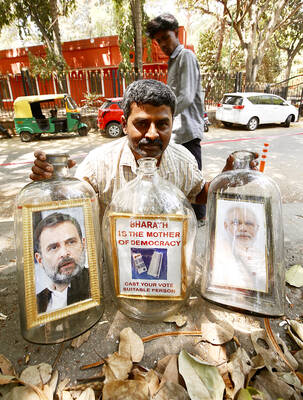
Indian Prime Minister Narendra Modi reaffirmed his pledge to replace India’s religion-based marriage and inheritance laws with a uniform civil code if he returns to office for a third term, a move that some minority groups have opposed. In an interview with the Times of India listing his agenda, Modi said his government would push for making the code a reality. “It is clear that separate laws for communities are detrimental to the health of society,” he said in the interview published yesterday. “We cannot be a nation where one community is progressing with the support of the Constitution while the other

CODIFYING DISCRIMINATION: Transgender people would be sentenced to three years in prison, while same-sex relations could land a person in jail for more than a decade Iraq’s parliament on Saturday passed a bill criminalizing same-sex relations, which would receive a sentence of up to 15 years in prison, in a move rights groups condemned as an “attack on human rights.” Transgender people would be sentenced to three years’ jail under the amendments to a 1988 anti-prostitution law, which were adopted during a session attended by 170 of 329 lawmakers. A previous draft had proposed capital punishment for same-sex relations, in what campaigners had called a “dangerous” escalation. The new amendments enable courts to sentence people engaging in same-sex relations to 10 to 15 years in prison, according to the


 RSS
RSS