


While the French continue to stage mass protests against changes to their employment laws, hundreds of thousands of their compatriots have voted with their feet and come to work in Britain.
Figures now suggest that -- contrary to popular perception -- there may be more French people living in Britain than there are British in France. Since 1999, about 15,000 French have moved to Britain each year while 10,000 British have gone the other way, according to figures from the UK's Office for National Statistics.
About two-thirds of the French moving to Britain are under 36, and three-quarters are single. They are often qualified mathematicians or engineers. Many head for well-paid work in London.
"Salaries are higher than in France and can grow quickly," said Samuel Remy, a French man working for the travel group Travco.
"Pay rises every year and bonuses depending on your performance are generally the case. This has to be set against the cost of living of London -- above all housing and transport," he said.
France's youth unemployment rate is around 23 percent, rising to 50 percent in young immigrant communities -- a crucial factor behind last year's riots in many areas. France's overall unemployment rate tops 9 percent, compared with 5 percent in the UK.
Besides this, the British economy has been reasonably successful at creating new jobs -- 2.4 million of them since 1997 -- and jobs in the UK tend to be better paid. Wages have been rising strongly in Britain for the past decade, but have stagnated in France.
The French consulate in London thinks there may be 300,000 to 400,000 French living in Britain today. The UK Foreign Office estimates that 300,000 British are living permanently in France, excluding second-home owners.
But while British in France are widely dispersed across the country, about 70 percent of French in the UK are in Greater London, according to the French consulate. Of those, about half work in financial services.
Celine Abadie, 28, came to London two months ago and within weeks was offered three jobs, of which she chose one at a public relations firm, NewsMarket.
"Right now in France the market is damp for jobs. I have friends who have been looking for work for six months," she said. "I love London -- it's so dynamic and cosmopolitan. Because of my job, I don't plan to leave here for at least five years. Friends told me that Paris is too narrow for me. The quality of life here is good. You can do a lot and enjoy a nice life."
Arnaud Chevalier, an academic at the London School of Economics, agreed. "I can only speak for academics," he said. "But we think the standard of work is higher in the UK: conditions are better; pay is better. These are the main reasons for people coming here. French universities are grotty."
The typical experience of French people in Britain is that they can find work quickly and in jobs not necessarily related to the subjects they studied, as is common among young Britons. In France, by contrast, graduates expect to find work in the field they studied.
"What I really like about the UK job market is it's more open in that they do not look so much at your schooling but value your past experience. It's also closer to the job market in the US for students trying to find work globally," said Francois Desmonts, head of the French Club at the London Business School.
Pascale Dauptain, 30, a business development director at FBC Media, said she loved living in London and now considered it home.
"It's dynamic and extremely international. I think people come here to make their way and find jobs. If the job's not right you can move very quickly. It's not even comparable to Paris. I recommend moving here all the time to my friends," she said.
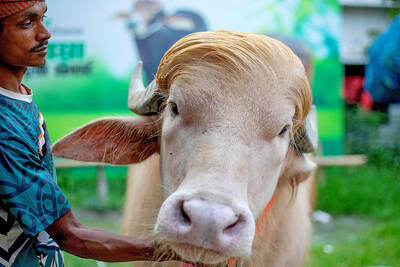
Crowds in Bangladesh are flocking to snap photographs with an unlikely social media star — an albino buffalo with flowing blond hair nicknamed “Donald Trump” that is due to be sacrificed within days. Owner Zia Uddin Mridha, 38, said his brother named the 700kg bull over its flowing helmet of hair resembling the signature look of the US president. “My younger brother picked this name because of the buffalo’s extraordinary hair,” he said at his farm in Narayanganj, just outside the capital, Dhaka. Mridha said that a constant stream of curious visitors — social media fans, onlookers and children — have come throughout

It began as a satirical online project. Now millions of young people in India are flocking to it as an outlet for their frustration. A parody political party called the Cockroach Janta Party, with the insect as its symbol, has exploded across India’s social media by turning absurdist humor into protest. Memes and short videos mocking corruption, joblessness and political dysfunction have flooded social media sites, where millions of users are embracing the cockroach — known for its ability to survive harsh conditions — as a tongue-in-cheek symbol of endurance. The online movement’s rise has been unusually rapid. The Cockroach Janta Party (CJP)

HOTTER: While Indians are accustomed to summer heat, climate change has caused northwestern India to warm faster than other parts of the country, an academic said Roads and markets have emptied during afternoons and some farmers have switched to nighttime work to avoid scorching temperatures as a heat wave grips large parts of India. The India Meteorological Department forecast maximum temperatures for yesterday of about 45°C in the capital, New Delhi, where authorities have opened temporary “cooling zones” to help people cope. The weather department warned that conditions would likely persist across several northern regions in the coming days, with temperatures staying well above seasonal averages. Authorities urged people to stay indoors during the hottest hours and take precautions against heat-related illnesses. India declares a heat wave whenever maximum temperatures
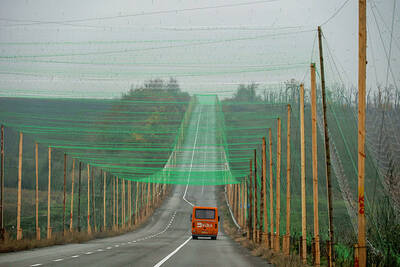
BIGGER ROLE: Beijing has said it maintains an impartial stance on the war in Ukraine, but by training Russian troops, China is far more involved than previously known China’s armed forces secretly trained about 200 Russian military personnel in China late last year, and some have since returned to fight in Ukraine, according to three European intelligence agencies and documents seen by Reuters. While China and Russia have held a number of joint military exercises since Moscow’s full-scale invasion of Ukraine in 2022, Beijing has repeatedly said that it is neutral in the conflict and presents itself as a peace mediator. The covert training sessions, which predominantly focused on the use of drones, were outlined in a dual-language Russian-Chinese agreement signed by senior Russian and Chinese officers in Beijing on


 RSS
RSS