


Afghanistan will encourage its powerful drug lords to invest their illegally earned profits back into the war-shattered country, according to the governor of the nation's top opium-growing region.
The offer comes amid warnings of another bumper poppy crop that will fuel a booming narcotics trade that already accounts for 35 percent of the impoverished nation's income.
"We as a government will provide them the opportunity to use their money for the national benefit," said Helmand Governor Mohammed Daud during a two-day trip this week to the region by US Ambassador Ronald Neumann.
"They must invest in industries. They must invest in construction companies," he said.
But he said so far the government has had no success in attracting the drug lords to open new businesses, and that most of the money is being sent overseas.
So profitable is the drug trade that it employs about one in 10 Afghans and brought in US$2.8 billion last year, Afghan and US officials say. The vast majority of that goes to traffickers and only a fraction to farmers.
About 140,000 hectares of poppies are believed to have been planted this year -- an increase of up to 40 percent from last year. The opium is refined into heroin before being smuggled out of the country to meet 90 percent of the world's supply.
A US diplomat, who spoke on condition of anonymity because of the sensitivity of the matter, said the drug trade was so entrenched that it was difficult to confront the narco bosses head-on.
He said one or two major traffickers have approached the Afghan government for talks on a possible informal amnesty in return for ending their involvement in drugs, swearing allegiance to President Hamid Karzai's government, investing their money at home and paying taxes.
But the diplomat said that no deals had been reached. Most of their money is stashed in banks in the United Arab Emirates, he said.
Asked about the offer in an interview Monday at the main US-led coalition base in Helmand, Neumann compared it to a broad national reconciliation program with Taliban militants and others that aims to bring peace after a quarter century of war.
"It's part of a larger problem, you have militia commanders, you have drug lords, you have all kinds of people that at the end of the day, some of them need to be arrested and put in prison, but basically Afghanistan has to come back together," he said.
But he said he was unaware of a formal program specifically targeting drug lords to get them to invest in Afghanistan.
"There is a lot of effort to get Afghans as a whole to invest ... [but] I don't know of any easy way that we are going to distinguish where the money comes from," he said.
Afghanistan wouldn't be the first nation with a vast drug industry to let barons launder their ill-gotten money.
Washington has accused Myanmar -- once the top world producer of opium -- of allowing drug kingpins and ethnic armies that reached ceasefires with the government to invest in commercial banks and other businesses.
Afghanistan's drug lords have acted with virtual impunity since US-led forces in 2001 ousted the Taliban, which in its last two years in power enforced a virtual ban on opium cultivation.
The new judiciary system is weak and has never prosecuted senior traffickers. The government's approach until now in dealing with drugs has been to forcibly eradicate poppy fields as part of a US and British-backed program, while also providing farmers with the means to grow legal crops.
While last year saw a notable decline in opium cultivation, only a tiny percentage of the opium fields that were planted were destroyed.
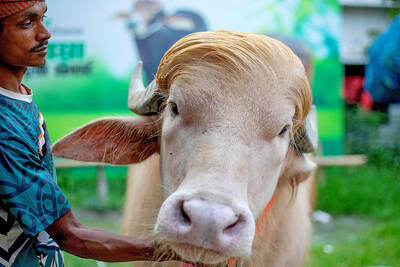
Crowds in Bangladesh are flocking to snap photographs with an unlikely social media star — an albino buffalo with flowing blond hair nicknamed “Donald Trump” that is due to be sacrificed within days. Owner Zia Uddin Mridha, 38, said his brother named the 700kg bull over its flowing helmet of hair resembling the signature look of the US president. “My younger brother picked this name because of the buffalo’s extraordinary hair,” he said at his farm in Narayanganj, just outside the capital, Dhaka. Mridha said that a constant stream of curious visitors — social media fans, onlookers and children — have come throughout

It began as a satirical online project. Now millions of young people in India are flocking to it as an outlet for their frustration. A parody political party called the Cockroach Janta Party, with the insect as its symbol, has exploded across India’s social media by turning absurdist humor into protest. Memes and short videos mocking corruption, joblessness and political dysfunction have flooded social media sites, where millions of users are embracing the cockroach — known for its ability to survive harsh conditions — as a tongue-in-cheek symbol of endurance. The online movement’s rise has been unusually rapid. The Cockroach Janta Party (CJP)

BIGGER ROLE: Beijing has said it maintains an impartial stance on the war in Ukraine, but by training Russian troops, China is far more involved than previously known China’s armed forces secretly trained about 200 Russian military personnel in China late last year, and some have since returned to fight in Ukraine, according to three European intelligence agencies and documents seen by Reuters. While China and Russia have held a number of joint military exercises since Moscow’s full-scale invasion of Ukraine in 2022, Beijing has repeatedly said that it is neutral in the conflict and presents itself as a peace mediator. The covert training sessions, which predominantly focused on the use of drones, were outlined in a dual-language Russian-Chinese agreement signed by senior Russian and Chinese officers in Beijing on
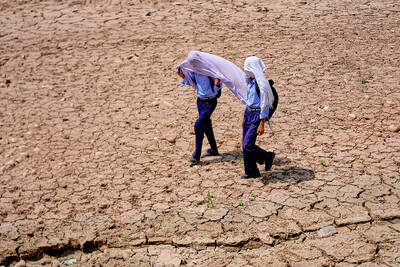
HOTTER: While Indians are accustomed to summer heat, climate change has caused northwestern India to warm faster than other parts of the country, an academic said Roads and markets have emptied during afternoons and some farmers have switched to nighttime work to avoid scorching temperatures as a heat wave grips large parts of India. The India Meteorological Department forecast maximum temperatures for yesterday of about 45°C in the capital, New Delhi, where authorities have opened temporary “cooling zones” to help people cope. The weather department warned that conditions would likely persist across several northern regions in the coming days, with temperatures staying well above seasonal averages. Authorities urged people to stay indoors during the hottest hours and take precautions against heat-related illnesses. India declares a heat wave whenever maximum temperatures


 RSS
RSS