


The annual meeting of China's rubber-stamp legislature opens on Sunday with the government expected to push through steps it hopes will narrow the wealth and development gap between its cities and the vast countryside.
The 10-day session could be an opportunity for President Hu Jintao (胡錦濤) to appoint a new vice premier to replace Huang Ju (黃菊), a close political ally of Hu's predecessor, Jiang Zemin (江澤民). Sources say Huang is suffering from pancreatic cancer.
Huang, 67, is ranked sixth in the all-powerful Politburo Standing Committee. He was being treated in the No. 301 military hospital in Beijing, said two Chinese sources with knowledge of Huang's situation. They said he was seriously ill and had undergone two operations this year.
Face-saving alternatives to naming a replacement to Huang include increasing the number of vice premiers or sharing out his portfolios to the other current vice premiers, the sources said.
But it is efforts to build a "new socialist countryside" that may generate the most debate at this National People's Congress (NPC) session and be the focus of a leadership increasingly worried about rural unrest on issues ranging from corruption to land seizures.
China is worried that stark gaps in income, healthcare and schooling between rich urban dwellers and the three-quarters of its 1.3 billion people who live in the countryside could lead to further protests that may challenge the Communists' monopoly on power.
The government is to unveil and formalize a raft of measures to better protect farmers from forced land seizures and boost spending on rural healthcare and schools.
Last year there was a gap of almost US$1,000 in average annual income between city dwellers and the 750 million people who live on the land, who earned an average of US$400.
According to an Internet survey by the People's Daily Web site, narrowing the wealth gap and cracking down on corruption were two of the most important topics people were paying attention to at this parliamentary session.
This year alone, central and provincial governments will give 103 billion yuan (US$12.8 billion) to local governments to make up a revenue shortfall after abolition of the agricultural tax last year.
China aims to raise spending on education from 2.7 percent to 4 percent of GDP as it focuses on improving rural schooling to stem a gap with rich coastal areas.
China has nine years of compulsory education, but fees levied by cash-strapped local governments in poor areas put primary education beyond the means of many rural families.
Meanwhile, the Chinese People's Political Consultative Conference (CPPCC), the NPC's main advisory body -- a gaggle of businesspeople, farmers, movie stars and Tibetan monks meant to keep Chinese leaders in touch with what's going on in remote regions -- begins its annual two-week session today. And it could find itself with a new role: messenger.
Officials wanting to reassure a frustrated public that they are taking action in response to growing anger over poverty and corruption might use the CPPCC to convey that message to the countryside.
"I will not be surprised if I see a more aggressive use of the CPPCC as an instrument to pacify the discontented rural population," said Steve Tsang (曾銳生), director of the Asian Studies Center at St. Antony's College at Oxford University in England.
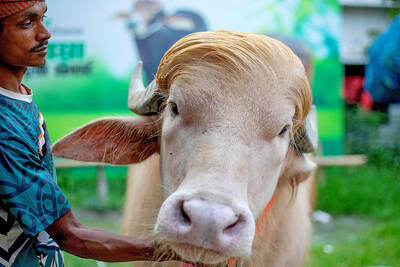
Crowds in Bangladesh are flocking to snap photographs with an unlikely social media star — an albino buffalo with flowing blond hair nicknamed “Donald Trump” that is due to be sacrificed within days. Owner Zia Uddin Mridha, 38, said his brother named the 700kg bull over its flowing helmet of hair resembling the signature look of the US president. “My younger brother picked this name because of the buffalo’s extraordinary hair,” he said at his farm in Narayanganj, just outside the capital, Dhaka. Mridha said that a constant stream of curious visitors — social media fans, onlookers and children — have come throughout

It began as a satirical online project. Now millions of young people in India are flocking to it as an outlet for their frustration. A parody political party called the Cockroach Janta Party, with the insect as its symbol, has exploded across India’s social media by turning absurdist humor into protest. Memes and short videos mocking corruption, joblessness and political dysfunction have flooded social media sites, where millions of users are embracing the cockroach — known for its ability to survive harsh conditions — as a tongue-in-cheek symbol of endurance. The online movement’s rise has been unusually rapid. The Cockroach Janta Party (CJP)
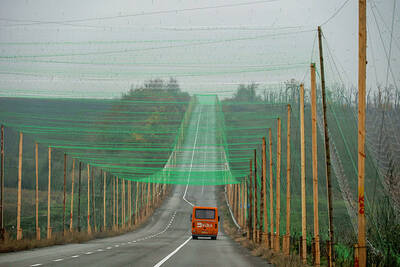
BIGGER ROLE: Beijing has said it maintains an impartial stance on the war in Ukraine, but by training Russian troops, China is far more involved than previously known China’s armed forces secretly trained about 200 Russian military personnel in China late last year, and some have since returned to fight in Ukraine, according to three European intelligence agencies and documents seen by Reuters. While China and Russia have held a number of joint military exercises since Moscow’s full-scale invasion of Ukraine in 2022, Beijing has repeatedly said that it is neutral in the conflict and presents itself as a peace mediator. The covert training sessions, which predominantly focused on the use of drones, were outlined in a dual-language Russian-Chinese agreement signed by senior Russian and Chinese officers in Beijing on
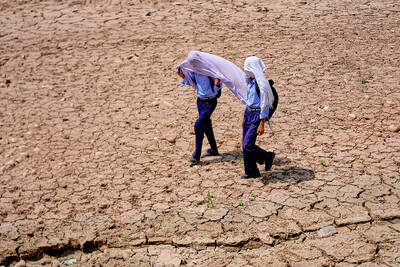
HOTTER: While Indians are accustomed to summer heat, climate change has caused northwestern India to warm faster than other parts of the country, an academic said Roads and markets have emptied during afternoons and some farmers have switched to nighttime work to avoid scorching temperatures as a heat wave grips large parts of India. The India Meteorological Department forecast maximum temperatures for yesterday of about 45°C in the capital, New Delhi, where authorities have opened temporary “cooling zones” to help people cope. The weather department warned that conditions would likely persist across several northern regions in the coming days, with temperatures staying well above seasonal averages. Authorities urged people to stay indoors during the hottest hours and take precautions against heat-related illnesses. India declares a heat wave whenever maximum temperatures


 RSS
RSS