


Yu Kei-cheong had great success with his first textbook, using short stories to help primary school pupils understand math, and a second volume is set to be released in the coming weeks.
But the teacher will never see that happen. He leapt to his death from his 22nd-storey apartment early this month -- watched by his teenage daughter -- after complaining of being unhappy at work.
Yu's was the second suicide that week by a Hong Kong teacher, and their deaths have sparked a renewed public debate about the hard-working lifestyle of this global financial center.
"Hong Kong is a very ill society," says Paul Yip, director of the Center for Suicide Research and Prevention at Hong Kong University.
"People are facing a lot of pressure at work. You used to have three people doing the same job, now you have two. Everyone is after higher productivity and more financial gains," he says.
Hong Kong's suicide rate of 18.6 per 100,000 people is above the world average of 14.5, and officials say the rate is increasing dramatically among working-age professionals as well as unskilled workers.
In 2003, the last year for which the figures have been fully compiled, there were 1,264 suicides, up 14.1 percent over 2002. The rate works out to more than three people every day.
Among professionals the suicide rate per 100,000 people increased from 2.28 between 1990 and 1994 to 7.3 from 1999 to 2003, according to official figures -- more than a threefold increase.
Clinical psychologist Paul Wong, who wrote the content for "Depressed Little Prince," the suicide center's Web site, says that people in the city who are suffering from depression are reluctant to seek help.
"Hong Kong people think that depression is a psychiatric illness, which is equivalent to being crazy," Wong says.
According to the WHO, depression ranks fourth in the 10 leading causes of global burden of disease and is expected to become the No. 2 two cause within the next two decades.
Many experts believe that financial instability may account for the rising number of Hong Kongers who are taking their own lives.
Economic turmoil from the 1997 Asian financial crisis and the SARS outbreak in 2003 have had a tremendous impact on the lives of ordinary people in a city that provides few economic safety nets.
"Figures in the West found people who committed suicide because of financial worries were fewer," Yip says. "Chinese people seem to be more worried about money matters."
But he stresses that money troubles are not the only motivation for suicide.
"Does the economic recovery mean everyone is happy? No. Did the teachers who killed themselves have financial problems? No, but they did it," he says.
Yip adds that work stress is another factor in Hong Kong, where workplace-related illness is believed to add around HK$40 million (US$5.1 million) to the city's health-care costs.
The families of both teachers have blamed new education reforms for the deaths of their loved ones, saying the changes added to their already heavy workloads.
The Professional Teachers' Union said several surveys showed teachers are working up to 60 hours a week since the reforms, which increased the number and size of classes they teach.

PRECARIOUS RELATIONS: Commentators in Saudi Arabia accuse the UAE of growing too bold, backing forces at odds with Saudi interests in various conflicts A Saudi Arabian media campaign targeting the United Arab Emirates (UAE) has deepened the Gulf’s worst row in years, stoking fears of a damaging fall-out in the financial heart of the Middle East. Fiery accusations of rights abuses and betrayal have circulated for weeks in state-run and social media after a brief conflict in Yemen, where Saudi airstrikes quelled an offensive by UAE-backed separatists. The United Arab Emirates is “investing in chaos and supporting secessionists” from Libya to Yemen and the Horn of Africa, Saudi Arabia’s al-Ekhbariya TV charged in a report this week. Such invective has been unheard of
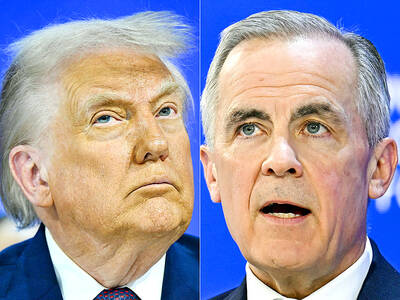
US President Donald Trump on Saturday warned Canada that if it concludes a trade deal with China, he would impose a 100 percent tariff on all goods coming over the border. Relations between the US and its northern neighbor have been rocky since Trump returned to the White House a year ago, with spats over trade and Canadian Prime Minister Mark Carney decrying a “rupture” in the US-led global order. During a visit to Beijing earlier this month, Carney hailed a “new strategic partnership” with China that resulted in a “preliminary, but landmark trade agreement” to reduce tariffs — but
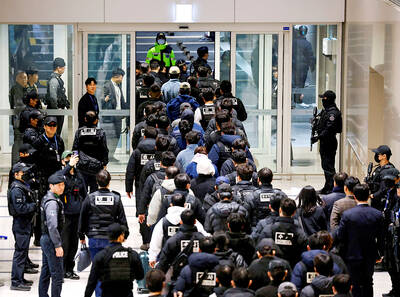
SCAM CLAMPDOWN: About 130 South Korean scam suspects have been sent home since October last year, and 60 more are still waiting for repatriation Dozens of South Koreans allegedly involved in online scams in Cambodia were yesterday returned to South Korea to face investigations in what was the largest group repatriation of Korean criminal suspects from abroad. The 73 South Korean suspects allegedly scammed fellow Koreans out of 48.6 billion won (US$33 million), South Korea said. Upon arrival in South Korea’s Incheon International Airport aboard a chartered plane, the suspects — 65 men and eight women — were sent to police stations. Local TV footage showed the suspects, in handcuffs and wearing masks, being escorted by police officers and boarding buses. They were among about 260 South
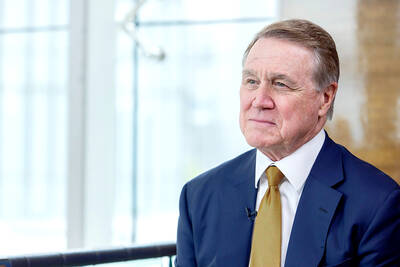
Chinese President Xi Jinping’s (習近平) purge of his most senior general is driven by his effort to both secure “total control” of his military and root out corruption, US Ambassador to China David Perdue said told Bloomberg Television yesterday. The probe into Zhang Youxia (張又俠), Xi’s second-in-command, announced over the weekend, is a “major development,” Perdue said, citing the family connections the vice chair of China’s apex military commission has with Xi. Chinese authorities said Zhang was being investigated for suspected serious discipline and law violations, without disclosing further details. “I take him at his word that there’s a corruption effort under


 RSS
RSS