


UN flights to two areas of Pakistan's quake-hit Kashmir region could resume next week, the UN said yesterday, a day after suspending air deliveries because dozens of survivors stormed two helicopters.
UN spokesman Ben Malor said both the world body and Pakistani authorities were investigating Friday's incident, and flights could resume in the next few days. The UN said on Saturday it canceled flights to Bana Mula and Leepa, both more than 120km southwest of Muzaffarabad, the capital of Pakistan-controlled Kashmir.
More than 50 survivors forced the pilots of two UN helicopters to take them to Muzaffarabad and Abbottabad, a hub for quake relief activities.
"Our biggest hope is that it wouldn't be long at all," Malor said.
"This is just one isolated incident ... It doesn't merit a total suspension," he added.
Malor said in the meantime, other UN agencies were assisting victims in the area, and this was an incident "just involving helicopters." He didn't specify what agencies were involved, or what aid was being distributed.
The UN's refugee agency, meanwhile, said about 100 families have left their mountain villages in the past few days for lower ground to escape the biting Himalayan cold. Three days of storms have dumped waist-high snow on several villages, blocking roads and forcing the suspension of aid flights. Temperatures have dipped to minus 15oC.
"Generally, there hasn't been a mass movement of people down," said Vivian Tan, a spokeswoman for the UN High Commissioner for Refugees.
"But another reason why people are not coming is that roads could be blocked from mudslides. The bad weather just keeps coming back," she added.
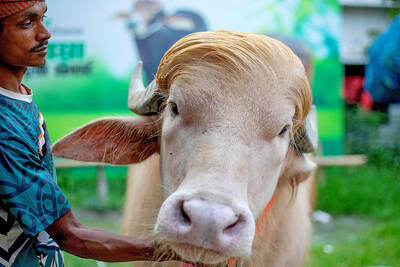
Crowds in Bangladesh are flocking to snap photographs with an unlikely social media star — an albino buffalo with flowing blond hair nicknamed “Donald Trump” that is due to be sacrificed within days. Owner Zia Uddin Mridha, 38, said his brother named the 700kg bull over its flowing helmet of hair resembling the signature look of the US president. “My younger brother picked this name because of the buffalo’s extraordinary hair,” he said at his farm in Narayanganj, just outside the capital, Dhaka. Mridha said that a constant stream of curious visitors — social media fans, onlookers and children — have come throughout

It began as a satirical online project. Now millions of young people in India are flocking to it as an outlet for their frustration. A parody political party called the Cockroach Janta Party, with the insect as its symbol, has exploded across India’s social media by turning absurdist humor into protest. Memes and short videos mocking corruption, joblessness and political dysfunction have flooded social media sites, where millions of users are embracing the cockroach — known for its ability to survive harsh conditions — as a tongue-in-cheek symbol of endurance. The online movement’s rise has been unusually rapid. The Cockroach Janta Party (CJP)

BIGGER ROLE: Beijing has said it maintains an impartial stance on the war in Ukraine, but by training Russian troops, China is far more involved than previously known China’s armed forces secretly trained about 200 Russian military personnel in China late last year, and some have since returned to fight in Ukraine, according to three European intelligence agencies and documents seen by Reuters. While China and Russia have held a number of joint military exercises since Moscow’s full-scale invasion of Ukraine in 2022, Beijing has repeatedly said that it is neutral in the conflict and presents itself as a peace mediator. The covert training sessions, which predominantly focused on the use of drones, were outlined in a dual-language Russian-Chinese agreement signed by senior Russian and Chinese officers in Beijing on
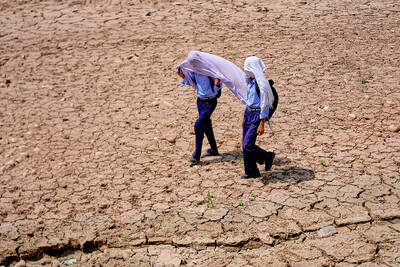
HOTTER: While Indians are accustomed to summer heat, climate change has caused northwestern India to warm faster than other parts of the country, an academic said Roads and markets have emptied during afternoons and some farmers have switched to nighttime work to avoid scorching temperatures as a heat wave grips large parts of India. The India Meteorological Department forecast maximum temperatures for yesterday of about 45°C in the capital, New Delhi, where authorities have opened temporary “cooling zones” to help people cope. The weather department warned that conditions would likely persist across several northern regions in the coming days, with temperatures staying well above seasonal averages. Authorities urged people to stay indoors during the hottest hours and take precautions against heat-related illnesses. India declares a heat wave whenever maximum temperatures


 RSS
RSS