


The Israeli government is planning to give up a large slice of land to US Christian evangelicals to build a biblical theme park by the Sea of Galilee where Jesus is said to have walked on water and fed 5,000 with five loaves and two fish.
A consortium of Christian groups, led by the television evangelist Pat Robertson, is in negotiation with the Israeli ministry of tourism and a deal is expected in the coming months. The project is expected to bring up to 1 million extra tourists a year, but an undeclared benefit will be the cementing of a political alliance between the Israeli right-wing and the US Christian right.
However, the alliance has not been welcomed by all Israelis, including some who fear the ultimate aim of the evangelicals is the conversion of the Jews to Christianity rather than support for Israel.
Jonathan Pulik, a spokesman for the Israeli ministry of tourism, said the Christian market was very important for Israel's tourism industry.
"We would like to give them more of a reason to come here. We would be willing to lease the land to them free of charge and they would finance the construction," Pulik said.
The site of the center, covering nearly 50 hectares and provisionally called the Galilee World Heritage Park, would be north-east of the Mount of the Beatitudes where Jesus delivered the Sermon on the Mount, and Capernaum which was described as the town of Jesus in the Bible. It would feature a garden and nature park, an auditorium, a Holy Land exhibition, outdoor amphitheaters, information center and a media studio. The ministry of tourism estimates the total cost would be US$48 million. Pulik also said that the project would bring large numbers of jobs to the area.
Robertson said in a statement that he was "fully cooperating" with the project but no deal had been formalized. He said he was thrilled that "there will be a place in the Galilee where evangelical Christians from all over the world can come to celebrate the actual place where Jesus Christ lived and taught."
A major part of the shore of the Sea of Galilee was Syrian until it was conquered by Israel in 1967. Syria and Israel are still officially in a state of war and Syria insists the return of the Golan Heights and the Galilee shore is a prerequisite for peace.
Uri Dagul, the project coordinator, said that the land issues would be concluded within a few weeks and then the final details would be agreed between the Israeli government and the Christian communities which are primarily US evangelical churches.
The US Christian right, best known for television evangelism and its stars such as Robertson and Jerry Falwell, has been among the strongest supporters of Israel in the US.
The primary reason is that, according to the Old Testament, Israel was given to the Jews by God. Fundamentalist Christians believe that in order for Jesus to return, two preconditions are Jewish control of the land of Israel and the conversion of the Jews to Christianity.
Yossi Sarid, a former government minister and member of the Knesset, said he was wary of the friendship of the US Christian right and projects such as the Galilee center.
"I am not enthusiastic about this cooperation because I have no desire to be cannon fodder for the evangelists. As a Jew, they believe I have to vanish before Jesus can make his second appearance. As I have no plans to convert, as an Israeli and a Jew, I find this a provocation. There is something sinister about their embrace," Sarid said.
Avraham Hirschson, the Israeli tourism minister, said: "I'm not a theologian, I'm the minister of tourism, and I'm not interested in the politics of our tourists as long as they come here. They come here as tourists, and they're friends of Israel."

Crowds in Bangladesh are flocking to snap photographs with an unlikely social media star — an albino buffalo with flowing blond hair nicknamed “Donald Trump” that is due to be sacrificed within days. Owner Zia Uddin Mridha, 38, said his brother named the 700kg bull over its flowing helmet of hair resembling the signature look of the US president. “My younger brother picked this name because of the buffalo’s extraordinary hair,” he said at his farm in Narayanganj, just outside the capital, Dhaka. Mridha said that a constant stream of curious visitors — social media fans, onlookers and children — have come throughout

It began as a satirical online project. Now millions of young people in India are flocking to it as an outlet for their frustration. A parody political party called the Cockroach Janta Party, with the insect as its symbol, has exploded across India’s social media by turning absurdist humor into protest. Memes and short videos mocking corruption, joblessness and political dysfunction have flooded social media sites, where millions of users are embracing the cockroach — known for its ability to survive harsh conditions — as a tongue-in-cheek symbol of endurance. The online movement’s rise has been unusually rapid. The Cockroach Janta Party (CJP)

BIGGER ROLE: Beijing has said it maintains an impartial stance on the war in Ukraine, but by training Russian troops, China is far more involved than previously known China’s armed forces secretly trained about 200 Russian military personnel in China late last year, and some have since returned to fight in Ukraine, according to three European intelligence agencies and documents seen by Reuters. While China and Russia have held a number of joint military exercises since Moscow’s full-scale invasion of Ukraine in 2022, Beijing has repeatedly said that it is neutral in the conflict and presents itself as a peace mediator. The covert training sessions, which predominantly focused on the use of drones, were outlined in a dual-language Russian-Chinese agreement signed by senior Russian and Chinese officers in Beijing on
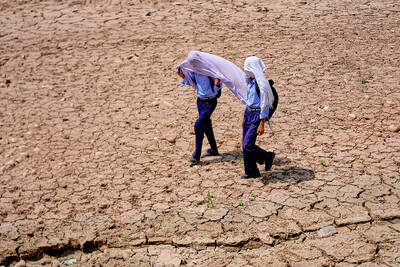
HOTTER: While Indians are accustomed to summer heat, climate change has caused northwestern India to warm faster than other parts of the country, an academic said Roads and markets have emptied during afternoons and some farmers have switched to nighttime work to avoid scorching temperatures as a heat wave grips large parts of India. The India Meteorological Department forecast maximum temperatures for yesterday of about 45°C in the capital, New Delhi, where authorities have opened temporary “cooling zones” to help people cope. The weather department warned that conditions would likely persist across several northern regions in the coming days, with temperatures staying well above seasonal averages. Authorities urged people to stay indoors during the hottest hours and take precautions against heat-related illnesses. India declares a heat wave whenever maximum temperatures


 RSS
RSS