


Mental health professionals say New Orleans appears to be experiencing a sharp increase in suicides in the wake of Hurricane Katrina, and interviews and statistics suggest that the rate is now double or more the national and local averages.
At least seven people have killed themselves in the four months since the storm, officials say, in a city whose population is now no more than 75,000 to 100,000. That compares with a national rate of 11 suicides per 100,000 for all of 2002, and a rate in New Orleans of about 9 per 100,000 for all of last year. There is broad agreement that the problem is likely to get worse.
Stevenson Palfi, 53, a well-known local filmmaker, was apparently the latest to take his own life. Palfi's house in the Mid-City section had taken 2.4m of water, and he was in despair over losing years of files and photographs, a computer -- in fact, all the contents of his office.

PHOTO: AP
The aftermath of the storm pushed him "right off the cliff emotionally," said a friend, Mary Katherine Aldin.
"This just hit him so hard," she said. "It was a cumulative devastation to him emotionally."
Palfi sat down to write a suicide note and a will, then shot himself on the second floor of his Banks Street home in the early hours of Dec. 14, Aldin said.
The signs of despair are pervasive here: A woman, having returned to see her flooded-out house for the first time, runs screaming down Mirabeau Avenue in the Gentilly neighborhood, where the police find her babbling uncontrollably; in a Bourbon Street nightclub, a man draws a gun and shoots himself in the head, even as dancers sway to the music; from half-ruined houses, the police retrieve homeowners, weeping and distraught; psychiatrists report that previously stable patients are now preoccupied with death and suicide.
"I would call the scope of this disaster, the scale of mental health problems, unprecedented," said Charles Curie, the mental health administrator at the federal Department of Health and Human Services.
Officials say that among those who have killed themselves was James Kent Treadway, a pediatrician who was a fixture in the Uptown neighborhood. Treadway, 58, committed suicide in his partly destroyed house on Nov. 16.
"He's got no practice, the house is flooded, his office was destroyed," said his brother-in-law, Michael Caire. "He just doesn't know how he's going to make it in the future."
Officials have also reported suicides among evacuees in cities like Houston, where large numbers of them have settled.
And in addition to those who have killed themselves here, about two dozen have tried to do so, a rate that is most likely also far higher than normal, officials say.
Jeff Wellborn, administrator of the Police Department's mobile mental health squad, said members of his unit were being called in frequently when a homeowner, witnessing the extent of losses for the first time, broke down.
"They're coming into town, and they get so depressed they can't handle it anymore," Wellborn said.
"These are not the same people we dealt with before the storm," he said. "They had no mental health history. We are seeing almost exclusively new patients."
Health professionals confronting this tide of despondency view it as one more sign that New Orleans, with its kilometers of ruined neighborhoods, moribund downtown and enclaves of semi-normality, is far from recovered. Nobody here can escape the persistent evidence of the city's devastation.
"There are a lot of people walking around with an endemic low-grade depression," said Dale Firestone, a local psychotherapist.
For an undetermined number, it is worse, experts said.
"I've had some very depressed people from Katrina," said Douglas Greve, a psychiatrist with a practice in the French Quarter. "These are profound depressions."

Le Tuan Binh keeps his Moroccan soldier father’s tombstone at his village home north of Hanoi, a treasured reminder of a man whose community in Vietnam has been largely forgotten. Mzid Ben Ali, or “Mohammed” as Binh calls him, was one of tens of thousands of North Africans who served in the French army as it battled to maintain its colonial rule of Indochina. He fought for France against the Viet Minh independence movement in the 1950s, before leaving the military — as either a defector or a captive — and making a life for himself in Vietnam. “It’s very emotional for me,”

The Chinese Communist Party’s (CCP) Central Committee is to gather in July for a key meeting known as a plenum, the third since the body of elite decisionmakers was elected in 2022, focusing on reforms amid “challenges” at home and complexities broad. Plenums are important events on China’s political calendar that require the attendance of all of the Central Committee, comprising 205 members and 171 alternate members with Chinese President Xi Jinping (習近平) at the helm. The Central Committee typically holds seven plenums between party congresses, which are held once every five years. The current central committee members were elected at the
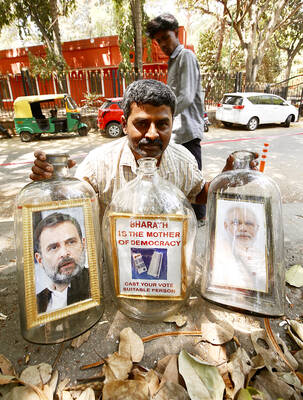
Indian Prime Minister Narendra Modi reaffirmed his pledge to replace India’s religion-based marriage and inheritance laws with a uniform civil code if he returns to office for a third term, a move that some minority groups have opposed. In an interview with the Times of India listing his agenda, Modi said his government would push for making the code a reality. “It is clear that separate laws for communities are detrimental to the health of society,” he said in the interview published yesterday. “We cannot be a nation where one community is progressing with the support of the Constitution while the other

CODIFYING DISCRIMINATION: Transgender people would be sentenced to three years in prison, while same-sex relations could land a person in jail for more than a decade Iraq’s parliament on Saturday passed a bill criminalizing same-sex relations, which would receive a sentence of up to 15 years in prison, in a move rights groups condemned as an “attack on human rights.” Transgender people would be sentenced to three years’ jail under the amendments to a 1988 anti-prostitution law, which were adopted during a session attended by 170 of 329 lawmakers. A previous draft had proposed capital punishment for same-sex relations, in what campaigners had called a “dangerous” escalation. The new amendments enable courts to sentence people engaging in same-sex relations to 10 to 15 years in prison, according to the


 RSS
RSS