


The reverse thrusters that should have slowed a Southwest Airlines jetliner before it slid off a runway and into a busy street didn't immediately kick in when the pilots tried to deploy them, federal investigators said after interviewing the crew.
The flight attendants said they could tell the Boeing 737 wasn't slowing after it touched down in the snow on Thursday evening, and the pilots said they applied the brakes manually as soon as they realized something was wrong, said Robert Benzon, National Transportation Safety Board investigator in charge.
"They all said it was a smooth landing but they could sense a lack of deceleration," Benzon said on Saturday.
The plane, with 98 passengers aboard, slid off a 1,950m runway at Midway Airport, through a fence and into street traffic, where it hit two cars and killed a six-year-old boy riding with his family. Ten people, most of them on the ground, were injured.
Investigators are still trying to determine how much of a role the braking equipment played in the accident.
Because of the blowing snow, none of the air traffic controllers actually saw the plane land, but more than 10 cameras have been identified that could provide additional information, including details about the runway conditions, Benzon said.
On Saturday, workers used a crane with a sling to lift the damaged airliner off the city street and into a hangar for further inspections. The plane's voice and data recorders have already been sent to Washington for analysis, NTSB member Ellen Engleman Conners said.
Southwest said the captain piloting the plane has been with the airline for more than 10 years, and the first officer has flown with Southwest for two-and-a-half years. It was the first fatal crash in the airline's 35-year history.
Though the airport had about 18cm of snow at the time, aviation officials said conditions were acceptable. Southwest chief executive Gary Kelly said on Friday that the plane had recently had a maintenance check and showed no signs of problems.
Midway -- built in 1923 and surrounded by houses and businesses -- is among nearly 300 US commercial airports without 300m buffer zones at the ends of runways.
Safety experts suggest the airports guard against accidents by using beds of crushable concrete that can slow an aircraft if it slides off the runway's end.
The crushable concrete beds -- called Engineered Material Arresting Systems -- are installed at 18 runways at 14 airports. They have stopped dangerous overruns three times since May 1999 at Kennedy Airport in New York.
A Chicago Department of Aviation spokeswoman could not immediately say whether an arresting system had been considered.
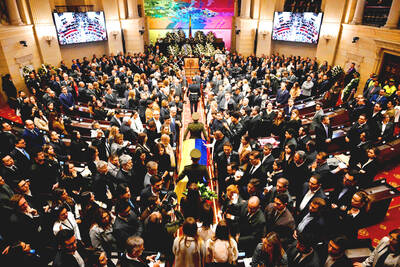
‘THEY KILLED HOPE’: Four presidential candidates were killed in the 1980s and 1990s, and Miguel Uribe’s mother died during a police raid to free her from Pablo Escobar Colombian presidential candidate Miguel Uribe has died two months after being shot at a campaign rally, his family said on Monday, as the attack rekindled fears of a return to the nation’s violent past. The 39-year-old conservative senator, a grandson of former Colombian president Julio Cesar Turbay (1978-1982), was shot in the head and leg on June 7 at a rally in the capital, Bogota, by a suspected 15-year-old hitman. Despite signs of progress in the past few weeks, his doctors on Saturday announced he had a new brain hemorrhage. “To break up a family is the most horrific act of violence that

HISTORIC: After the arrest of Kim Keon-hee on financial and political funding charges, the country has for the first time a former president and former first lady behind bars South Korean prosecutors yesterday raided the headquarters of the former party of jailed former South Korean president Yoon Suk-yeol to gather evidence in an election meddling case against his wife, a day after she was arrested on corruption and other charges. Former first lady Kim Keon-hee was arrested late on Tuesday on a range of charges including stock manipulation and corruption, prosecutors said. Her arrest came hours after the Seoul Central District Court reviewed prosecutors’ request for an arrest warrant against the 52-year-old. The court granted the warrant, citing the risk of tampering with evidence, after prosecutors submitted an 848-page opinion laying out
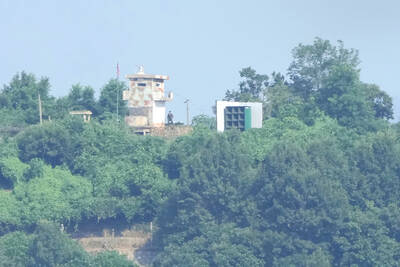
North Korean troops have started removing propaganda loudspeakers used to blare unsettling noises along the border, South Korea’s military said on Saturday, days after Seoul’s new administration dismantled ones on its side of the frontier. The two countries had already halted propaganda broadcasts along the demilitarized zone, Seoul’s military said in June after the election of South Korean President Lee Jae-myung, who is seeking to ease tensions with Pyongyang. The South Korean Ministry of National Defense on Monday last week said it had begun removing loudspeakers from its side of the border as “a practical measure aimed at helping ease
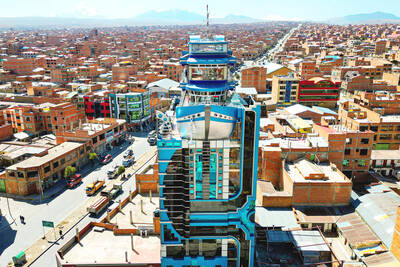
STAGNATION: Once a bastion of leftist politics, the Aymara stronghold of El Alto is showing signs of shifting right ahead of the presidential election A giant cruise ship dominates the skyline in the city of El Alto in landlocked Bolivia, a symbol of the transformation of an indigenous bastion keenly fought over in tomorrow’s presidential election. The “Titanic,” as the tallest building in the city is known, serves as the latest in a collection of uber-flamboyant neo-Andean “cholets” — a mix of chalet and “chola” or Indigenous woman — built by Bolivia’s Aymara bourgeoisie over the past two decades. Victor Choque Flores, a self-made 46-year-old businessman, forked out millions of US dollars for his “ship in a sea of bricks,” as he calls his futuristic 12-story


 RSS
RSS