


Ellen Johnson Sirleaf has won Liberia's presidential vote, becoming Africa's first elected woman head of state and embarking on a six-year mission to lift the war-torn country towards prosperity and reconciliation.
"I thank the Liberian people for performing their legal duty and I am happy to be the next president of Liberia," Sirleaf, dressed in a burgundy robe and headscarf, told reporters after a ceremony on Wednesday certifying the Nov. 8 results at the Centennial Pavillion in downtown Monrovia.
The Harvard-educated banker, 67, earned 59.4 percent of votes cast to best football hero George Weah in a run-off aimed to help Liberia turn the page on decades of lawlessness and corruption after back-to-back civil wars since 1989.
"Consequently, Ellen Johnson Sirleaf is hereby declared the winner of the run-off election," National Elections Commission chairwoman Frances Johnson Morris said.
She will be inaugurated on Jan. 16, as will the new bicameral legislature for Africa's oldest independent republic, settled in 1847 by freed American slaves.
"This is a historic moment not only for Liberia but for the continent as a whole," said UN special envoy Alan Doss, attending the ceremony that was ringed with tight UN and national security.
Weah has alleged massive vote fraud in the Nov. 8 polls, and has launched a complaint process with the NEC that his party, the Congress for Democratic Change, has vowed to take to the Supreme Court.
The elections were declared peaceful and credible by a host of international observers, and pressure has been mounting on Weah -- even from among his supporters, including two former warlords who endorsed his candidacy -- to concede in the interests of peace.
Niger President Mamadou Tandja, current head of the 15-member Economic Community of West African States, added his voice on Monday to the African chorus praising the elections and urging the dispute be resolved quickly and peacefully.
French President Jacques Chirac was among the first to extend his congratulations, releasing a public message hailing the writing of a "new page in Liberia's political history."
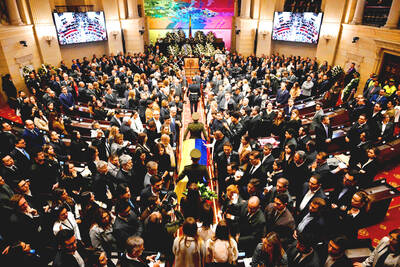
‘THEY KILLED HOPE’: Four presidential candidates were killed in the 1980s and 1990s, and Miguel Uribe’s mother died during a police raid to free her from Pablo Escobar Colombian presidential candidate Miguel Uribe has died two months after being shot at a campaign rally, his family said on Monday, as the attack rekindled fears of a return to the nation’s violent past. The 39-year-old conservative senator, a grandson of former Colombian president Julio Cesar Turbay (1978-1982), was shot in the head and leg on June 7 at a rally in the capital, Bogota, by a suspected 15-year-old hitman. Despite signs of progress in the past few weeks, his doctors on Saturday announced he had a new brain hemorrhage. “To break up a family is the most horrific act of violence that

HISTORIC: After the arrest of Kim Keon-hee on financial and political funding charges, the country has for the first time a former president and former first lady behind bars South Korean prosecutors yesterday raided the headquarters of the former party of jailed former South Korean president Yoon Suk-yeol to gather evidence in an election meddling case against his wife, a day after she was arrested on corruption and other charges. Former first lady Kim Keon-hee was arrested late on Tuesday on a range of charges including stock manipulation and corruption, prosecutors said. Her arrest came hours after the Seoul Central District Court reviewed prosecutors’ request for an arrest warrant against the 52-year-old. The court granted the warrant, citing the risk of tampering with evidence, after prosecutors submitted an 848-page opinion laying out
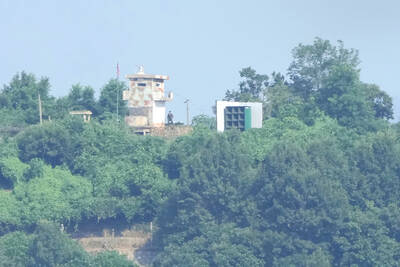
North Korean troops have started removing propaganda loudspeakers used to blare unsettling noises along the border, South Korea’s military said on Saturday, days after Seoul’s new administration dismantled ones on its side of the frontier. The two countries had already halted propaganda broadcasts along the demilitarized zone, Seoul’s military said in June after the election of South Korean President Lee Jae-myung, who is seeking to ease tensions with Pyongyang. The South Korean Ministry of National Defense on Monday last week said it had begun removing loudspeakers from its side of the border as “a practical measure aimed at helping ease
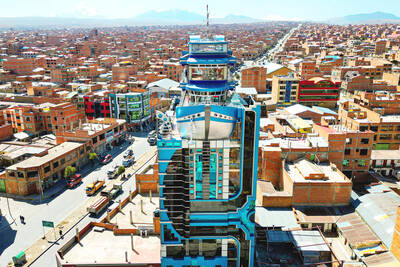
STAGNATION: Once a bastion of leftist politics, the Aymara stronghold of El Alto is showing signs of shifting right ahead of the presidential election A giant cruise ship dominates the skyline in the city of El Alto in landlocked Bolivia, a symbol of the transformation of an indigenous bastion keenly fought over in tomorrow’s presidential election. The “Titanic,” as the tallest building in the city is known, serves as the latest in a collection of uber-flamboyant neo-Andean “cholets” — a mix of chalet and “chola” or Indigenous woman — built by Bolivia’s Aymara bourgeoisie over the past two decades. Victor Choque Flores, a self-made 46-year-old businessman, forked out millions of US dollars for his “ship in a sea of bricks,” as he calls his futuristic 12-story


 RSS
RSS