


A Japanese space probe successfully landed and then departed from the surface of an asteroid 290 million kilometers from Earth, despite an initial announcement that the attempt had failed, Japan's space agency said.
JAXA officials had said on Sunday that the Hayabusa probe, on a mission to briefly land on the asteroid Itokawa, collect material, and then bring it back to Earth, had failed to touch down after maneuvering within meters of the asteroid's surface.
However, on Wednesday JAXA said that data sent from Hayabusa confirmed that it had landed on the asteroid on Sunday for about half an hour. However, the probe failed to collect material, JAXA said.
Before landing, Hayabusa dropped a small object as a touchdown target from 40m above the asteroid and then descended to within 17m of the surface, at which point ground control lost contact with the probe for about three hours, JAXA officials said earlier.
But after analyzing data later sent by the probe, the agency confirmed that it landed on the asteroid within about 30m of the landing target, JAXA said in a statement.
JAXA Associate Executive Director Yasunori Matogawa said it was the first time that a probe had successfully landed on an asteroid and then taken off.
"I think we did a great job," he said.
He said the probe had moved as far as 100km from the asteroid but was now getting closer for a second attempt.
The mission has been troubled by a series of glitches.
A rehearsal was aborted earlier this month when the probe had trouble finding a landing spot, and a small robotic lander deployed from the probe was lost. Hayabusa also suffered a problem with one of its three gyroscopes, but it has since been repaired.
Hayabusa was launched in May 2003 and has until early next month before it must leave orbit and begin its 290 million kilometer journey home. It is expected to return to Earth and land in the Australian Outback in June 2007.
The asteroid is named after Hideo Itokawa, the father of rocket science in Japan, and is orbiting the sun between Earth and Mars. It is 690m long and 300m wide and has a gravitational pull of only 1/100,000th of Earth's, which makes landing a probe there difficult.
Examining asteroid samples is expected to help unlock secrets of how celestial bodies were formed because their surfaces are believed to have remained relatively unchanged over the eons, unlike those of larger bodies such the planets or moons, JAXA said.
A NASA probe collected data for two weeks from the Manhattan-sized asteroid Eros in 2001, but did not return with samples.

‘THEY KILLED HOPE’: Four presidential candidates were killed in the 1980s and 1990s, and Miguel Uribe’s mother died during a police raid to free her from Pablo Escobar Colombian presidential candidate Miguel Uribe has died two months after being shot at a campaign rally, his family said on Monday, as the attack rekindled fears of a return to the nation’s violent past. The 39-year-old conservative senator, a grandson of former Colombian president Julio Cesar Turbay (1978-1982), was shot in the head and leg on June 7 at a rally in the capital, Bogota, by a suspected 15-year-old hitman. Despite signs of progress in the past few weeks, his doctors on Saturday announced he had a new brain hemorrhage. “To break up a family is the most horrific act of violence that

HISTORIC: After the arrest of Kim Keon-hee on financial and political funding charges, the country has for the first time a former president and former first lady behind bars South Korean prosecutors yesterday raided the headquarters of the former party of jailed former South Korean president Yoon Suk-yeol to gather evidence in an election meddling case against his wife, a day after she was arrested on corruption and other charges. Former first lady Kim Keon-hee was arrested late on Tuesday on a range of charges including stock manipulation and corruption, prosecutors said. Her arrest came hours after the Seoul Central District Court reviewed prosecutors’ request for an arrest warrant against the 52-year-old. The court granted the warrant, citing the risk of tampering with evidence, after prosecutors submitted an 848-page opinion laying out
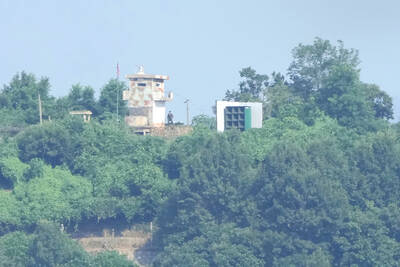
North Korean troops have started removing propaganda loudspeakers used to blare unsettling noises along the border, South Korea’s military said on Saturday, days after Seoul’s new administration dismantled ones on its side of the frontier. The two countries had already halted propaganda broadcasts along the demilitarized zone, Seoul’s military said in June after the election of South Korean President Lee Jae-myung, who is seeking to ease tensions with Pyongyang. The South Korean Ministry of National Defense on Monday last week said it had begun removing loudspeakers from its side of the border as “a practical measure aimed at helping ease

STAGNATION: Once a bastion of leftist politics, the Aymara stronghold of El Alto is showing signs of shifting right ahead of the presidential election A giant cruise ship dominates the skyline in the city of El Alto in landlocked Bolivia, a symbol of the transformation of an indigenous bastion keenly fought over in tomorrow’s presidential election. The “Titanic,” as the tallest building in the city is known, serves as the latest in a collection of uber-flamboyant neo-Andean “cholets” — a mix of chalet and “chola” or Indigenous woman — built by Bolivia’s Aymara bourgeoisie over the past two decades. Victor Choque Flores, a self-made 46-year-old businessman, forked out millions of US dollars for his “ship in a sea of bricks,” as he calls his futuristic 12-story


 RSS
RSS