


The Republican-controlled US Senate rejected a Democratic demand for a timetable to withdraw US troops from Iraq but urged President George W. Bush to outline his plan for "the successful completion of the mission."
Even the watered-down bill reflected growing bipartisan unease with Bush's Iraq policies.
The overall measure, adopted 98-0 on Tuesday, shows a willingness to defy the president in several ways despite a threatened veto. It would restrict the techniques used to interrogate terror detainees, ban inhuman treatment of them and tell the administration to provide lawmakers with quarterly reports on the status of operations in Iraq.
Bush, traveling in Japan, said he is happy to keep Congress informed of his plan to bring democracy to Iraq.
"It is important that we succeed in Iraq ... and we're going to," Bush said yesterday during a press conference with Japanese Prime Minister Junichiro Koizumi. "The only way that we won't succeed is if we lose our nerve and the terrorists are able to drive us out of Iraq by killing innocent lives."
The bill was not without victories for the president, including support for military tribunals with which Bush wants to try detainees at the prison in Guantanamo Bay, Cuba. Even that was tempered, however, with language letting the inmates appeal to a federal court their designation as enemy combatants and their sentences.
The Senate's votes on Iraq showed a willingness even by Republicans to question the White House on a war that's growing increasingly unpopular with the US public.
Polls show Bush's popularity has tumbled in part because of public frustration over Iraq, a war that has claimed the lives of more than 2,070 US troops.
Senate Democratic leader Harry Reid of Nevada said the outcome was "a vote of no confidence on the president's policies in Iraq." Republicans "acknowledged that there need to be changes made," he said.
Reid's counterpart with the majority Republicans, Senator Bill Frist of Tennessee, trumpeted the chamber's rejection of the Democratic call for a withdrawal timetable.
"It is an absolute repudiation of the cut-and-run strategy put forward by the Democrats," Frist said.
Bush also highlighted the rejection of the withdrawal amendment, calling it a "positive step."
"The Senate did ask that we report on progress being made in Iraq, which we're more than willing to do," Bush said. "That's to be expected. That's what the Congress expects. They expect us to keep them abreast of a plan that is going to work."
The fate of the legislation is uncertain. The House version of the bill, which sets Pentagon policy and authorizes spending, does not include the Iraq language or any of the provisions on the detention, interrogation or prosecution of terrorism suspects.
The measure faces a veto threat from the administration over a provision that imposes a blanket prohibition on the use of "cruel, inhuman and degrading" treatment of terrorism suspects in US custody.
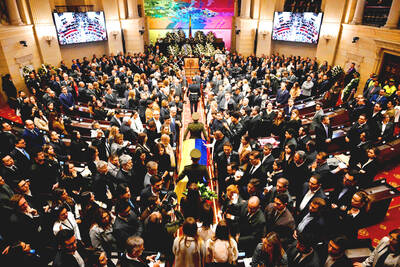
‘THEY KILLED HOPE’: Four presidential candidates were killed in the 1980s and 1990s, and Miguel Uribe’s mother died during a police raid to free her from Pablo Escobar Colombian presidential candidate Miguel Uribe has died two months after being shot at a campaign rally, his family said on Monday, as the attack rekindled fears of a return to the nation’s violent past. The 39-year-old conservative senator, a grandson of former Colombian president Julio Cesar Turbay (1978-1982), was shot in the head and leg on June 7 at a rally in the capital, Bogota, by a suspected 15-year-old hitman. Despite signs of progress in the past few weeks, his doctors on Saturday announced he had a new brain hemorrhage. “To break up a family is the most horrific act of violence that

HISTORIC: After the arrest of Kim Keon-hee on financial and political funding charges, the country has for the first time a former president and former first lady behind bars South Korean prosecutors yesterday raided the headquarters of the former party of jailed former South Korean president Yoon Suk-yeol to gather evidence in an election meddling case against his wife, a day after she was arrested on corruption and other charges. Former first lady Kim Keon-hee was arrested late on Tuesday on a range of charges including stock manipulation and corruption, prosecutors said. Her arrest came hours after the Seoul Central District Court reviewed prosecutors’ request for an arrest warrant against the 52-year-old. The court granted the warrant, citing the risk of tampering with evidence, after prosecutors submitted an 848-page opinion laying out
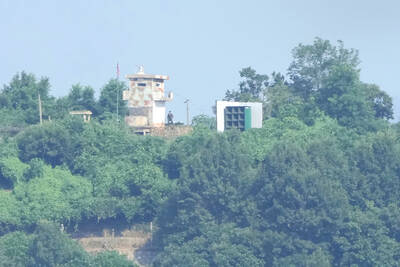
North Korean troops have started removing propaganda loudspeakers used to blare unsettling noises along the border, South Korea’s military said on Saturday, days after Seoul’s new administration dismantled ones on its side of the frontier. The two countries had already halted propaganda broadcasts along the demilitarized zone, Seoul’s military said in June after the election of South Korean President Lee Jae-myung, who is seeking to ease tensions with Pyongyang. The South Korean Ministry of National Defense on Monday last week said it had begun removing loudspeakers from its side of the border as “a practical measure aimed at helping ease
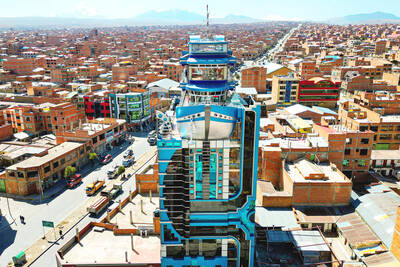
STAGNATION: Once a bastion of leftist politics, the Aymara stronghold of El Alto is showing signs of shifting right ahead of the presidential election A giant cruise ship dominates the skyline in the city of El Alto in landlocked Bolivia, a symbol of the transformation of an indigenous bastion keenly fought over in tomorrow’s presidential election. The “Titanic,” as the tallest building in the city is known, serves as the latest in a collection of uber-flamboyant neo-Andean “cholets” — a mix of chalet and “chola” or Indigenous woman — built by Bolivia’s Aymara bourgeoisie over the past two decades. Victor Choque Flores, a self-made 46-year-old businessman, forked out millions of US dollars for his “ship in a sea of bricks,” as he calls his futuristic 12-story


 RSS
RSS