


The battle for Muslim hearts and minds is playing out on TV screens and computer monitors these days, with the alternately fasting and feasting Ramadan masses presenting a ready audience.
At least two groundbreaking TV series focus on the damage that extremism is wreaking on the Muslim world, while a media organization closely associated with al-Qaeda has begun a high-quality Internet news broadcast to counter what it calls "lies and propaganda" on even Arab satellite news channels like Al-Jazeera, which has been blamed for under-reporting al-Qaeda activities.
The two mini-series are just a small part of a vast lineup of Ramadan comedies, period dramas and love stories playing on more than 100 satellite TV channels this year.

PHOTO: NY TIMES NEWS SERVICE
About two-thirds of the original Arabic TV programming produced during the year is broadcast in the ninth month of the Islamic calendar, when families gather nightly to break their fast, and advertisers spend more than half of their budgets to reach them.
But the two mini-series represent something new for Arab audiences.
"It is the first time in Arab drama that you see people who believe in the Koran and faith doing bad," said Ali al-Ahmed, director of Abu Dhabi TV.
Every night at 11:30pm in Saudi Arabia -- prime time during Ramadan -- his channel broadcasts The Rough Road, which tells the story of a fictional TV correspondent producing a documentary about mujahidin in Afghanistan, only to discover corruption and opportunism in their cause.
At 11pm, the Saudi-owned Middle East Broadcasting Co, shows Hour el Ayn (the beautiful virgins) based loosely on the true story of a militant attack on an expatriate compound in Saudi Arabia last year that left 17 people dead. Produced in Syria, the series begins in the attack's aftermath, with a wounded woman telling her story to a reporter, traces the lives of victims and attackers and their troubling cause, and emphasizing the viciousness and corruption of al-Qaeda.
The series is dedicated nightly to the "memory of the innocent victims of terror attacks" and opens with the quote "silence in the face of crime is another crime."
"We have allowed the extremists to tell their story," Ahmed said, noting militants' exploitation of major media to publicize their attacks. "Now we are warning the quiet majority to watch out for them. We are telling the society to be careful of these people, and we are allowing the drama to serve this cause."
The Internet news show also seeks to attract the big audiences available during Ramadan. Young Arabs in particular flock to the their computers after the evening feast, causing download speeds to droop.
Just before Ramadan, the Global Islamic Media Front, a group widely seen as a mouthpiece for al-Qaeda, issued a call on several Internet message boards calling on Muslims to volunteer their video production, editing and publishing skills.
Late last month, the Front started its half-hour news show, Voice of the Caliphate, which is posted on Web sites whose addresses are regularly changed.
"This is clearly intended to allow the armchair jihadis to get involved, from wherever they are," said Stephen Ulph, a researcher with the Jamestown Foundation and an analyst at the Dubai-based Institute for Near East and Gulf Military Studies.
Internet watchers say they have detected an uptick in Internet activity this month too.
"They are irritated by the Arabic satellite channels for not flagging enough of their operations," Ulph said.
"Their irritation with the mainstream media channels is strong, and their latest TV program is a result of this," he said.
In one recent program, a news anchor in covered face welcomed viewers with greetings for a Blessed Ramadan before delivering news of attacks by jihadists in Afghanistan, Iraq and elsewhere.
"This is a media war between al-Qaeda and its opponents," said Montasser al-Zayat, a lawyer and onetime spokesman for a militant group in Egypt.
He said Ayman al-Zawahiri, the No.2 leader of al-Qaeda, was "keen to broadcast videotapes because he wants to send a message to his people that the group's organizational structure is still there and to tell the Americans, `We are here.'"

Le Tuan Binh keeps his Moroccan soldier father’s tombstone at his village home north of Hanoi, a treasured reminder of a man whose community in Vietnam has been largely forgotten. Mzid Ben Ali, or “Mohammed” as Binh calls him, was one of tens of thousands of North Africans who served in the French army as it battled to maintain its colonial rule of Indochina. He fought for France against the Viet Minh independence movement in the 1950s, before leaving the military — as either a defector or a captive — and making a life for himself in Vietnam. “It’s very emotional for me,”

The Chinese Communist Party’s (CCP) Central Committee is to gather in July for a key meeting known as a plenum, the third since the body of elite decisionmakers was elected in 2022, focusing on reforms amid “challenges” at home and complexities broad. Plenums are important events on China’s political calendar that require the attendance of all of the Central Committee, comprising 205 members and 171 alternate members with Chinese President Xi Jinping (習近平) at the helm. The Central Committee typically holds seven plenums between party congresses, which are held once every five years. The current central committee members were elected at the
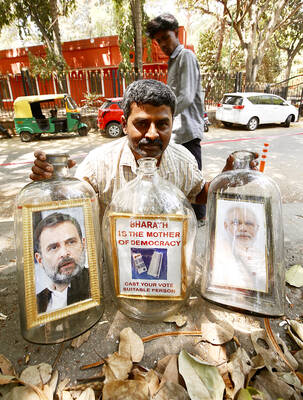
Indian Prime Minister Narendra Modi reaffirmed his pledge to replace India’s religion-based marriage and inheritance laws with a uniform civil code if he returns to office for a third term, a move that some minority groups have opposed. In an interview with the Times of India listing his agenda, Modi said his government would push for making the code a reality. “It is clear that separate laws for communities are detrimental to the health of society,” he said in the interview published yesterday. “We cannot be a nation where one community is progressing with the support of the Constitution while the other

CODIFYING DISCRIMINATION: Transgender people would be sentenced to three years in prison, while same-sex relations could land a person in jail for more than a decade Iraq’s parliament on Saturday passed a bill criminalizing same-sex relations, which would receive a sentence of up to 15 years in prison, in a move rights groups condemned as an “attack on human rights.” Transgender people would be sentenced to three years’ jail under the amendments to a 1988 anti-prostitution law, which were adopted during a session attended by 170 of 329 lawmakers. A previous draft had proposed capital punishment for same-sex relations, in what campaigners had called a “dangerous” escalation. The new amendments enable courts to sentence people engaging in same-sex relations to 10 to 15 years in prison, according to the


 RSS
RSS