


Lu Banglie (
Lu has said that he was battered unconscious and later driven hundreds of kilometers to his home town where he is now recuperating. Civil rights lawyers said they were considering a legal case against his attackers, thought to be a group of thugs hired by the local authorities to put down an anti-corruption campaign against the chief of Taishi village.
Although the attack was witnessed by a foreign correspondent, the local propaganda department insisted there had been no violence and provincial officials said it was too early to respond to requests for a full investigation.
Missing
Lu went missing on Saturday night after he attempted to take the Guardian's Benjamin Joffe-Walt into Taishi, a flashpoint in a growing wave of regional unrest that has challenged the authority of the Chinese Communist Party. He was last seen lying unconscious on the side of the road.
Late on Monday, however, Lu re-emerged from hospital in his home town of Zhijiang, Hubei Province to tell his version of what happened after he was dragged out of the car by an angry mob.
"Five to six of them pulled my hair and punched me in the head. They kicked my legs and body for a couple of minutes. Then I passed out. Some people then splashed water on me which brought me round, then I passed out again," he said.
When he came to, he was being driven back to Hubei.
Check up
The propaganda office said Lu had been picked off the road near Taishi at 9pm -- an hour after the assault -- taken to a nearby hospital for a check-up and then at 1.30am driven out of the area.
The Pan Yu propaganda office said there had definately been "no violence" and that Lu had "pretended to be dead."
Lu said such claims were laughable.
"When I came around, I was too nauseous to eat. My body aches all over and my head hurts," he said.
But he said only his arm was visibly wounded.
Legal action
His supporters, who include lawyer Gao Jisheng(
The Guardian has asked the Guangdong authorities to investigate the attack but a spokeswoman said a response would be made in the next few days.
Lu said he was aware of the dangers and had no regrets about going to Taishi.
"I believe you cannot write off truth. The authorities control the village tightly. They try to prevent news from leaking out, which hurts not only the democratization of Taishi village but the entire country," he said.

Through the noise of rushing papers and whirring belts at a print factory in Kyoto, two creators watch their photo essay come to life in broadsheet form — part of an effort to win new audiences in the age of artificial intelligence (AI). Despite the decline of the publishing industry, self-publication and handmade “zine” magazines are growing in popularity in Japan, reflecting the nation’s enduring love of paper in the digital era. While speaking to Agence France-Presse at the plant, his hands black with ink, one of the creators, Kazuma Obara, said: “I think [paper] is a medium that engages all five
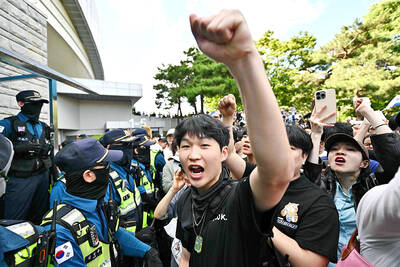
‘ABSURD MISTAKE’: The election commission said that there had been a failure to anticipate turnout after 14 polling stations ran short of ballot papers South Korean riot police yesterday cleared protesters from a Seoul polling station after a 35-hour blockade sparked by a shortage of ballot papers during local elections earlier this week. Wednesday’s election was the first nationwide vote since South Korean President Lee Jae-myung took office following the ouster of Yoon Suk-yeol over his short-lived martial law declaration. Lee’s ruling Democratic Party swept most races, but failed to flip the crucial Seoul mayoral seat. The South Korean National Election Commission apologized, blaming a failure to anticipate turnout after 14 polling stations in Seoul ran short of ballot papers. Some polling stations stayed open until 10pm to

Australian researchers have trained lab-grown brain cells on a silicon computer chip to play the 1990s shooter game Doom and said they are just scratching the surface of what the neurons could be capable of doing. It is the science-fiction work of biotech boffins at Cortical Labs, who researched and developed the technology that harnesses the workings of the brain’s networking system. Each so-called “biological computer” contains about 200,000 living human brain cells, grown from stem cells that were harvested from blood donations. Having mastered the simple computer game Pong, where a paddle is moved up and down to send a ball

France experienced its hottest spring on record, the French weather service said on Tuesday, after an exceptional early heat wave that also broke highs for the season in England and Wales. Meteo-France said the average nationwide temperature over March to May was 13.8°C — about 1.7°C above the norm, and surpassing records set in 2011 and 2020. “The warmest spring since records began in 1900,” it said in a bulletin. All three months were warmer than average, but the onset of an “unprecedented heatwave” late last month pushed the mercury to highs typically seen at the height of the summer. “Our country had never


 RSS
RSS