


A rights lawyer helping villagers in southern China resolve a tense land dispute with the local government has been formally arrested, his attorney said yesterday.
Gao Zhisheng told reporters the law firm received notice this week from police that Guo Feixiong had been arrested on charges of "gathering crowds to disturb social order."
"All we know is that he's been formally arrested. ... We don't know when the trial will take place," said Gao, head of the Beijing-based Zhisheng Legal Office and Guo's employer.
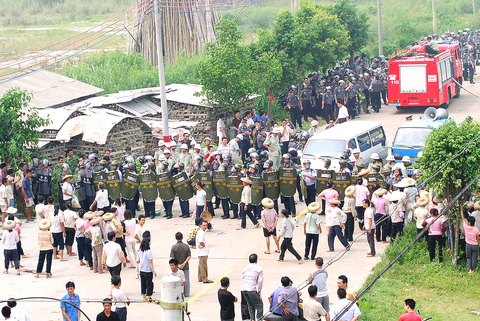
PHOTO: AP
Guo "disappeared" last month after he educated farmers at Taishi village in Guangdong Province in their ongoing battle to legally remove village head Chen Jinsheng, whom locals accuse of corrupt land practices.
Chen had allegedly sold villagers' land without their consent and pocketed some of the money.
Villagers told reporters yesterday numerous plainclothes police and uniformed guards have been posted in the village to monitor the activities of the villagers around the clock.
"They are guarding entrances to our village. They've also gone from door to door warning us not to cause trouble," said one woman who declined to be identified for fear of retribution. "People are afraid to speak to reporters."
Several previously outspoken villagers' mobile numbers have been switched off. Foreign reporters who tried to go to the village have been harassed.
Academics and lawyers around China view the case as a test of the central government's determination to fully implement laws on village democracy, something they had been promoting.
The case could have significant ramifications, especially given it involves China's richest province, as it could affect the widespread land redevelopment -- which often come with unfair seizure of land from the farmers -- going on in major cities.
Authorities may view any victory by the farmers to regain possession of the land Chen sold as having a negative impact, such as scaring away buyers and developers.
For weeks, civil affairs officials from the provincial capital Guangzhou's Panyu district refused to accept a petition to remove Chen and repeatedly sent police to detain villagers and break up peaceful protests.

‘CROSSING THE LINE’: China’s embassy in Seoul criticized US Forces Korea Commander General Xavier Brunson, asking if his ‘hostile’ remarks were authorized by Washington South Korea and the US are in talks over recent public remarks by the commander of US Forces Korea, Seoul’s presidential office said yesterday, after the comments drew sharp criticism from China. In a recent podcast interview, US Forces Korea Commander General Xavier Brunson described South Korea as “the dagger in the heart of Asia” from China’s east coast, prompting the Chinese embassy in Seoul to say that he had “truly crossed the line.” The interview came amid growing speculation that Washington might seek to expand the role of US Forces Korea in countering the growing regional influence of China, a key

Through the noise of rushing papers and whirring belts at a print factory in Kyoto, two creators watch their photo essay come to life in broadsheet form — part of an effort to win new audiences in the age of artificial intelligence (AI). Despite the decline of the publishing industry, self-publication and handmade “zine” magazines are growing in popularity in Japan, reflecting the nation’s enduring love of paper in the digital era. While speaking to Agence France-Presse at the plant, his hands black with ink, one of the creators, Kazuma Obara, said: “I think [paper] is a medium that engages all five

Australian researchers have trained lab-grown brain cells on a silicon computer chip to play the 1990s shooter game Doom and said they are just scratching the surface of what the neurons could be capable of doing. It is the science-fiction work of biotech boffins at Cortical Labs, who researched and developed the technology that harnesses the workings of the brain’s networking system. Each so-called “biological computer” contains about 200,000 living human brain cells, grown from stem cells that were harvested from blood donations. Having mastered the simple computer game Pong, where a paddle is moved up and down to send a ball

France experienced its hottest spring on record, the French weather service said on Tuesday, after an exceptional early heat wave that also broke highs for the season in England and Wales. Meteo-France said the average nationwide temperature over March to May was 13.8°C — about 1.7°C above the norm, and surpassing records set in 2011 and 2020. “The warmest spring since records began in 1900,” it said in a bulletin. All three months were warmer than average, but the onset of an “unprecedented heatwave” late last month pushed the mercury to highs typically seen at the height of the summer. “Our country had never


 RSS
RSS