

Diplomats working on a pivotal document on the management overhaul of the UN and updated approaches to terrorism, development and human rights have locked horns just days before it is to be presented to more than 170 world leaders for their endorsement.
Deep divisions persist despite crisis talks involving 32 ambassadors chosen to try to reach consensus, and there is looming embarrassment for the UN in having another failure on the heels of this week's report by the commission investigating the Iraqi oil-for-food program. The report, by a commission led by Paul Volcker, a former US Federal Reserve chairman, called for the kind of fundamental changes that the document puts forward.
Exposure
Once imagined as a visionary statement of the most far-reaching changes since the UN was created in San Francisco 60 years ago, the document instead is exposing the debilitating internal conflicts that often doom the organization to inaction.
"Trying to reach the ambitions we had for it back in January as San Francisco II has rapidly become unrealistic," Mark Malloch Brown, Secretary-General Kofi Annan's chief of staff, said in an interview on Friday.
"Now people are crimping it out of shape; they're emptying it of a lot of content," he said. "If this is just brinkmanship, we can still pull it out, but if not, my deepest fear is that we'll end up with a summit of empty words and broken promises."
That would be a great setback for Annan, who first proposed the changes, and whose future is increasingly being tied to whatever success he can have with pushing them forward.
Senator Norm Coleman, who has repeatedly called for Annan's resignation because of the oil-for-food scandal, came to the UN on Friday to reiterate it.
"The secretary-general is in no position to let that reform happen," he said. "If the guy leading the charge is stained with a record of incompetence, of mismanagement, of fraud, it's going to make it very hard for him to do the very heavy lifting required."
Rejection
Representative Tom Lantos rejected the notion, however, saying that Annan "is the first to recognize the need for the fiscal and administrative reforms at the institution that Congress has called for. Therefore, calls for him to step down are misguided and do him an injustice."
Stalling progress is a basic disagreement between nations that want to see more power vested in the office of the secretary general and the 15-member Security Council and others, from the developing world, who want to retain power in the 191-member General Assembly.
Abdallah Baali, Algeria's ambassador, said, "On management reform, you have one side basically saying that the secretary-general should be empowered and should have all flexibility as a kind of CEO and the other side saying that it is not ready to give up the prerogative of the General Assembly and would like to keep a close eye on the work of the secretary-general."
Also in dispute are measures to define terrorism as action against civilians that can never have any political justification, to enable the UN to take action in countries that don't protect their citizens from genocide.
A clash over development was defused on Tuesday when the US withdrew an earlier demand to eliminate all mention of the so-called millennium development goals and compromised on language covering the Kyoto Protocols on climate change and the goal of devoting 0.7 percent of gross national product to development aid.
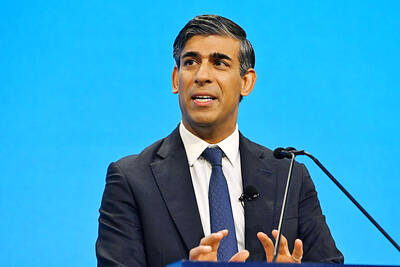
Former British prime minister Rishi Sunak on Wednesday urged so-called middle powers to become a “poisonous shrimp” to carve out strategic economic leverage in a more turbulent global environment. Sunak drew from a metaphor by former Singaporean prime minister Lee Kuan Yew (李光耀): A big fish will eat a smaller fish, and the smaller fish will eat the shrimp. Lee made the point a year after the Asian nation’s independence in 1966 that the city-state needed to build up its defense mechanisms — like a shrimp that stings — so it would be left alone by predators. “He was thinking about what Singapore’s

On his terrace overlooking the forest in eastern Pennsylvania, Ed Negra lays out four letters. All are from a developer promising a US$10,000 check to each household once its data center is running. “I call it a bribe,” the US retiree said. The scene is picture-perfect. Autumn leaves are turning russet, and there is a stunning mountain view in this corner of Pennsylvania, a key state in the US’ upcoming midterm elections. “We thought it was a beautiful place to retire,” said the septuagenarian, who used to manage a large building-supply store in neighboring New Jersey. He and his wife settled in a sprawling

A 16-year-old on Thursday shot his way through locked doors to get into an elementary school in Bend, Oregon, killing three children and a teacher. He was then shot by a person at the scene who followed him inside, authorities said. The suspect was found dead inside the school minutes after the shooting was first reported, Bend Police Chief Mike Krantz said. The three children killed were aged 5, 8 and 11. Another child, 7, and a teacher, 54, were injured and taken to the hospital in critical condition, he said. The first 911 call came just before 1pm from a person in

A University of Wyoming microbiology graduate student from China has been arrested on accusations she poisoned the tea of a colleague who had pending patents and with whom she did not get along, then tried to flee the country after police questioned her. Wang Aili, 32, was arrested on Tuesday last week at Los Angeles International Airport, where prosecutors allege she sought to return to China. With her were laptops, electronic storage devices and documents now in the possession of police, who allege Wang was seen on surveillance video rummaging through the desk of the victim who specialized in technology for disease


 RSS
RSS