


The British Foreign Office ordered the assassination in 1941 of one of India's most prominent freedom fighters, Netaji Subhash Chandra Bose, according to documents presented by an Irish historian and reported by a television network yesterday.
Eunan O'Halpin, a professor at Trinity College in Dublin, said he found the documents at the Public Records Office in London and presented the information at a lecture on Sunday in Calcutta, one day before the 59th anniversary of India's independence from Britain, NDTV reported.
O'Halpin said the assassination was ordered on March 7, 1941, when Bose was in hiding in Kabul after escaping virtual house arrest in Calcutta. The order was reconfirmed in June.
The assassination was to have been attempted in Turkey, a country Bose was expected to pass through on his way to Germany, O'Halpin said.
However, Netaji never went to Turkey. He reached Berlin via Moscow.
"As far as I know, he was the only significant political leader in any colony fighting British colonization who was explicitly targeted for assassination," O'Halpin said of the man who set up the Indian National Army to fight the British and who coordinated with the Axis powers during World War II.
"Now the reason he was targeted is because of his intentions to not simply lead India out of the empire but to do it by force and in conjunction with the Axis," the professor added.
Bose went missing in 1945, and the disappearance of the man known popularly as "Netaji," which means "leader" in Hindi, remains a mystery.
There are varying theories, including one that says he died in a 1945 plane crash in Taiwan, but none have been confirmed and no body has been recovered. Probes into his disappearance have yet to reach a conclusion.
NDTV quoted Netaji's grandnephew and Harvard historian Sugata Bose as saying the documents were a "rare find." Netaji's family had briefed Indian Prime Minister Manmohan Singh about the revelations before making the documents public on the eve of India's Independence Day, NDTV said.
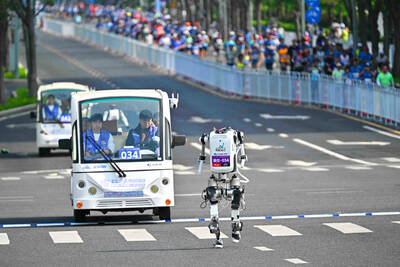
A humanoid robot that won a half-marathon race for robots in Beijing on Sunday ran faster than the human world record in a show of China’s technological leaps. The winner from Honor, a Chinese smartphone maker, completed the 21km race in 50 minutes and 26 seconds, said a WeChat post by the Beijing Economic-Technological Development Area, also known as Beijing E-Town, where the race began. That was faster than the human world record holder, Ugandan Jacob Kiplimo, who finished the same distance in about 57 minutes in March at the Lisbon road race. The performance by the robot marked a significant step forward
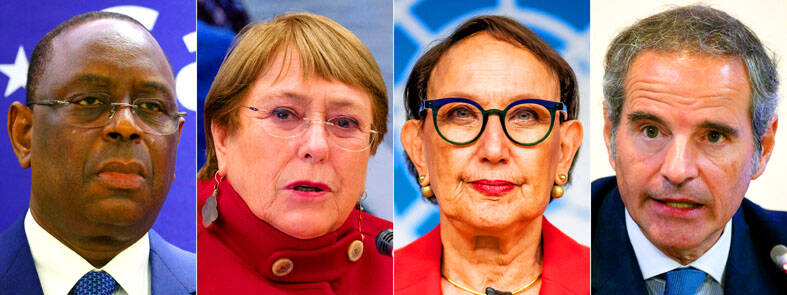
Four contenders are squaring up to succeed Antonio Guterres as secretary-general of the UN, which faces unprecedented global instability, wars and its own crushing budget crisis. Chile’s Michelle Bachelet, Argentina’s Rafael Grossi, Costa Rica’s Rebeca Grynspan and Senegal’s Macky Sall are each to face grillings by 193 member states and non-governmental organizations for three hours today and tomorrow. It is only the second time the UN has held a public question-and-answer, a format created in 2016 to boost transparency. Ultimately the five permanent members of the UN’s top body, the Security Council, hold the power, wielding vetoes over who leads the
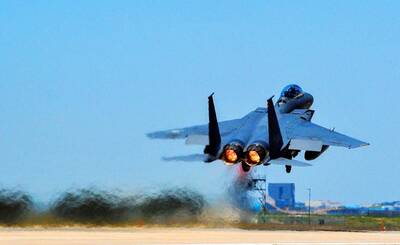
South Korea’s air force yesterday apologized for a 2021 midair collision involving two fighter jets, a day after auditors said the pilots were taking selfies and filming during the flight and held them responsible for the accident. “We sincerely apologize to the public for the concern caused by the accident that occurred in 2021,” an air force spokesman told a news conference, adding that one of the pilots involved had been suspended from flying duties, received severe disciplinary action and has since left the military. The apology followed a report released on Wednesday by the South Korean Board of Audit and Inspection,

An earthquake registering a preliminary magnitude of 7.7 off northern Japan on Monday prompted a short-lived tsunami alert and the advisory of a higher risk of a possible mega-quake for coastal areas there. The Cabinet Office and the Japan Meteorological Agency said there was a 1% chance for a mega-quake, compared to a 0.1% chance during normal times, in the next week or so following the powerful quake near the Chishima and Japan trenches. Officials said the advisory was not a quake prediction but urged residents in 182 towns along the northeastern coasts to raise their preparedness while continuing their daily lives. Prime


 RSS
RSS