


US regulations that make it easier for law enforcers to tap Internet phone calls also will make computer systems more vulnerable to hackers, digital privacy and civil liberties groups say.
While the groups don't want the Internet to be a haven for terrorists and criminals, they complain that expanding wiretapping laws to cover Internet calls, or Voice over Internet Protocol (VoIP), will create additional points of attack and security holes that hackers can exploit.
"Once you enable third-party access to Internet-based communication, you create a vulnerability that didn't previously exist" Marc Rotenberg, executive director at the Electronic Privacy Information Center, said in an interview on Wednesday. "It will put at risk the stability and security of the Internet."
Acting on appeals from the US Department of Justice and other law-enforcement officials, the Federal Communications Commission (FCC) voted last week to require providers of Internet phone calls and broadband services to ensure their equipment can allow police wiretaps.
The decision applies to VoIP providers and to cable and phone companies that provide broadband services. The companies will have 18 months to comply with the FCC's order.
"We recognize that people use different methods for communication, and certainly most of the time the people are using the method that they can avoid detection most,"said FBI spokesman Ed Cogswell.
Besides objections about privacy and security, digital-rights experts worry that expansion of the wiretapping law will stifle innovation. They also argue that the FCC lacks the authority to order companies to make changes to their systems for wiretapping purposes.

PARLIAMENT CHAOS: Police forcibly removed Brazilian Deputy Glauber Braga after he called the legislation part of a ‘coup offensive’ and occupied the speaker’s chair Brazil’s lower house of Congress early yesterday approved a bill that could slash former Brazilian president Jair Bolsonaro’s prison sentence for plotting a coup, after efforts by a lawmaker to disrupt the proceedings sparked chaos in parliament. Bolsonaro has been serving a 27-year term since last month after his conviction for a scheme to stop Brazilian President Luiz Inacio Lula da Silva from taking office after the 2022 election. Lawmakers had been discussing a bill that would significantly reduce sentences for several crimes, including attempting a coup d’etat — opening up the prospect that Bolsonaro, 70, could have his sentence cut to
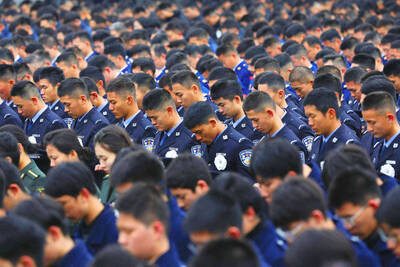
China yesterday held a low-key memorial ceremony for the 1937 Nanjing Massacre, with Chinese President Xi Jinping (習近平) not attending, despite a diplomatic crisis between Beijing and Tokyo over Taiwan. Beijing has raged at Tokyo since Japanese Prime Minister Sanae Takaichi last month said that a hypothetical Chinese attack on Taiwan could trigger a military response from Japan. China and Japan have long sparred over their painful history. China consistently reminds its people of the 1937 Nanjing Massacre, in which it says Japanese troops killed 300,000 people in what was then its capital. A post-World War II Allied tribunal put the death toll

‘UNWAVERING ALLIANCE’: The US Department of State said that China’s actions during military drills with Russia were not conducive to regional peace and stability The US on Tuesday criticized China over alleged radar deployments against Japanese military aircraft during a training exercise last week, while Tokyo and Seoul yesterday scrambled jets after Chinese and Russian military aircraft conducted joint patrols near the two countries. The incidents came after Japanese Prime Minister Sanae Takaichi triggered a dispute with Beijing last month with her remarks on how Tokyo might react to a hypothetical Chinese attack on Taiwan. “China’s actions are not conducive to regional peace and stability,” a US Department of State spokesperson said late on Tuesday, referring to the radar incident. “The US-Japan alliance is stronger and more
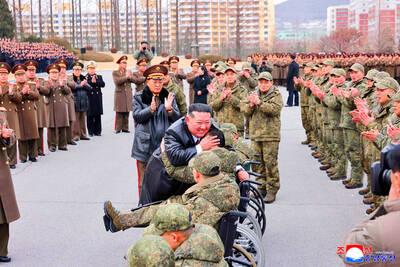
FALLEN: The nine soldiers who were killed while carrying out combat and engineering tasks in Russia were given the title of Hero of the Democratic People’s Republic of Korea North Korean leader Kim Jong-un attended a welcoming ceremony for an army engineering unit that had returned home after carrying out duties in Russia, North Korean state media KCNA reported on Saturday. In a speech carried by KCNA, Kim praised officers and soldiers of the 528th Regiment of Engineers of the Korean People’s Army (KPA) for “heroic” conduct and “mass heroism” in fulfilling orders issued by the ruling Workers’ Party of Korea during a 120-day overseas deployment. Video footage released by North Korea showed uniformed soldiers disembarking from an aircraft, Kim hugging a soldier seated in a wheelchair, and soldiers and officials


 RSS
RSS