


Almost 25,000 Iraqi civilians were killed in the two years since the US-led invasion of the country, most of them during the actual war, according to a report released Tuesday that is sure to stir debate.
The report, by a London-based group called Iraq Body Count, is a statistical tally of civilian deaths reported in the news media. In all, the researchers counted 24,865 civilians killed since the invasion of Iraq began in March 2003, almost half of them in Baghdad alone, with another major portion in Fallujah.
There is no definitive account of how many civilians have died in Iraq, and the issue has long been contentious. Antiwar campaigners contend that the Bush administration and the Pentagon have deliberately avoided body counts so as to minimize the toll on Iraqis, while supporters of the war question the accuracy of the counts.
Partly as a result, tallies of the Iraqi dead -- which have ranged as high as 100,000 in one study, published in October in the Lancet, the British medical journal -- have not been compiled systematically.
Michael O'Hanlon, a senior fellow in foreign policy studies at the Brookings Institution who compiles a statistical abstract of Iraq to track its progress, or lack of it, under the occupation, said the Iraq Body Count figures were within the realm of reason.
"We've used their data before," he said. "It's probably not too far off, and it's certainly a more serious work than the Lancet report."
According to the new report, US fire accounted for the greatest loss of life in Iraq, about 9,270 civilians, or 37.3 percent of the total. There are no estimates by the US government of civilian deaths at the hands of the military. Most of those fatalities came during the war, the report stated. The crime wave that has overcome Iraq since former president Saddam Hussein's government fell was the second leading cause of death, accounting for almost 35.9 percent of the deaths, or 8,935, the report said.
In comparison, insurgent attacks targeting US-led multinational forces caused only 9.5 percent of the deaths, or 2,353 while attacks by terrorists, whom the authors call "unknown agents," amounted to 11.0 percent of the civilian dead, or 2,731, the report said. It is not clear how the report differentiated between insurgents and terrorists. Iraq Body Count's calculations show the death toll from such violence continuing to rise.
The figures were compiled from more than 10,000 news media reports of civilian deaths. The deaths were painstakingly cross-referenced and reconfirmed across various news media, researchers said. They asserted that the results offered the first full picture of the civilian death toll in the country, down to the number of deaths caused by various weapons.
"We are contributing to the picture of what has happened in Iraq, but we are also showing that a lot is already known," said Hamit Dardagan, a founder of Iraq Body Count and author of the report. "This shows that we don't have to wait to tally up every single death; we can look at the data that's available now."
For example, the researchers say that civilian deaths recorded in the second year of the occupation were almost twice as high as they were in the first year. Over half of all civilian deaths involved explosive devices, with air strikes during the war causing most of those deaths. Children were disproportionately affected by explosive devices, most severely by air strikes and unexploded ordnance like cluster bombs.
"This study says that Iraqis have basically accepted becoming the most violent country in the Middle East as a price for becoming the most democratic," he said.

The Burmese junta has said that detained former leader Aung San Suu Kyi is “in good health,” a day after her son said he has received little information about the 80-year-old’s condition and fears she could die without him knowing. In an interview in Tokyo earlier this week, Kim Aris said he had not heard from his mother in years and believes she is being held incommunicado in the capital, Naypyidaw. Aung San Suu Kyi, a Nobel Peace Prize laureate, was detained after a 2021 military coup that ousted her elected civilian government and sparked a civil war. She is serving a
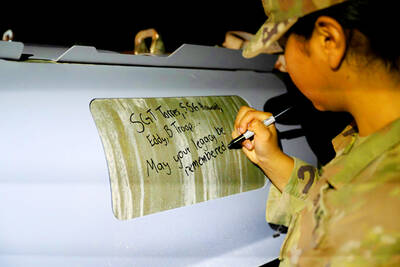
REVENGE: Trump said he had the support of the Syrian government for the strikes, which took place in response to an Islamic State attack on US soldiers last week The US launched large-scale airstrikes on more than 70 targets across Syria, the Pentagon said on Friday, fulfilling US President Donald Trump’s vow to strike back after the killing of two US soldiers. “This is not the beginning of a war — it is a declaration of vengeance,” US Secretary of Defense Pete Hegseth wrote on social media. “Today, we hunted and we killed our enemies. Lots of them. And we will continue.” The US Central Command said that fighter jets, attack helicopters and artillery targeted ISIS infrastructure and weapon sites. “All terrorists who are evil enough to attack Americans are hereby warned
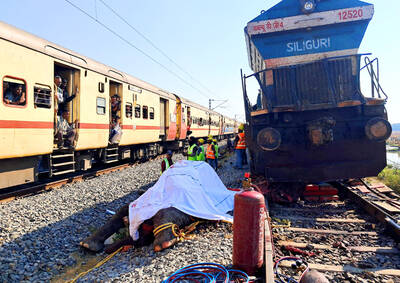
Seven wild Asiatic elephants were killed and a calf was injured when a high-speed passenger train collided with a herd crossing the tracks in India’s northeastern state of Assam early yesterday, local authorities said. The train driver spotted the herd of about 100 elephants and used the emergency brakes, but the train still hit some of the animals, Indian Railways spokesman Kapinjal Kishore Sharma told reporters. Five train coaches and the engine derailed following the impact, but there were no human casualties, Sharma said. Veterinarians carried out autopsies on the dead elephants, which were to be buried later in the day. The accident site
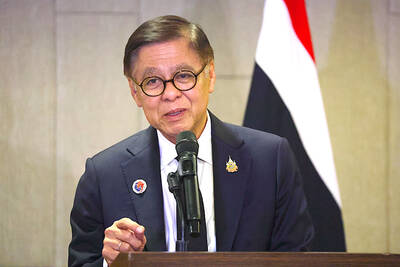
RUSHED: The US pushed for the October deal to be ready for a ceremony with Trump, but sometimes it takes time to create an agreement that can hold, a Thai official said Defense officials from Thailand and Cambodia are to meet tomorrow to discuss the possibility of resuming a ceasefire between the two countries, Thailand’s top diplomat said yesterday, as border fighting entered a third week. A ceasefire agreement in October was rushed to ensure it could be witnessed by US President Donald Trump and lacked sufficient details to ensure the deal to end the armed conflict would hold, Thai Minister of Foreign Affairs Sihasak Phuangketkeow said after an ASEAN foreign ministers’ meeting in Kuala Lumpur. The two countries agreed to hold talks using their General Border Committee, an established bilateral mechanism, with Thailand


 RSS
RSS