


The Islamic Hamas and the Palestinians' ruling Fatah party agreed early yesterday to end their recent round of armed clashes, which have taken place against the backdrop of Israel's planned Gaza Strip withdrawal.
Hours later, however, Hamas opened fire on the home of a top Palestinian security chief.
The clashes, coming as Israeli police confront their own opposition over the withdrawal, began last Friday, when two Palestinian teens were killed in a gunbattle. On Tuesday, the unrest led to Hamas offices torched by arsonists, wrecked cars and casualties on both sides.
Leaders of the two movements announced the accord at a news conference after midnight in Gaza City.
"We agreed to withdraw all armed forces from the streets of northern Gaza," local Hamas leader Mizar Rayyan said.
Barely two hours later, Hamas gunmen refused to stop at a Palestinian police roadblock in Gaza, and then opened fire on the homes of Palestinian police chief, Rashid Abu Shbak, and Fatah leader Abdullah Efrangi, said Soufian Abu Zaida, a Cabinet minister and top Fatah official.
Abu Zaida played down the incident, however, saying the situation was under control.
The tension is related to Palestinian rocket and mortar barrages against Israeli settlements in Gaza and towns just outside the territory, a month before Israel's scheduled pullout. Palestinian leader Mahmoud Abbas wants to coordinate the pullout with Israel, while the militants prefer to step up attacks and claim credit for driving the Israelis out by force.
About 20km away in Israel, police were surrounding a farming village where several thousand Israeli opponents of the Gaza pullout were camping out for a second night, hoping to march on Gaza and reinforce settlers who plan to resist evacuation.
Police declared the gathering illegal but made no move to break it up, while insisting they would not allow the protesters into Gaza itself.
With control of Gaza after the pullout at stake, Abbas is trying to contain increasingly defiant Islamic militants.
Fatah unofficially asked its affiliated militant group, the Al Aqsa Martyrs' Brigade, to help fight Hamas as Abbas seeks to ensure a smooth Israeli pullout from Gaza settlements, Fatah and Al Aqsa members said.
Abbas said in Gaza on Monday that he still preferred negotiations to temper militants' behavior, but he has recently begun using force, keenly aware of Hamas' growing power after it won a series of regional elections.

SPEAKING OUT: After Siranudh Scott’s allegations surfaced, celebrities and public figures took to social media to share their own experiences of sexual misconduct and abuse A high-profile alleged sexual abuse case within a wealthy Thai beer brewing family has prompted a wave of painful accounts from survivors of unconnected abuse in the conservative nation. Siranudh Scott, a member of the billionaire Thai family that founded the ubiquitous Singha beer brand, posted an emotional video this month accusing his elder brother Sunit of repeatedly abusing him when he was a teenager. Sunit, who is in his 30s, later denied the allegations in a video posted online, but Singha parent Boonrawd dismissed him from his executive role with the company on Tuesday last week. “I felt I needed to speak

SEEKING ORDER: Rodrigo Paz said that ‘anyone who wants to destroy the nation will have to deal with this president and the full force of the constitution’ Bolivian President Rodrigo Paz on Wednesday said that the nation was at a “breaking point” after nearly a month of protests that have caused shortages of food, fuel and medicine. Paz, who took office six months ago amid the worst economic crisis there in four decades, is battling a groundswell of fury over his policies. The political capital, La Paz, has been besieged by low-income workers and members of the indigenous majority calling for his resignation. “The country needs order and is reaching breaking point,” the 58-year-old said at a public event in La Paz, renewing his appeal for dialogue. On Tuesday, the Bolivian
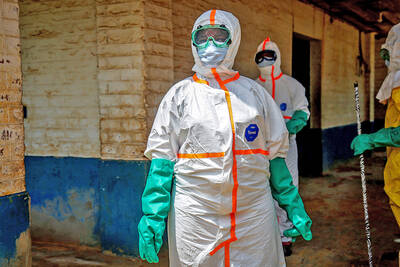
COMMUNITY CONFLICT: Concerns about disease spread from corpses has run up against friends and families’ desire to bury their dead as infection spreads in the area Angry residents of a town at the epicenter of the Ebola outbreak in the Democratic Republic of the Congo (DR Congo) attacked and burned a tent that was part of a health center where people are being treated for the virus, the staff there said Saturday. It was the second such attack in the region in a week. No one was hurt in the attack, according to reports but as patients ran out to escape the fire, 18 people with suspected Ebola infections fled the facility and are unaccounted for, a hospital director said. Angry residents arrived at the clinic in the

Forecasters in Europe yesterday warned of exceptional heat as record temperatures driven by a “heat dome” push temperatures well above seasonal norms across the continent. The surge follows a record-breaking Monday, with France logging its hottest day in the month of May on record, its weather agency said, and the UK also posting unprecedented highs. A so-called “heat dome” of warm air from northern Africa trapped under a high-pressure system over western Europe is behind the high temperatures not usually seen until high summer. Restrictions on outdoor work were imposed in parts of Italy, beaches in southwest France filled earlier than usual and


 RSS
RSS