


Renewing his attack on conservatives and the Bush administration, National Association for the Advancement of Colored People (NAACP) chairman Julian Bond accused national leaders of rolling back past civil rights gains, crippling efforts to battle racism and undermining democracy.
"The president likes to talk to the talk, but he doesn't walk the walk," Bond told members on Sunday at the annual convention of the NAACP, a civil rights group.
President George W. Bush has turned down five invitations to attend NAACP gatherings, including this year's, and Bond on Sunday invited Bush to the next one, in Washington.
"Mr. President, we're extending the invitation a year in advance," Bond said. "We want to see you and we want you to see us -- we want to know you think you're our president, too."
The NAACP has been battling an investigation by the Internal Revenue Service, which has said NAACP officials' political statements, mainly attacking the Bush administration, are partisan comments that violate the group's nonprofit status.
The Baltimore-based group also dealt this year with allegations that former president Kweisi Mfume granted workplace favors to an NAACP employee with whom he had a relationship, and it has struggled in recent years to raise money.
Its national board last month selected a new president, retired Verizon executive Bruce Gordon, who has pledged to raise an endowment and improve efficiencies in the organization. He is expected to be confirmed on Thursday.
The group's 96th convention, a six-day event, is being attended by more than 8,000 people, including 2,200 young adults.
Republican Representative James Sensenbrenner also spoke to the group on Sunday evening, saying he would help fight for reauthorization of the Voting Rights Act, portions of which are due to expire in 2007.
"The stakes have not been higher on this in the last 25 years," Sensenbrenner said.
Bond stressed the convention's theme, Conscience of a Nation, saying the NAACP has been a pivotal force in shaping the US and plans to continue doing so.
"There is not a single American -- black, white, male, female, Christian, Muslim or Jewish, straight or gay -- who is not a beneficiary of the work the NAACP did in the past or is doing today," Bond said.
But, he said, "the enemies of justice and fair play" are trying to "steal the just spoils of our righteous war."
He criticized Democrats who agreed recently to support conservative judicial nominees. And he pointed to conservative blacks and some black churches that receive federal funding and promote conservative causes.
Earlier on Sunday, civil rights advocates and other NAACP officials echoed those sentiments, saying blurring the lines between religious groups and politics threatens equal opportunity.
Democratic Representative Bobby Scott said religious groups that receive federal funding for social programs are increasingly hostile to program participants who disagree with their views on social issues.
"When you allow discrimination based on religion in federal programs, you lose all your moral authority to enforce civil rights legislation," Scott said.


Showcasing phallus-shaped portable shrines and pink penis candies, Japan’s annual fertility festival yesterday teemed with tourists, couples and families elated by its open display of sex. The spring Kanamara Matsuri near Tokyo features colorfully dressed worshipers carrying a trio of giant phallic-shaped objects as they parade through the street with glee. The festival, as legend has it, honors a local blacksmith in the Edo Period (1603-1868) who forged an iron dildo to break the teeth of a sharp-toothed demon inhabiting a woman’s vagina that had been castrating young men on their wedding nights. A 1m black steel phallus sits in the courtyard of

JAN. 1 CLAUSE: As military service is voluntary, applications for permission to stay abroad for over three months for men up to age 45 must, in principle, be granted A little-noticed clause in sweeping changes to Germany’s military service policy has triggered an uproar after it emerged that the law requires men aged up to 45 to get permission from the armed forces before any significant stay abroad, even in peacetime. The legislation, which went into effect on Jan. 1 aims to bolster the military and demands all 18-year-old men fill out a questionnaire to gauge their suitability to serve in the armed forces, but stops short of conscription. If the “modernized” model fails to pull in enough recruits, parliament will be compelled to discuss the reintroduction of compulsory service, German
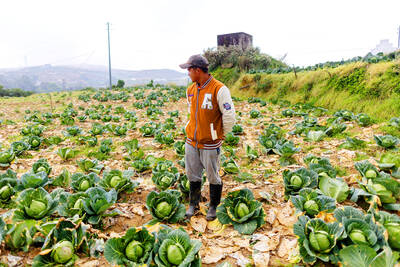
Filipino farmers like Romeo Wagayan have been left with little choice but to let their vegetables rot in the field rather than sell them at a loss, as rising oil prices linked to the Iran war drive up the cost of harvesting, labor and transport. “There’s nothing we can do,” said Wagayan, a 57-year old vegetable farmer in the northern Philippine province of Benguet. “If we harvest it, our losses only increase because of labor, transportation and packing costs. We don’t earn anything from it. That’s why we decided not to harvest at all,” he said. Soaring costs caused by the Middle East

Hungarian Prime Minister Viktor Orban’s officially declared wealth is fairly modest: some savings and a jointly owned villa in Budapest. However, voters in what Transparency International deems the EU’s most corrupt country believe otherwise — and they might make Orban pay in a general election this Sunday that could spell an end to his 16-year rule. The wealth amassed by Orban’s inner circle is fueling the increasingly palpable frustration of a population grappling with sluggish growth, high inflation and worsening public services. “The government’s communication machine worked well as long as our economic situation remained relatively good,” said Zoltan Ranschburg, a political analyst


 RSS
RSS