


Voters in Luxembourg briefly revived the European constitution on Sunday when they strongly endorsed the measure weeks after emphatic "no" votes in France and Holland.
Jean-Claude Juncker, the Luxembourg prime minister who had threatened to resign if the Grand Duchy had voted the same way, emerged triumphant after the constitution was approved by 56.52 percent to 43.48 percent.
As an arch-federalist, Juncker immediately attempted to use the results to keep the debate alive.
"If Luxembourg had said `no' the constitution would have been dead," he declared on Sunday night.
As Luxembourg has said "yes" the process can go ahead. There is a way for the European constitution to be adopted.
"If Luxembourg had said `no,' Europe would have been in an ultra-serious crisis. Now that Luxembourg has voted `yes,' Europe is still in crisis, but there is a silver lining," he said.
The Luxembourg prime minister earlier concluded that French and Dutch "no" votes were not a rejection of the constitution but were motivated by other concerns. On Sunday he appeared to suggest that only Luxembourg has a veto.
However, Jose Manuel Barroso, the president of the European Commission, offered Juncker some hope Sunday night when he hailed the vote as "a strong signal" that most European countries support the constitution.
Every other EU member to have approved the constitution has relied on a parliamentary vote, except for Spain. Barroso balanced his upbeat language by admitting that the future of the constitution is "uncertain."
Choosing his words carefully German Chancellor Gerhard Schroder said: "It is an encouragement and invitation to all Europeans to seek joint ways of quickly overcoming the current crisis."
The remarks reflect the private view of many European leaders who believe it is all but impossible to see how the constitution can survive the double rejection by voters in France and the Netherlands on May 29 and June 1.

PHISHING: The con might appear convincing, as the scam e-mails can coincide with genuine messages from Apple saying you have run out of storage For a while you have been getting messages from Apple saying “your iCloud storage is full.” They say you have exceeded your storage plan, so documents are no longer being backed up, and photos you take are not being uploaded. You have been resisting Apple’s efforts to get you to pay a minimum of £0.99 (US$1.33) a month for more storage, but it seems that you cannot keep putting off the inevitable: You have received an e-mail which says your iCloud account has been blocked, and your photos and videos would be deleted very soon. To keep them you need
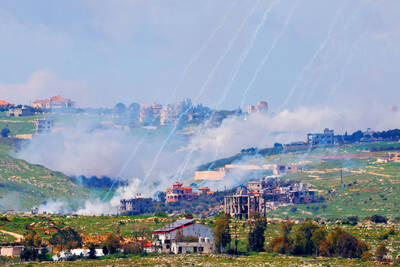
The Israeli military has demolished entire villages as part of its invasion of south Lebanon, rigging homes with explosives and razing them to the ground in massive remote detonations. The Guardian reviewed three videos posted by the Israeli military and on social media, which showed Israel carrying out mass detonations in the villages of Taybeh, Naqoura and Deir Seryan along the Israel-Lebanon border. Lebanese media has reported more mass detonations in other border villages, but satellite imagery was not readily available to verify these claims. The demolitions came after Israeli Minister of Defense Israel Katz called for the destruction of

A US YouTuber who caused outrage for filming himself kissing a statue commemorating Korean wartime sex slaves has been sentenced to six months in prison, a court in Seoul said yesterday. Johnny Somali, 25, gained notoriety several years ago for recording himself doing a series of provocative stunts in South Korea and Japan, and streaming them on platforms such as YouTube and Twitch. South Korean authorities indicted Somali — whose real name is Ramsey Khalid Ismael — in 2024 on public order violations and obstruction of business, and banned him from leaving the country. “The court has sentenced him to six months in
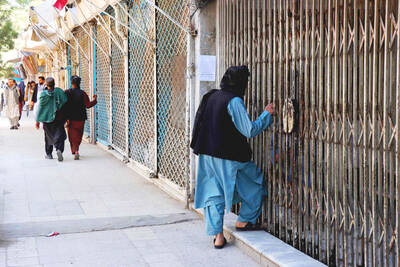
The death toll from a shooting in western Afghanistan rose to 11 on Saturday, after gunmen targeted civilians at a picnic spot in Herat, the provincial authority said. Bullet marks were visible on a wall of the Sayed Mohammad Agha Shia shrine, while bloodstains marked a blanket abandoned at the scene. “Eleven people have been recorded dead and eight others wounded from Friday’s incident, with the condition of two of the wounded reported as critical,” Herat’s information office said in a statement. The update raises a toll of seven killed provided on Friday by the Afghan Ministry of Interior Affairs


 RSS
RSS