

The US yesterday issued the latest in a series of security alerts warning its citizens in Indonesia of a possible threat by terrorists to attack hotels in Jakarta.
A message issued by the US embassy in the Indonesian capital said that it had learned of plans to strike at noon on an unspecified date, although the nature of the attack was not known.
"The embassy has learned that as of June 1, 2005, there were plans by extremists to conduct bomb attacks targeting the lobbies of hotels frequented by Westerners in Jakarta," it said.
Last week the US shuttered its embassy and diplomatic offices in Indonesia after an unspecified threat. The missions were reopened on Tuesday, although an advisory against unnecessary travel to Indonesia remains in place.
The US and other Western countries, including Australia and Britain, have issued frequent warnings about possible attacks in the world's largest Muslim-populated country.
Militants have carried out deadly bombings, including the October 2002 Bali bombings and deadly attacks on Jakarta's Marriott hotel and the city's Australian embassy.

A Chinese artificial intelligence (AI) cybersecurity tool called ARTEX was used in a spate of recent hacks of Japanese companies, the subsidiary of a major Tokyo-based Internet company yesterday. Dozens of Japanese companies, from restaurant chains to a car hire operator, have disclosed unauthorized access or data breaches in the past weeks — potentially impacting millions of customers. The information security arm of GMO Internet Group Inc said it had “confirmed ARTEX was used” having investigated the attacks in collaboration with external organizations. “It also became clear ... the attacks were almost exclusively targeting Japan,” GMO cybersecurity center director Daiki

China’s first fully artificial intelligence (AI)-generated feature film opened in cinemas yesterday in what promised to be a tough box-office test for the country’s booming tech industry as advance ticket sales lag. More than 10,000 screenings of the sci-fi thriller Sanxingdui: Future Past were scheduled yesterday, according to ticketing platform Maoyan. However, public reception has been less than enthusiastic. Presale revenue as of yesterday morning was 80,000 yuan (US$11,992), while total box-office takings were forecast to remain below 150,000 yuan, only a fraction of the reported production cost, Maoyan said. Ticket prices range from 20 to 90 yuan, bringing the number sold to a
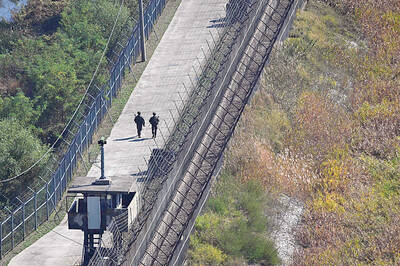
A STEP UP: The moving of small military positions forward should be taken seriously amid the North’s recent demonstrations of its firepower, an analyst said North Korea has moved new units into “firing positions,” the sister of leader Kim Jong-un said yesterday, days after Pyongyang warned it was considering deploying additional strike means to its border with South Korea. Tensions between Seoul and Pyongyang have soared since the South last month blamed an explosion inside the heavily fortified demilitarized zone (DMZ) separating the two countries on landmines laid by North Korea, an accusation it has rejected. “Our military leadership underlined the need to make those rogues aware that our new firepower units have taken their firing positions,” state media cited Kim Yo-jong as saying. Her statement came a
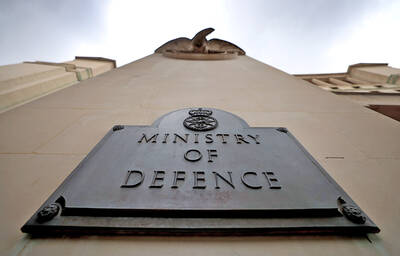
Thousands of British and French troops have taken part in a military training exercise that included one of Britain’s largest airborne operations in two decades, the British government said yesterday. The war game is designed to show how NATO countries could be defended against a modern-day attack and comes during fears about Russian aggression in Europe amid Moscow’s war against Ukraine. About 2,500 troops were involved in the seven-week exercise, in which 600 British and French paratroopers dropped from four RAF A400M Atlas transport aircraft over Germany. The exercise called Rhino Titan, held at the Sennelager military training center in


 RSS
RSS