

Afghan soldiers conducting a sweep in a mountain area south of the capital exchanged fierce fire with suspected Taliban rebels, killing eight and capturing 16 in some of the heaviest fighting in months, officials said yesterday.
Mohammed Zahir Azimi, a spokesman for the Afghan defense ministry, said US warplanes joined in the battle on Monday in the mountains of southern Zabul Province. A spokesman in the Zabul governor's office, Ali Khail, said Chechens and Arabs were among those killed and captured.
Khail also said the US military provided air support for the Afghan forces, and that some of the captured militants were turned over to US custody.
A spokeswoman for the US military, Lieutenant Cindy Moore, said that as of Monday night she had received no reports of fighting in the area involving US forces. The region is extremely remote, and there was no way to immediately reconcile the stories.
In another incident, suspected Taliban rebels ambushed a patrol of Afghan soldiers in Oruzgan Province, sparking a one-hour firefight, a senior official said.

Philippine Secretary of National Defense Gilberto Teodoro Jr on Tuesday hit out at China at an international forum after a memo asserting Beijing’s position over their longstanding maritime dispute was delivered to him while he was speaking on stage. The unusual incident was captured on video at the Seoul Defense Dialogue as the secretary was responding to a question about “gray zone” coercion in the South China Sea. The video shows what appears to be a conference staffer placing it on the table next to him while speaking. “I have a note here, I think this is from China,” he said, describing
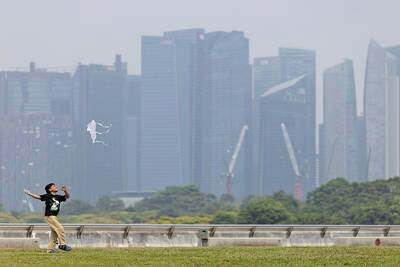
Singapore’s air quality hit an unhealthy level yesterday, as haze from forest fires raging in Indonesia continued to spread across swathes of Southeast Asia. The city-state is currently one of the 10 most-polluted major cities in the world, coming in at third in IQAir’s ranking. Kuching, in the Malaysian part of the island of Borneo, was No. 1. A government taskforce has “activated haze response plans” for schools, workplaces and community centers, Singaporean Minister for Sustainability and the Environment Grace Fu (傅海) said in a video message on Facebook. Most people could continue essential daily activities, but the elderly or vulnerable should

PAINSTAKING PROCESS: Ice makers freeze water for up to 72 hours, replace tainted water with a fresh batch once freezing begins, and are constantly stirring In the historic Japanese city of Kanazawa, craftsmen painstakingly shape and slice blocks of ice destined to chill negronis in some of the world’s trendiest bars. The men work for Kuramoto Ice, a century-old company in Ishikawa on the Sea of Japan coast and one of dozens of Japanese firms producing ultra-clear, premium ice. This luxury product, believed by those in the industry to melt more slowly than regular blocks, is a staple of Japan’s cocktail culture, but its popularity is also spilling over to bars abroad, from the US to Australia, who pay as much as ¥200 (US$1.28) per cube. Kuramoto Ice

COMMITMENT: China could view reduced US-Seoul exercises as an opportunity to reassert itself, but the US had reassured Manila of its resolve, the defense chief said China could see recent cuts to US-South Korean military exercises as an opportunity to reassert itself in the Indo-Pacific region, Philippine Secretary of Defense Gilberto Teodoro said yesterday, though he said Washington had assured Manila that its commitments to the Philippines remained unchanged. Speaking to Reuters on the sidelines of the Seoul Defense Dialogue, Teodoro said there had been no reduction in US-Philippine military activities, and that bilateral and multilateral cooperation involving Manila continued to expand. US President Donald Trump’s decision last month to scale back military exercises with South Korea has prompted debate among security analysts over the credibility of US


 RSS
RSS