


Under pressure from the opposition and the street, Lebanon's pro-Syrian prime minister Omar Karameh produced a spectacular surprise with the announcement of his government's resignation despite the certainty of victory in a vote of no-confidence.
Karameh resigned on Monday in the face of mass protests, bringing to a head a political crisis sparked by the murder two weeks ago of his predecessor Rafiq Hariri.
The announcement was greeted with loud applause in the national assembly in Beirut, where the opposition had been seeking a vote of no-confidence in Karameh's four-month-old government.
The surprise resignation occurred on the first day of a general debate in parliament demanded by the opposition and devoted to the assassination.
This is the second time since 1992 that 70-year-old Karameh has been forced to resign in the face of pressure from the streets.
On the first occasion he had to step down in the teeth of public discontent over social and economic problems.
This time round what is at stake is nothing less than the future of the Syrian army presence in Lebanon.
The withdrawal of the 14,000 Syrian troops on Lebanese soil is being demanded both by the opposition and by the international community at large. The demand has become greater and greater following the death of Hariri.
"The Damascus regime has collapsed in Beirut," said one observer.
The announcement of Karameh's resignation came as a surprise not only to parliamentary deputies, but above all to the pro-Syrian speaker of parliament Nabih Berri.
Visibly shaken, he said in public: "I might at least have been told in advance."
Surprise was also palpable at the presidential palace, where President Emile Lahoud accepted the resignation, requesting Karameh to expedite unfinished business.
Interior Minister Soleiman Frangie was prompted to remark that he felt glad about stepping down, "because we've shown we're democrats."
Only a few days previously Karameh had made his departure conditional on an alternative government being ready to take over to avoid a constitutional void.
The opposition last week called for a transitional government to prepare spring parliamentary elections and supervise the Syrian withdrawal. The elections must take place before the end of May, according to the constitution.
The opposition also called for continuing rallies on Martyrs' Square in Beirut pending the dismissal of security officials and the Syrian withdrawal.
Karameh justified his government's resignation on the grounds of considerations of moral order.
He said he did not wish to be an obstacle to what was considered by some to be the country's welfare, an allusion to street demonstrations and opposition anger over Hariri's death.
He said he had also ceded to the wishes of Hariri's sister, parliamentary deputy Bahia Hariri, who had called for the government's resignation as a matter of priority.
Karameh said he was submitting his resignation despite the assurance of surviving a vote of no-confidence.
Following applause in the assembly, the vast crowd outside on Martyrs' Square, now unofficially renamed Liberty Square, chanted exultantly: "Your turn will come Lahoud, yours too Bashar," a reference to Syrian President Bashar al-Assad.
Syria has not clearly announced its intentions yet, although both the US and the UN have urged it to withdraw its forces from Lebanon.
"Technically we can withdraw our troops before the end of the year," Assad said in an interview Monday with the Italian newspaper La Repubblica. "Strategically, that will happen only if we obtain serious guarantees. In other words -- peace."
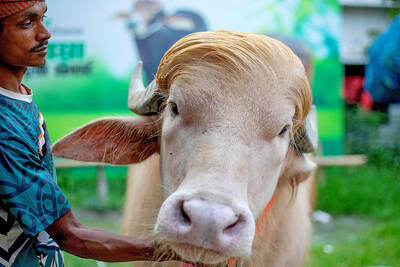
Crowds in Bangladesh are flocking to snap photographs with an unlikely social media star — an albino buffalo with flowing blond hair nicknamed “Donald Trump” that is due to be sacrificed within days. Owner Zia Uddin Mridha, 38, said his brother named the 700kg bull over its flowing helmet of hair resembling the signature look of the US president. “My younger brother picked this name because of the buffalo’s extraordinary hair,” he said at his farm in Narayanganj, just outside the capital, Dhaka. Mridha said that a constant stream of curious visitors — social media fans, onlookers and children — have come throughout

It began as a satirical online project. Now millions of young people in India are flocking to it as an outlet for their frustration. A parody political party called the Cockroach Janta Party, with the insect as its symbol, has exploded across India’s social media by turning absurdist humor into protest. Memes and short videos mocking corruption, joblessness and political dysfunction have flooded social media sites, where millions of users are embracing the cockroach — known for its ability to survive harsh conditions — as a tongue-in-cheek symbol of endurance. The online movement’s rise has been unusually rapid. The Cockroach Janta Party (CJP)
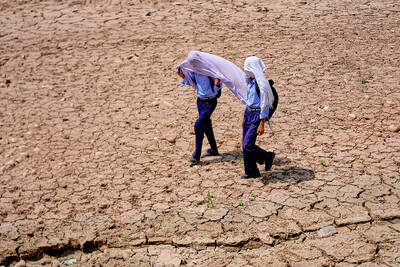
HOTTER: While Indians are accustomed to summer heat, climate change has caused northwestern India to warm faster than other parts of the country, an academic said Roads and markets have emptied during afternoons and some farmers have switched to nighttime work to avoid scorching temperatures as a heat wave grips large parts of India. The India Meteorological Department forecast maximum temperatures for yesterday of about 45°C in the capital, New Delhi, where authorities have opened temporary “cooling zones” to help people cope. The weather department warned that conditions would likely persist across several northern regions in the coming days, with temperatures staying well above seasonal averages. Authorities urged people to stay indoors during the hottest hours and take precautions against heat-related illnesses. India declares a heat wave whenever maximum temperatures
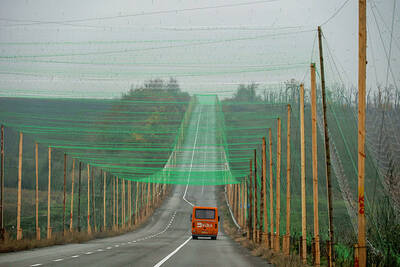
BIGGER ROLE: Beijing has said it maintains an impartial stance on the war in Ukraine, but by training Russian troops, China is far more involved than previously known China’s armed forces secretly trained about 200 Russian military personnel in China late last year, and some have since returned to fight in Ukraine, according to three European intelligence agencies and documents seen by Reuters. While China and Russia have held a number of joint military exercises since Moscow’s full-scale invasion of Ukraine in 2022, Beijing has repeatedly said that it is neutral in the conflict and presents itself as a peace mediator. The covert training sessions, which predominantly focused on the use of drones, were outlined in a dual-language Russian-Chinese agreement signed by senior Russian and Chinese officers in Beijing on


 RSS
RSS