


President Jacques Chirac on Thurs-day cautioned US President George W. Bush and British Prime Minister Tony Blair over their campaign for the democratization of the Middle East.
Chirac, in a speech in London during a two-day visit to Britain for celebrations marking the centenary of the Entente Cordiale Treaty, which laid the foundations for a permanent alliance between the two countries, said he supported reformers everywhere.
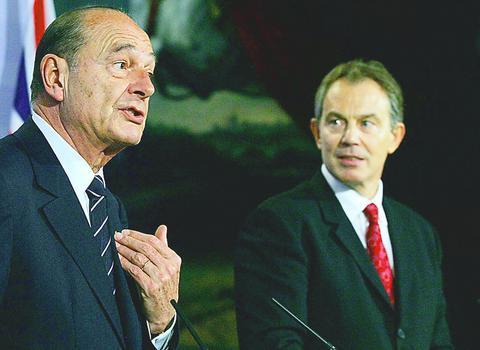
PHOTO: AP
"Yet we must avoid any confusion between democratization and Westernization," he said.
Israel is the only democracy in the Middle East and Bush has irritated Arab leaders with his campaign for a speedy introduction of democracy in their countries. France is the most pro-Arab country in Europe.
The French president warned Bush and Blair that "although our memory is sometimes short, the peoples submitted to the West's domination in the past have not forgotten and are quick to see a resurgence of imperialism and colonialism in our actions."
In the speech, Chirac reiterated his view that Europe should form a bloc as a counterbalance to the US. He called for the revival of multilateralism, mainly through the UN, rather than a world based on the "logic of power," namely the US.
Earlier, at a joint press conference, Chirac and Blair attempted to bury their differences 18 months after relations between France and Britain were strained by the Iraq war.
Although there is still a gulf between the two over Iraq, with France keen to see a timetable for the withdrawal of US, British and other troops, Chirac and Blair concentrated on areas of cooperation.
Chirac, who had two hours of talks with Blair, said Iraq was the "one and only issue" over which the two countries disagreed.
"Who is right or wrong, history will tell," he said.
Chirac reiterated his view that the invasion and continued occupation of Iraq has made the world more dangerous.
"If you observe the way things are developing in the world in terms of security and the expansion of terrorism -- not just in the Middle East but throughout the world -- if you look at all that, you cannot say, and be credible, that the situation has significantly improved," he said.
Before the war in Iraq beganlast year, the Blair government accused France of poisoning the debate in the UN and, at one point, deliberately distorted a statement by Chirac about using the French veto in the Security Council.
But at the press conference both men were in an emollient mood.
"On the question of Iraq, I think the differences at the time of the conflict were well known. But both of us are now working under UN Resolution 1546, both of us want to see a stable and democratic Iraq. And both of us will do what we can to ensure that that happens," Blair said.
Chirac said he had been taken aback at media suggestions in the press of divisions between France and Britain.
"They do not reflect either my own beliefs -- and certainly not the British government's -- or our experience of Franco-British cooperation," he said.
He and Blair said they shared the same analysis of what needed to be done in the Israeli-Palestinian conflict, and on Africa and climate change, and emphasized that British and French soldiers were working side by side in Afghanistan.
Chirac has been pushing Britain to align itself more closely with Europe. But on Thursday he said the close, almost family, relationship between the US and Britain was helpful.
"The fact that the UK can be a friendly partner between the European Union and the United States is advantageous for Europe," he said.

South Korea’s air force yesterday apologized for a 2021 midair collision involving two fighter jets, a day after auditors said the pilots were taking selfies and filming during the flight and held them responsible for the accident. “We sincerely apologize to the public for the concern caused by the accident that occurred in 2021,” an air force spokesman told a news conference, adding that one of the pilots involved had been suspended from flying duties, received severe disciplinary action and has since left the military. The apology followed a report released on Wednesday by the South Korean Board of Audit and Inspection,

Indonesian police have arrested 13 people after shocking images of alleged abuse against small children at a daycare center went viral, sparking outrage across the nation, officials said on Monday. Police on Friday last week raided Little Aresha, a daycare center in Yogyakarta on Java island, following a report from a former employee. CCTV footage circulating on social media showed children, most younger than two, lying on the floor wearing only diapers, their hands and feet bound with rags. The police have confirmed that the footage is authentic. Police said they also found 20 children crammed into a room just 3m by 3m. “So

About 240 Indians claiming descent from a Biblical tribe landed at Tel Aviv airport on Thursday as part of a government operation to relocate them to Israel. The newcomers passed under a balloon arch in blue and white, the colors of the Israeli flag, as dozens of well-wishers welcomed them with a traditional Jewish song. They were the first “bnei Menashe” (“sons of Manasseh”) to arrive in Israel since the government in November last year announced funding for the immigration of about 6,000 members of the community from the states of Manipur and Mizoram in northeast India. The community claims to descend from

‘TROUBLING’: The firing of Phelan, who was an adviser to a nonprofit that supported the defense of Taiwan, was another example of ‘dysfunction’ under Trump, a US senator said US Secretary of the Navy John Phelan has been fired, a US official and a person familiar with the matter said on Wednesday, in another wartime shakeup at the Pentagon coming just weeks after US Secretary of Defense Pete Hegseth ousted the Army’s top general. The Pentagon announced his departure in a brief statement, saying he was leaving the administration “effective immediately,” but it did not provide a reason or say whether it was his decision to go. The sources, who spoke on condition of anonymity, said Phelan was dismissed in part because he was moving too slowly to implement reforms to


 RSS
RSS