


Recent investigations into al-Qaeda, including those by the Sept. 11 commission, have substantially altered the commonly held view that Osama bin Laden's inheritance and massive fortune are being used to finance his international terror operations.
While bin Laden isn't poor, he's not worth the US$300 million once believed. Nor is he thought to be directly financing his terror group with his personal wealth or a network of businesses in Sudan, where he operated from 1991 to 1996.
"There has been a revision of collective thinking," said Kenneth Katzman, a Congressional Research Service expert who has studied terror groups. "The new thinking is that bin Laden's fortune didn't really enter into al-Qaeda that much, or wasn't the driving force in al-Qaeda."
The report from the Sept. 11 commission concluded that al-Qaeda has many financing avenues and could easily find new sources, particularly given the attack's price tag of just US$400,000 to US$500,000 over two years.
While the report said the government has been unable to determine the source of the attack's financing, the commission said it appears al-Qaeda's financial support doesn't come from bin Laden personally.
"The CIA now estimates that it cost al-Qaeda about US$30 million per year to sustain its activities before 9/11 and that this money was raised almost entirely through donations" the report said.
The belief that bin Laden was worth such staggering sums gathered steam shortly after the Sept. 11, 2001, attacks when Katzman released a report -- drawing on a 1996 State Department fact sheet, he said recently -- indicating that al-Qaeda was tapping bin Laden's US$300 million personal fortune, along with other sources.
By February 2002, Katzman had updated the estimate, indicating that bin Laden may be worth anywhere from US$50 million to US$300 million, but that the group had apparently become self-sustaining. The change got little notice.
Bin Laden was believed to have inherited money from his father, who oversaw the growth of a construction empire, making the bin Ladens one of the richest families in Saudi Arabia. The 17th of 52 children, bin Laden was thought primarily to be using the money to finance operations in Afghanistan and Sudan, as well as to help him secure his place as the leader of al-Qaeda.
The Sudanese businesses were believed to include an Islamic bank, an import-export firm, and operations that exported agricultural products. But the Sept. 11 commission said that the businesses did not provide significant income, and that when bin Laden left in 1996, it appears the Sudanese government took his assets.
"He left Sudan with practically nothing," the commission found. "When bin Laden arrived in Afghanistan, he relied on the Taliban until he was able to reinvigorate his fund-raising efforts by drawing on ties to wealthy Saudi individuals that he had established during the Afghan war in the 1980s."
Responding to an inquiry from a senate panel late last year, the US Treasury Department's Office of Foreign Assets Control said the overstated estimates about bin Laden's wealth and his financial backing of al-Qaeda actually trivialized the threat posed by his group.
Perhaps even more dangerous, bin Laden's benefit to radical Islam is that he -- "coming from a wealthy and influential family" -- was considered a trusted person and had the ability to receive and dispose of charitable money, the office wrote in a memo, obtained by reporters in April.
Bin Laden could then direct the money to support local institutions in many countries, in an attempt to radicalize those communities and give him a base to recruit and train.
Still, bin Laden is not thought to be poor. US officials found information in early 2000 indicating that from 1970 to 1994 bin Laden received US$1 million a year, the Sept. 11 commission found.
Bin Laden was effectively cut off from the money in a 1994 crackdown, the commission said, when the Saudi government revoked his citizenship, forced his family to find a buyer for his share of the company and later froze the proceeds of that sale. His family disavowed him.
However, in a recent interview, bin Laden's estranged sister-in-law said she does not believe that family members have cut him off entirely.
Carmen Binladin, who has changed the spelling of her name and lives in Switzerland, said bin Laden is not the only religious brother in the family, and she expects his sisters support him, too. "They are very close to Osama," she said.
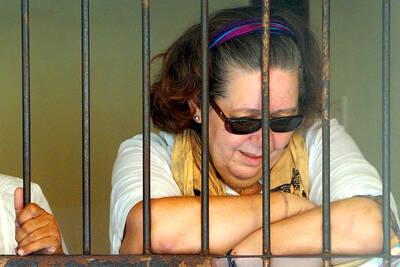
Indonesia was to sign an agreement to repatriate two British nationals, including a grandmother languishing on death row for drug-related crimes, an Indonesian government source said yesterday. “The practical arrangement will be signed today. The transfer will be done immediately after the technical side of the transfer is agreed,” the source said, identifying Lindsay Sandiford and 35-year-old Shahab Shahabadi as the people being transferred. Sandiford, a grandmother, was sentenced to death on the island of Bali in 2013 after she was convicted of trafficking drugs. Customs officers found cocaine worth an estimated US$2.14 million hidden in a false bottom in Sandiford’s suitcase when
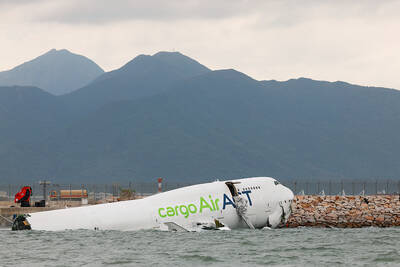
CAUSE UNKNOWN: Weather and runway conditions were suitable for flight operations at the time of the accident, and no distress signal was sent, authorities said A cargo aircraft skidded off the runway into the sea at Hong Kong International Airport early yesterday, killing two ground crew in a patrol car, in one of the worst accidents in the airport’s 27-year history. The incident occurred at about 3:50am, when the plane is suspected to have lost control upon landing, veering off the runway and crashing through a fence, the Airport Authority Hong Kong said. The jet hit a security patrol car on the perimeter road outside the runway zone, which then fell into the water, it said in a statement. The four crew members on the plane, which
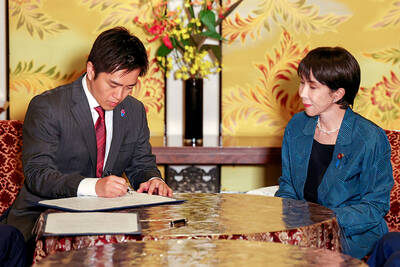
Japan’s ruling Liberal Democratic Party (LDP) and its junior partner yesterday signed a coalition deal, paving the way for Sanae Takaichi to become the nation’s first female prime minister. The 11th-hour agreement with the Japan Innovation Party (JIP) came just a day before the lower house was due to vote on Takaichi’s appointment as the fifth prime minister in as many years. If she wins, she will take office the same day. “I’m very much looking forward to working with you on efforts to make Japan’s economy stronger, and to reshape Japan as a country that can be responsible for future generations,”
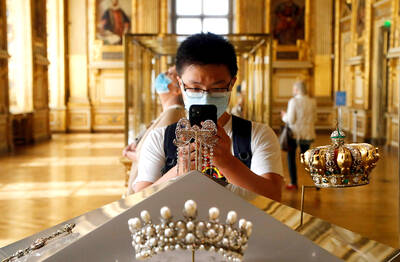
SEVEN-MINUTE HEIST: The masked thieves stole nine pieces of 19th-century jewelry, including a crown, which they dropped and damaged as they made their escape The hunt was on yesterday for the band of thieves who stole eight priceless royal pieces of jewelry from the Louvre Museum in the heart of Paris in broad daylight. Officials said a team of 60 investigators was working on the theory that the raid was planned and executed by an organized crime group. The heist reignited a row over a lack of security in France’s museums, with French Minister of Justice yesterday admitting to security flaws in protecting the Louvre. “What is certain is that we have failed, since people were able to park a furniture hoist in the middle of


 RSS
RSS