


German Chancellor Gerhard Schroder has adopted a Russian orphan, it was revealed on Tuesday.
Three-year-old Victoria, from St Petersburg, has been living at the Schroders' family home in Hanover in northern Germany for several weeks.
The chairman of Schroder's Social Democrat party, Franz Muentefering, confirmed the reports.
"I wish them all the best together," he told reporters.
A spokesperson for the Kremlin said Russian President Vladimir Putin had been informed of Schroder's intention to adopt a Russian child.
"The decision was made fully in line with Russian law based on the decision of a Russian court," a Kremlin source told the Russian news agency Interfax, adding that Doris Schroder-Kopf, the chancellor's wife, was present in court for the final decision. It has been an emotional month for Schroder, who turned 60 in April and is facing almost weekly street demonstrations against his attempts to reform the flagging German economy.
Last week he visited for the first time the grave of his father, who was a conscript in the Nazi army and was killed by Romanian villagers during World War II.
It is not clear when Victoria arrived at the Schroder's home. Neighbors say that Schroder-Kopf has been seen carrying the toddler in the garden for several weeks, according to the German daily Bild.
It appears that the whole Schroder family flew to Russia a few weeks ago to collect the toddler.
The addition to the family was such a closely guarded secret that the German secret service that provides Schroder's bodyguards was told "the Schroders will be four" just before arriving at the plane to fly them home, Bild reported.
Schroder's last official visit to Russia was on July 8, when he led a delegation of about 30 top German businessmen on a one-day trip to meet Putin.
Victoria is the couple's second child. Schroder-Kopf, a 41- year old former journalist and the chancellor's fourth wife, has a 13-year-old daughter, Klara, from a previous relationship.
A successful children's author, Schroder-Kopf has dedicated herself to promoting children's causes and published a book of essays explaining politics to young Germans, called The Chancellor Lives in the Swimming Pool.
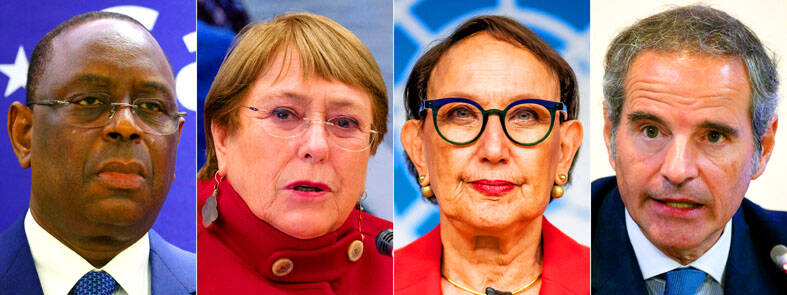
Four contenders are squaring up to succeed Antonio Guterres as secretary-general of the UN, which faces unprecedented global instability, wars and its own crushing budget crisis. Chile’s Michelle Bachelet, Argentina’s Rafael Grossi, Costa Rica’s Rebeca Grynspan and Senegal’s Macky Sall are each to face grillings by 193 member states and non-governmental organizations for three hours today and tomorrow. It is only the second time the UN has held a public question-and-answer, a format created in 2016 to boost transparency. Ultimately the five permanent members of the UN’s top body, the Security Council, hold the power, wielding vetoes over who leads the
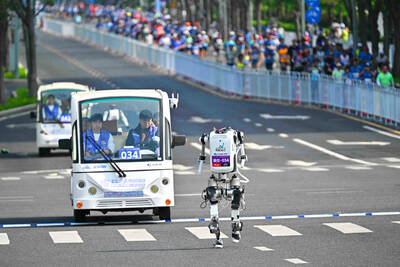
A humanoid robot that won a half-marathon race for robots in Beijing on Sunday ran faster than the human world record in a show of China’s technological leaps. The winner from Honor, a Chinese smartphone maker, completed the 21km race in 50 minutes and 26 seconds, said a WeChat post by the Beijing Economic-Technological Development Area, also known as Beijing E-Town, where the race began. That was faster than the human world record holder, Ugandan Jacob Kiplimo, who finished the same distance in about 57 minutes in March at the Lisbon road race. The performance by the robot marked a significant step forward

An earthquake registering a preliminary magnitude of 7.7 off northern Japan on Monday prompted a short-lived tsunami alert and the advisory of a higher risk of a possible mega-quake for coastal areas there. The Cabinet Office and the Japan Meteorological Agency said there was a 1% chance for a mega-quake, compared to a 0.1% chance during normal times, in the next week or so following the powerful quake near the Chishima and Japan trenches. Officials said the advisory was not a quake prediction but urged residents in 182 towns along the northeastern coasts to raise their preparedness while continuing their daily lives. Prime
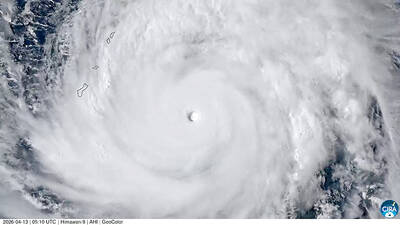
HAZARDOUS CONDITION: The typhoon’s sheer size, with winds extending 443km from its center, slowed down the ability of responders to help communities, an official said The US Coast Guard was searching for six people after losing contact with their disabled boat off the coast of Guam following Typhoon Sinlaku. The crew of the 44m dry cargo vessel, the US-registered Mariana, on Wednesday notified the coast guard that the boat had lost its starboard engine and needed assistance, Petty Officer 3rd Class Avery Tibbets said yesterday. The coast guard set up a one-hour communication schedule with the vessel, but lost contact on Thursday. A Coast Guard HC-130 Hercules aircraft was launched to search for the six people on board, but it had to return to Guam because of


 RSS
RSS