


Veteran print and radio journalist Juan Balagtas does not leave his home in the southern city of Zamboanga without a loaded gun.
He drives around in a heavily tinted van with a bodyguard as he heads to the local radio station, where his popular program attacking corrupt politicians and Islamic militants airs daily.
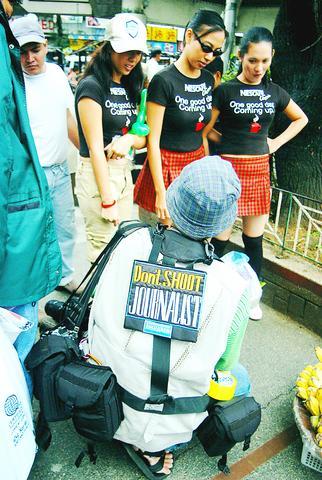
"I carry a .45-caliber pistol if I go out. It's difficult to move around when you know you have enemies," said Balagtas, who also writes for a Manila broadsheet.
Balagtas is not his real name, because he feared if he was identified, "I may not live tomorrow."
Zamboanga is a hotbed of Al-Qaeda-linked militants as well as political warlords who have private armies that are often better armed than the police and military.
Forty-five broadcast journalists have been gunned down in the Philippines since democracy was restored after the peaceful "People Power" revolt that ousted dictator Ferdinand Marcos in 1986.
Six reporters have been killed so far this year. The latest was broadcaster Fernando Consignado, whose body was found Thursday with a bullet wound to the head in his home south of Manila.
Just days earlier, radio journalist Jonathan Abayon was shot in the head by a former soldier following a heated argument in the southern city of General Santos.
Reporter and radio correspondent Arnel Manalo was killed by gunmen riding a motorcycle earlier this month, as was crusading radio commentator Rogelio Mariano on July 31. Other journalists were killed in February and June.
Police are probing whether the killings were work-related, and said they would ease restrictions on gun permits for journalists.
The move has triggered a heated debate in a country where a proliferation of unlicensed firearms is blamed for rising crime.
Balagtas said only bona-fide members of the press whose lives were in danger should be allowed to arm themselves.
"You don't really have to own a firearm if you're not under threat and you know you didn't do anything wrong," he said.
Three years ago, one of his colleagues was gunned down outside his home after allegedly angering a politician.
Balagtas himself had to lie low for months after receiving threats and being followed by a man the police had identified as a suspect in his friend's murder.
"I grew a beard, changed my appearance. I knew they were after me," Balagtas said. "I carried my pistol around, because I was also receiving threats I would be killed."
The suspect in his friend's killing remains at large, with the family failing to pursue the case in court since a witness was killed.
Jaime Laude, a newspaper journalist covering the police and military beats in Manila, also owns a handgun and has undergone rigid training in handling firearms.
"In this trade, especially when you cover the police and political beats, you are exposed to threats to your life. You do your work, and sometimes people get hurt," he said.
However, he said the responsibility of maintaining peace and order lay with the police.
"If you arm all the journalists, you might as well arm all civilians and disband the police and the military," Laude said.
Guns will not ensure safety against a "determined killer" and corrupt police officers, Laude said.
"It is a sad reflection on law enforcement when the best defense journalists are offered is advice to carry a weapon," the Committee to Protect Journalists Asia coordinator Abi Wright said.
"The problem with impunity remains paramount in the Philippines... That is the best defense for freedom of the press," she said.
ROCKY RELATIONS: The figures on residents come as Chinese tourist numbers drop following Beijing’s warnings to avoid traveling to Japan The number of Chinese residents in Japan has continued to rise, even as ties between the two countries have become increasingly fractious, data released on Friday showed. As of the end of December last year, the number of Chinese residents had increased by 6.5 percent from the previous year to 930,428. Chinese people accounted for 22.6 percent of all foreign residents in Japan, making them by far the largest group, Japanese Ministry of Justice data showed. Beijing has criticized Tokyo in increasingly strident terms since Japanese Prime Minister Sanae Takaichi last year suggested that a military conflict around Taiwan could

A pro-Iran hacking group claimed to breach FBI Director Kash Patel’s personal e-mail inbox and posted some of the contents online. The e-mails provided by the hacking group include travel details, correspondence with leasing agents in Washington and global entry, and loyalty account numbers. The e-mail address the hackers claim to have compromised has been previously tied to Patel’s personal details, and the leaked e-mails contain photos of Patel and others, in addition to correspondence with family members and colleagues. “The FBI is aware of malicious actors targeting Director Patel’s personal email information,” the agency said in a statement on

RIVALRY: ‘We know that these are merely symbolic investigations initiated by China, which is in fact the world’s most profligate disrupter of supply chains,’ a US official said China has started a pair of investigations into US trade practices, retaliating against similar probes by US President Donald Trump’s administration as the superpowers stake out positions before an expected presidential summit in May. The move, announced by the Chinese Ministry of Commerce on Friday, is a direct mirror of steps Trump took to revive his tariff agenda after the US Supreme Court last month struck down some of his duties. “China expresses its strong dissatisfaction and firm opposition to these actions,” a ministry spokesperson said in a statement, referring to the so-called Section 301 investigations initiated on March 11.

When a hiker fell from a 55m waterfall in wild New Zealand bush, rescuers were forced to evacuate the badly hurt woman without her dog, which could not be found. After strangers raised thousands of dollars for a search, border collie Molly was flown to safety by a helicopter pilot who was determined to reunite the pet and the owner. A week earlier, an emergency rescue helicopter found the woman with bruises and lacerations after a fall at a rocky spot at the waterfall on the South Island’s West Coast. She was airlifted on March 24, but they were forced to


 RSS
RSS