


■ China
Beijing on power alert
The government has issued a warning on power shortages in the capital, Beijing,
and urged residents and businesses to scale back electricity use, the China Daily said yesterday.
The Beijing Municipal Development and Reform Commission has issued a "yellow alert," suggesting
an expected power shortfall
of 300,000kw requiring local businesses and government offices to take action, the newspaper said. The move was the latest by energy-thirsty China to battle
its worst power crunch in
years that has been fueled by breakneck economic growth and scorching summer heat affecting swathes of the world's most populous nation.
■ China
Cash for keeping daughters
Rural families are being offered cash incentives
to stop aborting baby girls
and help correct the sex imbalance, the China Daily said yesterday. Under the "Care for Girls" pilot program, girls would be exempt from paying school fees, insurance would be given to households until their daughters
grow up and families with
just one daughter would
enjoy housing, employment, education and welfare privileges, the newspaper said. China has stringent rules on family planning, which allow couples usually to have just one child, at least in the cities, and limit numbers elsewhere.
■ China
Telephone kills boy
A 16-year-old boy was killed by lightning when he picked up the phone in his home
in Wuhan Province during a thunderstorm, a news report said yesterday. The teenager heard strange noises coming from his phone in the early hours of the morning at
his home last weekend and thought it was a caller trying to get through on a bad line. However, the noise was in fact a deadly build-up of static and when the schoolboy lifted the receiver a bolt of lightning shot down the phone line and killed him. Experts quoted
by the Hong Kong edition
of the China Daily said
the telephone line had been affected because his house was in a rural, exposed area.
■ Indonesia
Massacre general cleared
A court yesterday cleared the country's army special forces chief of charges of gross human-rights violations for his role in a 1984 military massacre in Jakarta. Major General Sriyanto Muntarsan, who heads the elite Kopassus military wing, had faced 10 years in jail if found guilty of involvement in the Tanjung Priok killings, named after the port area of the capital where they occurred. Prosecutors say 10 people were killed when troops opened fire on
a crowd of protesters without first firing warning shots. Human rights investigators say at least 24 people died and 24 were injured.
■ Australia
Huge ant colony found
A huge ant colony measuring 100km across has been found under the southern city of Melbourne, scientists said yesterday. Monash University researcher
Elissa Suhr said the super-colony of Argentine ants
was threatening native biodiversity in the country's second-largest city. Suhr said the introduced pest's natural aggression kept numbers under control in its native country, but the genetic make-up of the ants had mutated, allowing them
to cooperate to build the supercolony. Suhr said the Argentine ants killed native ants and the insect life
they normally preyed upon, posing a major threat to biodiversity. She said the ants were ranked among
the world's 100 worst animal invaders.
■ United Kingdom
Perps won't get winnings
Home Secretary David Blunkett said yesterday he plans to bar convicted felons from benefiting from financial windfalls while behind bars after a jailed rapist won ?7 million pounds (US$12.6 million) on the national lottery. Blunkett said that proposed legislation before parliament would force offenders who won the lottery or other wealthy criminals to contribute to a compensation fund for victims of crime. His comments follow public outrage in Britain over the lottery win of convicted rapist Iorworth Hoare, who was on day release from his low-security prison when he bought the winning ticket on Saturday.
■ Russia
UFO wreck claimed found
Russian scientists claim to have discovered the wreck of an alien device at the site of an unexplained explosion in Siberia almost a hundred years ago, the Interfax news agency reported late Wednesday. The scientists, who belong to the Tunguska space phenomenon public state fund, said they found the remains of an extra-terrestrial device that allegedly crashed near the Tunguska river in Siberia in 1908. They also claim to have discovered a 50kg rock which they have sent to the Siberian city of Krasnoyarsk for analysis.
■ Germany
Experts mull mobile ban
Aviation engineers are mulling whether to abolish a worldwide ban on using mobile phones aboard airliners, according to German business magazine Capital. It said experts at German flag carrier Lufthansa and the German Aerospace Centre DZLR were convinced wireless phones do not disrupt aviation electronic (avionic) systems. The ban was imposed out of fears that "fly-by-wire" planes might become uncontrollable. In tests, the experts had subjected all a Lufthansa jet's systems to signals 25 times as strong as those coming from a mobile, and found all systems operated normally.
■ United States
Monkey motivator found
Scientists in the US have found a gene treatment that they say turned lazy monkeys into monkeys that didn't procrastinate when they were given a task. The research was conducted at the National Institute of Mental Health (NIMH) near Washington, DC. The treatment temporarily suppresses a gene in a brain circuit involved in reward learning, the NIMH said. Without the gene, the monkeys lost their sense how much work must be accomplished in order to receive a reward. After about 10 weeks the treatment wore off, and the monkeys returned to being unmotivated.
■ United States
Vowels make you sexier
Scientists say the right name can make you sexier. Linguist Amy Perfors, of the Massachusetts Institute of Technology, posted photos of men and women on the US Web site "Hot or Not," which lets viewers rate pictures according to how attractive they find them. When she posted the same pictures with different names, she found that the attractiveness scores went up and down depending on the vowels, the London-based magazine New Scientist reported. Men with "front vowels" in their names -- sounds formed at the front of the mouth like the "a" in Matt -- were considered sexier than men with "back vowel" sounds like the "au" in Paul, she concluded.
■ United States
Dead man not CIA, US says
The person shown beheaded on an Islamist website was not an officer in the Central Intelligence Agency (CIA) as had been claimed by the militants in Iraq who posted a video of the execution on the internet, a US official said on Wednesday. The video shows a militant hacking a man's head off with a long knife with several blows before lifting the head in the air. The website claimed the individual was a CIA agent, and shows an identification badge around his neck with the word "visitor" printed on it. The CIA was evaluating the video to determine its authenticity, and all CIA personnel in Iraq had been accounted for, said the official, who spoke on condition of anonymity.
■ Colombia
Suspected rebels kill nine
Suspected Marxist rebels on Wednesday broke into a remote makeshift coca farm in northeast Colombia and massacred nine peasants before setting the place ablaze, officials and survivors said. A local councilman said the attack was carried out by Colombia's largest rebel group, the Revolutionary Armed Forces of Colombia, or FARC. He said the rebels likely suspected the peasants of working for right-wing paramilitary fighters. "They let some go and ordered the others to the floor and gunned them down," said Emilio Jimenez, a councilman from Pecheli, about 320 km northeast of Bogota.
■ United States
Thief skips jewels for food
A hungry burglar more interested in food than glittering jewelry broke into nearly a dozen Seattle homes in the last week to gobble down vast quantities of food before being arrested, police said on Wednesday. In one instance the ravenous burglar consumed six shrimp kebabs, a dozen mini corndogs, half a large package of lunch meat, a box of Creamsicles, a dozen clumps of frozen cookie dough, several handfuls of M&Ms, two fruit drinks and a glass of milk, according to Julie Sanchez, one of the burglary victims interviewed on local television. The man, in his late 20s, was not identified by police since he has not yet been charged with a crime.
■ Dominican Rep
Seven dead after boat drifts
At least seven people perished while 43 others remain missing and feared dead after a boat in which a group of migrants tried to reach Puerto Rico from the Dominican Republic ran out of fuel and began drifting in the open sea, officials said Wednesday. The boat that set out from the west coast of the country on July 29 remained adrift for nearly 12 days, during which many of the 79 people on board died of exposure or dehydration, or jumped in despair into the sea, survivors said. Only 36 were rescued Tuesday by the Dominican navy, but seven of them died hours later.
■ United States
Public defibrillators urged
Distributing portable defibrillators to restart a quivering heart -- and training the public to use them -- can double the survival rate for people who have collapsed from cardiac arrest, according to a massive North American study. Meanwhile, a second study released Wednesday concluded that rescue workers who try to save cardiac arrest patients by inserting a breathing tube and giving drugs may be wasting their time. The findings in the New England Journal of Medicine provide new impetus for making the 4.5 kg defibrillators widely available in health clubs, shopping malls and other places where lots of people go.
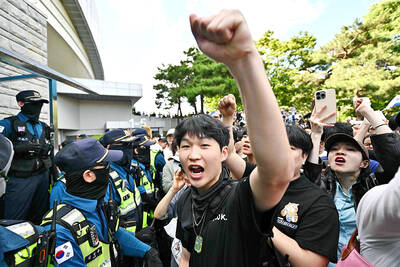
‘ABSURD MISTAKE’: The election commission said that there had been a failure to anticipate turnout after 14 polling stations ran short of ballot papers South Korean riot police yesterday cleared protesters from a Seoul polling station after a 35-hour blockade sparked by a shortage of ballot papers during local elections earlier this week. Wednesday’s election was the first nationwide vote since South Korean President Lee Jae-myung took office following the ouster of Yoon Suk-yeol over his short-lived martial law declaration. Lee’s ruling Democratic Party swept most races, but failed to flip the crucial Seoul mayoral seat. The South Korean National Election Commission apologized, blaming a failure to anticipate turnout after 14 polling stations in Seoul ran short of ballot papers. Some polling stations stayed open until 10pm to

France experienced its hottest spring on record, the French weather service said on Tuesday, after an exceptional early heat wave that also broke highs for the season in England and Wales. Meteo-France said the average nationwide temperature over March to May was 13.8°C — about 1.7°C above the norm, and surpassing records set in 2011 and 2020. “The warmest spring since records began in 1900,” it said in a bulletin. All three months were warmer than average, but the onset of an “unprecedented heatwave” late last month pushed the mercury to highs typically seen at the height of the summer. “Our country had never

A Sherpa guide was found crawling to base camp on Mount Everest a week after he went missing and was reunited with his family, who had given up hope he would return. Dawa Sherpa was last seen on Friday last week descending the mountain, but he did not reach base camp even though his client did. The pair were among the last climbers on the mountain as the climbing season came to an end and the route was dismantled. Dawa was located by a cleaning crew on Thursday morning as he was crawling down the snowy slopes around the Khumbu Icefall, just above
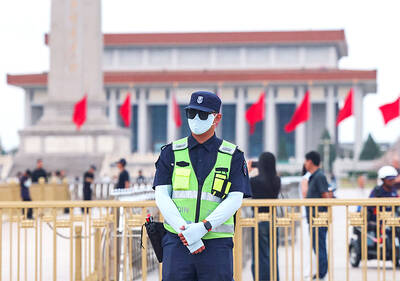
Chinese authorities are snuffing out any remembrance of the deadly 1989 military crackdown on student-led pro-democracy protests in Tiananmen Square, which happened 37 years ago yesterday, in a further tightening of a years-long campaign to erase what happened from public memory. Police told relatives of the victims they would not be allowed to visit a cemetery in Beijing on the anniversary of the crackdown, a person with knowledge of the matter said. Relatives of the victims visited the cemetery on the anniversary for more than 30 years to read memorial statements with police keeping watch, Amnesty International said. Hundreds of people,


 RSS
RSS