


Lying on a blue plastic sheet in a makeshift, crowded hospital ward, Riyadh Islam, 4, cries out for water.
His grandmother, who has been watching the dehydrated child toss and turn in discomfort for hours, quickly gives him a drink from a steel cup and murmurs comforting words.
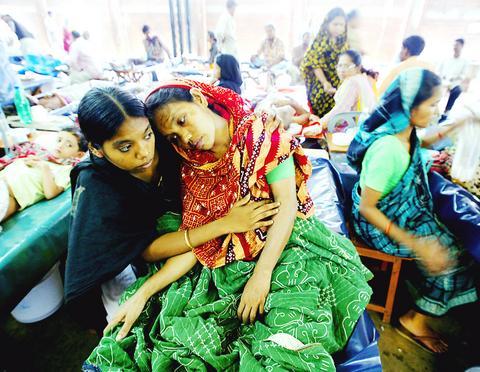
PHOTO: REUTERS
Islam, son of a motorized rickshaw driver, needs all the comfort he can get. He is one of tens of thousands of Bangladeshis suffering from severe diarrhea, the messy aftermath of the worst floods in this impoverished nation for 15 years.
Although the river levels have dropped in the past 10 days, the lack of clean drinking water in some waterlogged areas and the contamination of wells have led to a sharp spike in cases of waterborne diseases, particularly diarrhea.
Officials said yesterday that over 140,000 had fallen ill with diarrhea in the past four weeks and at least 70 had died. Most cases were reported this month as flood waters started to fall. Some newspapers put the death toll at around 150.
Across low-lying Bangladesh and eastern India, more than 1,720 people have died from drowning, snakebites and disease since the start of last month as annual monsoon rains caused rivers to overflow into densely populated areas.
In Bangladesh, the government has sent out more than 4,000 medical teams to contain the diarrhea outbreak and authorities said the situation was well under control.
But a visit to the International Center for Diarrheal Disease Re-search, Bangladesh -- famous for creating the Oral Rehydration Solution -- shows it is a tough battle.
Staff have used bamboo and tarpaulins to convert a parking lot and a reception area into temporary wards to deal with the rush.
Hundreds of diarrhea patients, mainly from teeming Dhaka slums particularly badly hit by the floods, lie on plastic sheets on rows of metal cots and wooden beds. Serious cases have saline drips attached to their hands.
More than half of the admissions are children.
Beds and sheets have a hole in them with a plastic funnel to take patients' waste to already partially filled buckets below. Liberal use of disinfectant cannot totally mask the fetid smell.
Lokman Hossain, a thin 6-year-old, looks scared as he lies with a saline needle stuck to his hand.
"He was in very bad condition for three days. His stool was like water and he is very weak," said Mohammad Firoz, a teenage cousin who is looking after him.
Asked how he is feeling, Hossain whispers: "I'm okay."
A tearful mother pleads with a harried nurse to attend to her semi-delirious child as more patients are wheeled in.
Research center spokesman Ishtiaque Zaman said the number of patients had soared since the beginning of the month as people in waterlogged areas with little or no sanitation started to fall ill.
"We have stopped research work and are just tending to patients," Zaman said.
With large areas of the country still submerged, the World Health Organization has forecast a further possible rise in waterborne diseases, pneumonia and skin and eye infections.
The doctors at the center have little time to talk.
"We are very, very busy," Anjan Das said, as he rushed to attend to a patient who had just been wheeled into the packed, 100m-long ward.
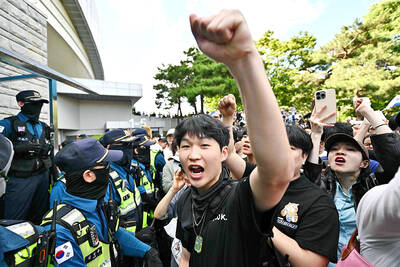
‘ABSURD MISTAKE’: The election commission said that there had been a failure to anticipate turnout after 14 polling stations ran short of ballot papers South Korean riot police yesterday cleared protesters from a Seoul polling station after a 35-hour blockade sparked by a shortage of ballot papers during local elections earlier this week. Wednesday’s election was the first nationwide vote since South Korean President Lee Jae-myung took office following the ouster of Yoon Suk-yeol over his short-lived martial law declaration. Lee’s ruling Democratic Party swept most races, but failed to flip the crucial Seoul mayoral seat. The South Korean National Election Commission apologized, blaming a failure to anticipate turnout after 14 polling stations in Seoul ran short of ballot papers. Some polling stations stayed open until 10pm to

France experienced its hottest spring on record, the French weather service said on Tuesday, after an exceptional early heat wave that also broke highs for the season in England and Wales. Meteo-France said the average nationwide temperature over March to May was 13.8°C — about 1.7°C above the norm, and surpassing records set in 2011 and 2020. “The warmest spring since records began in 1900,” it said in a bulletin. All three months were warmer than average, but the onset of an “unprecedented heatwave” late last month pushed the mercury to highs typically seen at the height of the summer. “Our country had never
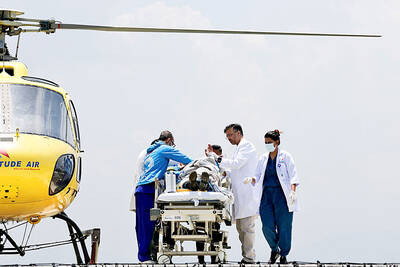
A Sherpa guide was found crawling to base camp on Mount Everest a week after he went missing and was reunited with his family, who had given up hope he would return. Dawa Sherpa was last seen on Friday last week descending the mountain, but he did not reach base camp even though his client did. The pair were among the last climbers on the mountain as the climbing season came to an end and the route was dismantled. Dawa was located by a cleaning crew on Thursday morning as he was crawling down the snowy slopes around the Khumbu Icefall, just above
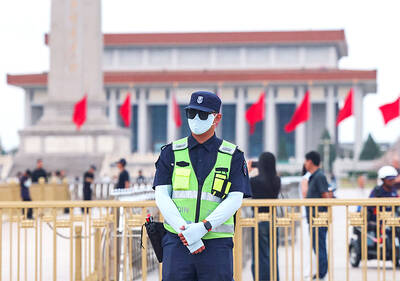
Chinese authorities are snuffing out any remembrance of the deadly 1989 military crackdown on student-led pro-democracy protests in Tiananmen Square, which happened 37 years ago yesterday, in a further tightening of a years-long campaign to erase what happened from public memory. Police told relatives of the victims they would not be allowed to visit a cemetery in Beijing on the anniversary of the crackdown, a person with knowledge of the matter said. Relatives of the victims visited the cemetery on the anniversary for more than 30 years to read memorial statements with police keeping watch, Amnesty International said. Hundreds of people,


 RSS
RSS