

Pakistan yesterday questioned a top al-Qaeda suspect captured in Dubai over his alleged role in attempts to kill President Pervez Musharraf, as investigators ruled out al-Qaeda's hand in bombings in Karachi at the weekend.
"He is under questioning by Pakistani investigators," Information Minister Sheikh Rashid said.
"He is required in many terrorist cases for interrogation."
Qari Saifullah Akhtar, whose arrest last week was the latest in a string of high-level al-Qaeda arrests since mid-July, was handed over to Pakistan late Saturday or early Sunday.
On Sunday night twin bombs tore through a religious school in Karachi, the crowded port city where scores of terror suspects have hidden.
But investigators ruled out al-Qaeda involvement in the blasts, which killed eight people, including at least six students.
"Al-Qaeda will not target religious students," Karachi police chief Tariq Jamil said.
"The main possibility on which we are working is sectarianism," he said, referring to rivalry between extremists in the majority Sunni and minority Shiite Muslim sects.
Akhtar is reported to have trained militants in Afghanistan before the Taliban regime's ouster in late 2001 and is wanted in connection with two assassination attempts against Musharraf in December, officials have said.
His capture is the latest blow to Osama bin Laden's al-Qaeda network, coming on the heels of Pakistan's penetration of an active al-Qaeda cell accused of plotting fresh attacks in Britain and the US.
The hunt is still on for other top operatives hiding out in the rugged borderlands and crowded cities of Pakistan, the world's second largest Muslim nation.
Security forces are targeting two top masterminds, identified by intelligence officials as Libyan national Abu Farj and an Egyptian known only as Hamza. Both are believed to be close associates of bin Laden.
"We are searching all the time. We are looking for these people who are on wanted lists, or who are involved in terrorist activities," Rashid said.
Akhtar headed Pakistan's top Taliban ally, the militant organization Harkat Jihad-e-Islami, and is reported to have trained militants in Afghanistan, a senior Pakistani intelligence official who asked not to be named said.
Rashid said Akhtar's arrest could "lead to the arrests of other members of his group."
The July arrests of alleged key al-Qaeda operatives Ahmed Khalfan Ghailani of Tanzania and computer whiz Naeem Noor Khan led to the capture of al-Qaeda suspects in the UK and to a security alert in the US.
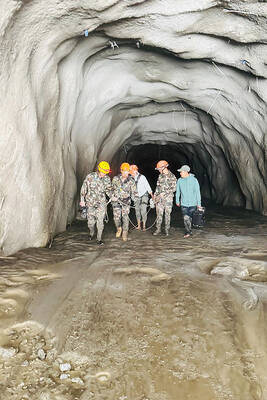
DEATH TOLL 903: More than 900 workers are believe to be trapped in the tunnels and underground areas of several hydropower projects after flash floods in Nepal-Tibet Rescue teams were working to reach more than 900 people thought to be trapped in the tunnels and underground areas of half a dozen hydropower projects in Nepal following the devastating flash floods, ?the National Disaster Risk Reduction and Management Authority said yesterday. The death toll from the unprecedented deluge of ice, rock, mud ?and debris that crashed through valleys of Nepal on Wednesday last week has risen to 903 people, with 16 more dead reported on the Tibet side of the border. More than 4,000 are missing in Nepal, with another 500 in Tibet. Hundreds of bodies, many unidentified, have been

Ontario Premier Doug Ford on Saturday answered US President Donald Trump’s “Lake America” decree with a billboard-sized message on the Canadian shoreline — “Lake Ontario. Now and Always” — as Canadian leaders met Trump’s move with ridicule rather than outrage. Wearing a Canada national soccer team jersey, Ford unveiled the sign near Grimsby and posed for photographs. The message is repeated in French. The display followed Trump’s executive order directing US federal agencies to call Lake Ontario “Lake America.” After months of tariffs, threats to make Canada the 51st US state and personal attacks on its leaders, the reaction in
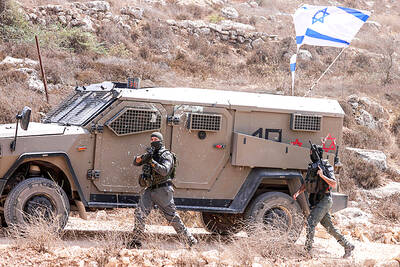
Dozens of Israeli settlers on Saturday attacked the Palestinian village of Qusra in the northern occupied West Bank after nearly three weeks of tension in the area, drawing rare condemnation from Israeli Prime Minister Benjamin Netanyahu. Earlier this month, a group of settlers began blocking supplies from entering Palestinian houses on the outskirts of the village near Nablus, trapping residents inside and drawing unusually strong criticism from the US ambassador. Weeks later, Israeli forces continue to operate in the area while settlers still roam the surrounding hills. On Saturday, Qusra residents and dozens of settlers had descended on the village,
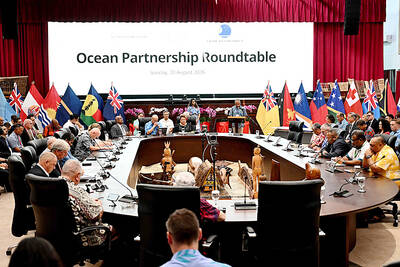
TAIWAN-CHINA ISSUE: Beijing has protested Taiwan’s inclusion in the 18-member state forum, which is being hosted by Palau, an ally of Taiwan At least five leaders would skip the Pacific Island region’s annual summit, officials said yesterday, hours before the opening of talks overshadowed by Taiwan-China tensions. The gathering aims to grapple with challenges such as climate change, drug crime and the Chinese test-firing of a ballistic missile in July that landed in the Pacific Ocean. China’s security and economic influence has added resonance this year, because the 18-member Pacific Islands Forum is being hosted by Palau, a diplomatic ally of Taiwan. Beijing has protested against Taiwan’s inclusion among aid partners invited to attend along with China, Singapore, Japan, the UK and the US. China has


 RSS
RSS