


A time bomb hidden in a fruit seller's hand cart and a grenade lobbed in a busy Kashmir market killed two people and wounded 44 in Kashmir yesterday in what police suspect was retaliation by militants for a recent crackdown.
In the first attack, a timed explosive set off a massive blast yesterday morning on the main thoroughfare in Srinagar, the summer capital of Jammu-Kashmir state, killing two civilians and wounding 21 others, police said.
Hours later, suspected militants hurled a grenade at paramilitary soldiers, wounding three troopers and 20 civilians in a crowded market in Anantnag town, 55km north of Srinagar, a police spokesman said on condition of anonymity. Ten of the wounded were in critical condition, police said.
The blast in Srinagar occurred on Maulana Azad Road, the wide, tree-lined avenue taken by hundreds of tourists each day to the picturesque Dal Lake boulevard, senior police officer Javed Ahmad said.
Bushes along the site, near a sprawling golf course, were uprooted and the road was strewn with leaves amid blotches of blood. Relatives of the dead wailed and beat their chests, mourning the victims.
A senior police official said the two attacks were believed to be reprisals for a Tuesday crackdown launched by security forces against Lashkar-e-Tayyaba, the region's most feared militant group. Twenty people who police said were planning to blow up the country's main stock exchange were arrested, including two who were killed when they allegedly tried to escape.
In a Srinagar hospital, Latif Ahmed, a 25-year-old taxi driver, shrieked in pain on a hospital bed, calling out for his mother as a doctor bandaged one of the wounds on his neck, chest and head. Ahmed was driving his three-wheel "autorickshaw" when the fruit cart blast occurred.
"I was driving my auto and there was a huge sound behind me. I was thrown out of the autorickshaw," Ahmed said. "Then there was only smoke. I don't know what happened after that."
No one immediately claimed responsibility for the attack.
Police say separatist rebels in recent weeks have carried out attacks to scare away tourists, who are traveling to the region in the largest numbers since 1989.
However, the top militant group, Lashkar-e-Tayyaba, has said it is not targeting tourists.
Tourism is a key industry in the Indian-controlled portion of Kashmir.
The region is divided between India and Pakistan. A territorial dispute over the Himalayan province and a 15-year-old insurgency by Pakistan-based Muslim militant groups is the main source of tension between the two nuclear-armed neighbors, which have fought three wars since becoming independent in 1947.
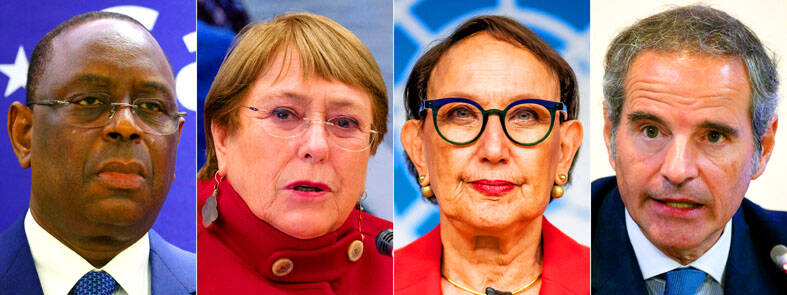
Four contenders are squaring up to succeed Antonio Guterres as secretary-general of the UN, which faces unprecedented global instability, wars and its own crushing budget crisis. Chile’s Michelle Bachelet, Argentina’s Rafael Grossi, Costa Rica’s Rebeca Grynspan and Senegal’s Macky Sall are each to face grillings by 193 member states and non-governmental organizations for three hours today and tomorrow. It is only the second time the UN has held a public question-and-answer, a format created in 2016 to boost transparency. Ultimately the five permanent members of the UN’s top body, the Security Council, hold the power, wielding vetoes over who leads the

South Korea’s air force yesterday apologized for a 2021 midair collision involving two fighter jets, a day after auditors said the pilots were taking selfies and filming during the flight and held them responsible for the accident. “We sincerely apologize to the public for the concern caused by the accident that occurred in 2021,” an air force spokesman told a news conference, adding that one of the pilots involved had been suspended from flying duties, received severe disciplinary action and has since left the military. The apology followed a report released on Wednesday by the South Korean Board of Audit and Inspection,

Young Chinese, many who fear age discrimination in their workplace after turning 35, are increasingly starting “one-person companies” that have artificial intelligence (AI) do most of the work. Smaller start-ups are already in vogue in Silicon Valley and elsewhere, with rapidly advancing AI tools seen as a welcome teammate even as they threaten layoffs at existing firms. More young people in China are subscribing to the model, as cities pledge millions of dollars in funding and rent subsidies for such ventures, in alignment with Beijing’s political goal of “technological self-reliance.” “The one-person company is a product of the AI era,” said Karen Dai

About 240 Indians claiming descent from a Biblical tribe landed at Tel Aviv airport on Thursday as part of a government operation to relocate them to Israel. The newcomers passed under a balloon arch in blue and white, the colors of the Israeli flag, as dozens of well-wishers welcomed them with a traditional Jewish song. They were the first “bnei Menashe” (“sons of Manasseh”) to arrive in Israel since the government in November last year announced funding for the immigration of about 6,000 members of the community from the states of Manipur and Mizoram in northeast India. The community claims to descend from


 RSS
RSS