


The proud horsemen of the Sokoto Caliphate strained to rein in their skittish steeds as the horns blared and the sun beat down from a cloudless blue sky onto the parched earth of the field of honor.
Nearby the black-turbanned camel riders found it easier to control their placid mounts as the beat of the war drums mounted in intensity, and the wailing voices of thousands of Muslim pilgrims rose in song.
The Grand Durbar called to celebrate the 200th anniversary of Shehu Usman Dan Fodio's jihad to unite the Islamic emirates of west Africa deliberately recalled his skill in war, but Nigerians see in his legacy a hope for peace.
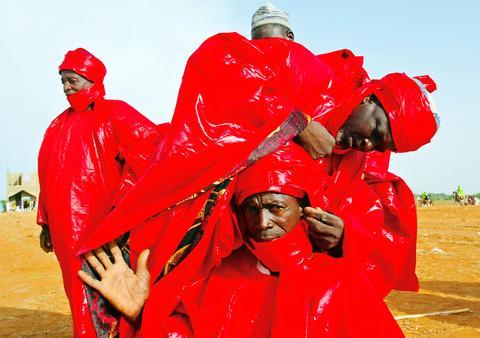
PHOTO: AP
For while the first caliph's campaign was led by 25,000 desert warriors, the inheritance he left to an empire spanning 650,000km2 was one of learning, tolerance and the rule of law.
"It is never too late to return to those values," said Nigerian President Olusegun Obasanjo, a southern Christian who on Sunday donned the turban of a northern Muslim lord and mounted a nomad's warhorse.
As he and Sultan Muhammadu Maccido Abubakar III cantered through the dust and the wildly cheering crowds, an army of sword-wielding infantrymen, drum-beating camel riders and splendidly robed horsemen surged behind them.
Each royal house from the three dozen emirates united during Dan Fodio's long ride to victory was represented in the multicolored tunics worn by dozens of tribes -- Hausa, Fulani and Touareg -- from across the region.
Proud as they are, the warriors bowed respectfully as they passed the bicentary durbar's guests of honor: 200 traditional rulers, the presidents of Nigeria, Niger, Chad and Ghana and envoys from as far as distant Senegal.
Dust from the parade ground was mixed with acrid black smoke as volleys of musket fire rang out among the revellers, who had come to renew two centuries of allegiance to the sultan, ruler of this ancient Nigerian city.
Many Nigerians feel they need to return to the values promoted by Dan Fodio, whose caliphate rescued the region from the whims of local feudal lords and built a society built on learning, Shariah law and social equality.
With today's Nigeria and other parts of the caliph's former west African realm sinking deeper into poverty and beset by corruption, lawlessness and ethnic strife, Sultan Maccido feels his countrymen should look to the past.
"For our part we will continue to preach peaceful co-existence irrespective of our religious and cultural differences," the monarch told the crowd and, through television, the rest of his tens of millions of followers.
Both the sultan and Obasanjo lamented a recent upsurge in violence between Nigeria's Muslims and Christians -- which has left hundreds dead in the past two months alone -- and called for peace and understanding.
Then they mounted their horses, draped in the extravagant finery of desert notables, followed by footmen supporting white, brocaded canopies.
The display recalled a battle fought on the very same field in 1903 when Sultan Attahiru I took on the British Empire in the Battle of Gingiwa.
The sultan's last stand cost him his temporal power, but his successors continued to serve as spiritual leaders under empires, dictators and latterly elected rule.

‘CROSSING THE LINE’: China’s embassy in Seoul criticized US Forces Korea Commander General Xavier Brunson, asking if his ‘hostile’ remarks were authorized by Washington South Korea and the US are in talks over recent public remarks by the commander of US Forces Korea, Seoul’s presidential office said yesterday, after the comments drew sharp criticism from China. In a recent podcast interview, US Forces Korea Commander General Xavier Brunson described South Korea as “the dagger in the heart of Asia” from China’s east coast, prompting the Chinese embassy in Seoul to say that he had “truly crossed the line.” The interview came amid growing speculation that Washington might seek to expand the role of US Forces Korea in countering the growing regional influence of China, a key

Through the noise of rushing papers and whirring belts at a print factory in Kyoto, two creators watch their photo essay come to life in broadsheet form — part of an effort to win new audiences in the age of artificial intelligence (AI). Despite the decline of the publishing industry, self-publication and handmade “zine” magazines are growing in popularity in Japan, reflecting the nation’s enduring love of paper in the digital era. While speaking to Agence France-Presse at the plant, his hands black with ink, one of the creators, Kazuma Obara, said: “I think [paper] is a medium that engages all five

Australian researchers have trained lab-grown brain cells on a silicon computer chip to play the 1990s shooter game Doom and said they are just scratching the surface of what the neurons could be capable of doing. It is the science-fiction work of biotech boffins at Cortical Labs, who researched and developed the technology that harnesses the workings of the brain’s networking system. Each so-called “biological computer” contains about 200,000 living human brain cells, grown from stem cells that were harvested from blood donations. Having mastered the simple computer game Pong, where a paddle is moved up and down to send a ball

France experienced its hottest spring on record, the French weather service said on Tuesday, after an exceptional early heat wave that also broke highs for the season in England and Wales. Meteo-France said the average nationwide temperature over March to May was 13.8°C — about 1.7°C above the norm, and surpassing records set in 2011 and 2020. “The warmest spring since records began in 1900,” it said in a bulletin. All three months were warmer than average, but the onset of an “unprecedented heatwave” late last month pushed the mercury to highs typically seen at the height of the summer. “Our country had never


 RSS
RSS