


China has postponed a visit by the UN special investigator on torture, saying it needs more time to prepare, an official said yesterday.
Theo van Boven had planned to visit later this month to investigate reports of abuses in Chinese jails, but the visit has been put off until later this year, van Boven said in a statement.
Rights groups say Chinese police and security services commonly use torture as punishment and to obtain confessions or information. China routinely denies the charges.
"The need for additional time to prepare for the two-week visit, especially given the different authorities, departments and provinces involved, was cited by the government as a reason for the postponement," a statement on van Boven's Web site said.
The UN has tried for almost a decade to arrange the inspector's visit, but China's government has repeatedly stalled on granting permission.
Human-rights groups say China has been unwilling to accept the terms of a visit, which include measures such as allowing unlimited access to prisons without prior notice and confidential interviews with detainees and representatives of civic groups.
However, van Boven said China had accepted his conditions as part of its invitation issued last November.
China's Foreign Ministry had no immediate comment on the postponement.
A report by the Xinhua News Agency quoted van Boven's statement and said such invitations were part of China's commitment to the international community. The report defended the government's human-rights record, saying its efforts to improve human rights among Chinese had "won appreciation from the international community."
Van Boven's statement said his visit's goal was to "assess first-hand the situation in the country concerning torture, including institutional and legislative factors that contribute to such practices.
"While a visit to China has been long-awaited ... he is assured that the need for further preparation indicates the importance the Government attaches to the visit," the statement added.
Human-rights groups claim detainees, including those perceived as political opponents of the ruling Communist Party, face regular abuse in China.
The banned spiritual movement Falun Gong says its practitioners have been tortured and killed by the hundreds in Chinese prisons and labor camps.
A New York-based group, Human Rights in China, expressed disappointment over the postponement of the inspector's visit. Beijing appeared to have made the invitation to deflect criticism, only to abandon it once international pressure had lessened, the group said.
"This eleventh-hour postponement raises serious questions about the sincerity of the [Chinese] government's commitment to international cooperation," the group said in a news release.
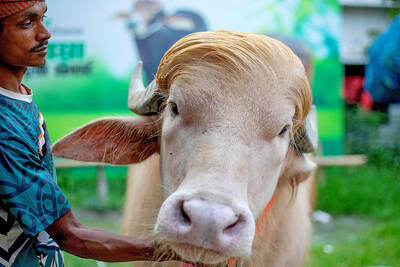
Crowds in Bangladesh are flocking to snap photographs with an unlikely social media star — an albino buffalo with flowing blond hair nicknamed “Donald Trump” that is due to be sacrificed within days. Owner Zia Uddin Mridha, 38, said his brother named the 700kg bull over its flowing helmet of hair resembling the signature look of the US president. “My younger brother picked this name because of the buffalo’s extraordinary hair,” he said at his farm in Narayanganj, just outside the capital, Dhaka. Mridha said that a constant stream of curious visitors — social media fans, onlookers and children — have come throughout

It began as a satirical online project. Now millions of young people in India are flocking to it as an outlet for their frustration. A parody political party called the Cockroach Janta Party, with the insect as its symbol, has exploded across India’s social media by turning absurdist humor into protest. Memes and short videos mocking corruption, joblessness and political dysfunction have flooded social media sites, where millions of users are embracing the cockroach — known for its ability to survive harsh conditions — as a tongue-in-cheek symbol of endurance. The online movement’s rise has been unusually rapid. The Cockroach Janta Party (CJP)

BIGGER ROLE: Beijing has said it maintains an impartial stance on the war in Ukraine, but by training Russian troops, China is far more involved than previously known China’s armed forces secretly trained about 200 Russian military personnel in China late last year, and some have since returned to fight in Ukraine, according to three European intelligence agencies and documents seen by Reuters. While China and Russia have held a number of joint military exercises since Moscow’s full-scale invasion of Ukraine in 2022, Beijing has repeatedly said that it is neutral in the conflict and presents itself as a peace mediator. The covert training sessions, which predominantly focused on the use of drones, were outlined in a dual-language Russian-Chinese agreement signed by senior Russian and Chinese officers in Beijing on

HOTTER: While Indians are accustomed to summer heat, climate change has caused northwestern India to warm faster than other parts of the country, an academic said Roads and markets have emptied during afternoons and some farmers have switched to nighttime work to avoid scorching temperatures as a heat wave grips large parts of India. The India Meteorological Department forecast maximum temperatures for yesterday of about 45°C in the capital, New Delhi, where authorities have opened temporary “cooling zones” to help people cope. The weather department warned that conditions would likely persist across several northern regions in the coming days, with temperatures staying well above seasonal averages. Authorities urged people to stay indoors during the hottest hours and take precautions against heat-related illnesses. India declares a heat wave whenever maximum temperatures


 RSS
RSS