


In a surprise move, Jordan's King Abdullah II postponed a White House meeting with US President George W. Bush this week, citing questions about the US commitment to the Middle East peace process.
The snub Monday from one of Washington's closest allies comes amid Arab anger at Bush for endorsing an Israeli proposal to withdraw unilaterally from the Gaza Strip and parts of the West Bank but keep Jewish settlements on other West Bank land claimed by the Palestinians.
Bush's statement after a White House meeting with Israeli Prime Minister Ariel Sharon last week constituted a historic shift in US policy, and Palestinian leaders accused the administration of undercutting the possibility of a negotiated settlement.
The White House played down any hint of friction with Jordan, saying today's meeting with Abdullah was rescheduled to the first week of May "because of developments in the region."
"The king decided this week it was better for him to be in Jordan and we understand that," Sean McCormack, spokesman for the National Security Council, said Monday in Washington.
But Abdullah has been in the US since last week and it was not clear whether he had left. A palace statement said Abdullah instructed his foreign minister to remain in Washington to continue meetings and discussions with officials in the Bush administration and to prepare for the king's return to the US in May.
The palace statement said the Abdullah-Bush meeting would not be held "until discussions and deliberations are concluded with officials in the American administration to clarify the American position on the peace process and the final situation in the Palestinian territories, especially in light of the latest statements by officials in the American administration."
Jordan is considered a key moderate ally of the US and is one of only two of Israel's Arab neighbors to have a peace treaty with the Jewish state. But some Jordanian citizens question their government's relationship with the US, which they accuse of siding with Israel against the Palestinians.
Abdullah is under pressure at home to demonstrate that his US ties can further Arab positions on the Israeli-Palestinian question as well as on the US occupation of Iraq.
Jordan is especially concerned that a final peace settlement would be at its expense if refugees were dumped into the kingdom, exhausting its meager resources and disturbing its demographic balance. Roughly half of Jordan's 5.1 million population is of Palestinian families who fled or were forced out of their homes in 1948 and 1967 Mideast wars.
The rift between the Bush administration and its moderate Arab allies over Bush's statement on Israeli settlements is one of the worst to emerge in years -- and has exacerbated the already tense relations between the US and Arab countries over the war in Iraq.
Arab leaders have accused the administration of essentially taking away from the Palestinians their primary negotiating levers in any final peace deal -- the disputes over whether Israel must remove all settlements from the West Bank, and whether Israel must allow back some Palestinian refugees.

When a hiker fell from a 55m waterfall in wild New Zealand bush, rescuers were forced to evacuate the badly hurt woman without her dog, which could not be found. After strangers raised thousands of dollars for a search, border collie Molly was flown to safety by a helicopter pilot who was determined to reunite the pet and the owner. A week earlier, an emergency rescue helicopter found the woman with bruises and lacerations after a fall at a rocky spot at the waterfall on the South Island’s West Coast. She was airlifted on March 24, but they were forced to
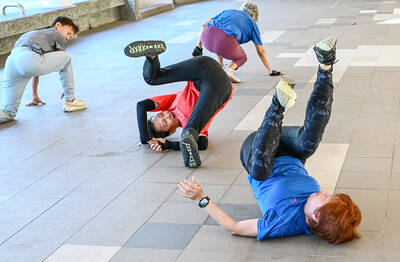
CONFIDENCE BOOSTER: ’After parkour ... you dare to do a lot of things that you think only young people can do,’ a 67-year-old parkour enthusiast said In a corner of suburban Singapore, Betty Boon vaults a guardrail, crawls underneath a slide, executes forward shoulder rolls and scales a steep slope, finishing the course to applause. “Good job,” the 69-year-old’s coach cheers. This is “geriatric parkour,” where about 20 retirees learned to tackle a series of relatively demanding exercises, building their agility and enjoying a sense of camaraderie. Boon, an upbeat grandmother, said learning parkour has aided her confidence and independence as she ages. “When you’re weak, you will be dependent on someone,” she said after sweating it out with her parkour classmates in suburban Toa Payoh,
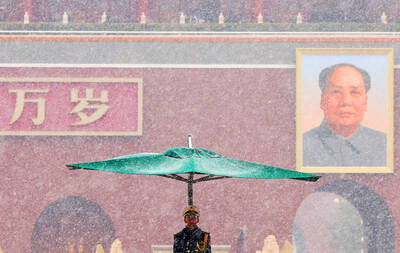
Chinese dissident artist Gao Zhen (高兟), famous for making provocative satirical sculptures of former Chinese leader Mao Zedong (毛澤東), was tried on Monday over accusations of “defaming national heroes and martyrs,” his wife and a rights group said. Gao, 69, who was detained in 2024 during a visit from the US, faces a maximum three-year prison sentence, said his wife, Zhao Yaliang (趙雅良), and Shane Yi, a researcher at the Chinese Human Rights Defenders group which operates outside the nation. The closed-door, one-day trial took place at Sanhe City People’s Court in Hebei Province neighboring the capital, Beijing, and ended without a
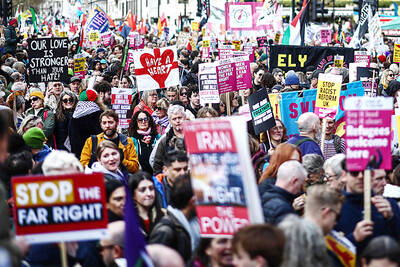
‘TOXIC CLIMATE’: ‘I don’t really recognize Labour anymore... The idea that you can implement far-right ideas in order to stop the far right is nonsense,’ a protester said Tens of thousands of people on Saturday marched through central London to protest against the far right, weeks ahead of local elections and six months after Britain saw one of its largest far-right demonstrations. Organized by hundreds of civic groups, including trade unions, anti-racism campaigners and Muslim representative bodies, Saturday’s Together Alliance event was billed as the biggest in UK history to counter right-wing extremism. A separate pro-Palestinian march had also converged with the main rally. While organizers claimed 500,000 had turned out in total, the police gave a figure of about 50,000. Protesters carrying placards with slogans such as


 RSS
RSS