


British Prime Minster Tony Blair said Thursday that the UN should play a key role in mediating Iraq's transition to sovereignty and curtailing the violence that has hindered the US-led occupation.
"The circumstances will require us at some point in the near future to have a new UN Security Council resolution that will allow us to point [the] way toward political transition in Iraq," said Blair, who was to meet US President George W. Bush yesterday to discuss the Iraq crisis.
Blair made the comments during a joint news conference with UN Secretary-General Kofi Annan at the residence of the British ambassador to the UN, Emyr Jones Parry.
Annan said he and Blair discussed the recommendations by his special adviser, Lakhdar Brahimi, for a caretaker government to take power from the US-led coalition on June 30 and lead Iraq until elections in January.
"It has not been easy," Annan said, "but we are trying to do whatever we can to help."
Annan said Brahimi has been trying "to encourage the Iraqis to come to some consensus on how to form a transitional government, and I think Mr. Brahimi's effort is to help them move in that direction."
Brahimi left Iraq on Thursday and is expected to return to New York in late April to brief Annan and the UN Security Council before returning to Iraq to finalize his recommendations on a transitional government.
He went to Iraq at the request of the coalition and the 25-member US-appointed Iraqi Governing Council to try to come up with a plan acceptable to a wide range of Iraqis. In recent days, Iraq has seen the heaviest fighting since Baghdad fell to US troops a year ago, with coalition forces fighting Sunni and Shiite Muslim militants.
The violence "is obviously a difficult issue, particularly with security at the moment," Blair said.
"But our determination to get there remains undimmed," he said.
"We have to stand firm," he said.
Blair is one of the staunchest supporters of US foreign policy in Iraq, the Middle East and elsewhere, despite criticism at home. He and Bush last met in November, when Bush traveled to Britain.
Britain has about 8,000 troops in Iraq, one of several allies backing up the US force of more than 135,000.
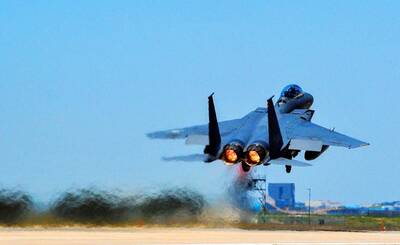
South Korea’s air force yesterday apologized for a 2021 midair collision involving two fighter jets, a day after auditors said the pilots were taking selfies and filming during the flight and held them responsible for the accident. “We sincerely apologize to the public for the concern caused by the accident that occurred in 2021,” an air force spokesman told a news conference, adding that one of the pilots involved had been suspended from flying duties, received severe disciplinary action and has since left the military. The apology followed a report released on Wednesday by the South Korean Board of Audit and Inspection,

Indonesian police have arrested 13 people after shocking images of alleged abuse against small children at a daycare center went viral, sparking outrage across the nation, officials said on Monday. Police on Friday last week raided Little Aresha, a daycare center in Yogyakarta on Java island, following a report from a former employee. CCTV footage circulating on social media showed children, most younger than two, lying on the floor wearing only diapers, their hands and feet bound with rags. The police have confirmed that the footage is authentic. Police said they also found 20 children crammed into a room just 3m by 3m. “So

About 240 Indians claiming descent from a Biblical tribe landed at Tel Aviv airport on Thursday as part of a government operation to relocate them to Israel. The newcomers passed under a balloon arch in blue and white, the colors of the Israeli flag, as dozens of well-wishers welcomed them with a traditional Jewish song. They were the first “bnei Menashe” (“sons of Manasseh”) to arrive in Israel since the government in November last year announced funding for the immigration of about 6,000 members of the community from the states of Manipur and Mizoram in northeast India. The community claims to descend from

‘TROUBLING’: The firing of Phelan, who was an adviser to a nonprofit that supported the defense of Taiwan, was another example of ‘dysfunction’ under Trump, a US senator said US Secretary of the Navy John Phelan has been fired, a US official and a person familiar with the matter said on Wednesday, in another wartime shakeup at the Pentagon coming just weeks after US Secretary of Defense Pete Hegseth ousted the Army’s top general. The Pentagon announced his departure in a brief statement, saying he was leaving the administration “effective immediately,” but it did not provide a reason or say whether it was his decision to go. The sources, who spoke on condition of anonymity, said Phelan was dismissed in part because he was moving too slowly to implement reforms to


 RSS
RSS