


US Attorney General John Ashcroft told the Sept. 11 commission on Tuesday that the administration of former US president Bill Clinton bore most of the blame for the attacks because it allowed the nation's defenses to wither for eight years.
Facing charges he blocked counterterrorism funds in 2001 at a dramatic day of testimony on the attacks that killed nearly 3,000 people, Ashcroft found himself at the center of a storm over his actions in the months before they took place.
In two staff reports, the panel investigating the hijacked airliner assaults on New York and Washington also leveled stinging criticism at the Justice Department and FBI for failing to meet the growing threat from al-Qaeda.
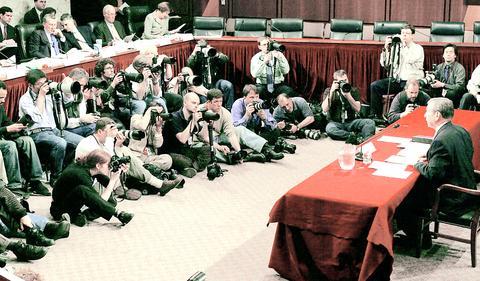
PHOTO: EPA
The commission cited a May 10 Justice Department document setting priorities for 2001. The top priorities cited were reducing gun violence and combating drug trafficking. There was no mention of counterterrorism.
When Dale Watson, the head of the counterterrorism division, saw the document, he "almost fell out of his chair," the commission report said.
Ashcroft testified that he had told the Senate the previous day that his No. 1 priority was to protect the American people against terrorism. He said the May 10 memorandum was based on goals developed by the previous administration.
"We did not know that an attack was coming because for nearly a decade our government had blinded itself to its enemies," Ashcroft said.
"Our agents were isolated by government-imposed walls, handcuffed by government-imposed restrictions and starved for basic information and technology."
Earlier, Thomas Pickard, who was acting FBI director in the summer of 2001, said Ashcroft had blocked the funds he sought.
"The additional funds we were looking for on counterterrorism were denied," Pickard said. He appealed the decision but added, "On Sept. 12, I read a denial of that appeal from the attorney general."
Ashcroft said the Justice Department was still operating under the Clinton administration's budget in 2001. He said US President George W. Bush had proposed the largest counterterrorism budget increase for five years and was moving urgently to upgrade the FBI's antiquated computer systems when the attacks took place.
He said that over the eight years of the Clinton administration, the FBI's technology budget was "starved for funds" and was US$36 million below its 1992 level.
The commission's two staff reports issued on Tuesday analyzed in detail the failure to prevent the hijacked airliner attacks on New York and Washington.
The FBI came in for criticism as well, with the commission determining the bureau was hampered by a culture resistant to change, inadequate resources and legal barriers.
"On Sept. 11, 2001, the FBI was limited in several areas critical to an effective, preventive counterterrorism strategy," the report said.
Appearing before the panel to defend his oversight of the bureau from 1993 until a few months before the attacks, former FBI Director Louis Freeh testified that he sought permission to hire almost 1,900 counterterrorism linguists, analysts and agents in the last three years but was allowed to add just 76.
He rejected a characterization by the commission's Republican chairman, former New Jersey governor Thomas Kean, that the staff report amounted to an indictment of the FBI.
The second report quoted Pickard as saying he had briefed Ashcroft on terrorist threats in late June and July 2001 but the attorney general was not interested.
"After two such briefings, the attorney general told him he did not want to hear this information anymore," the report quoted Pickard as saying. Pickard himself repeated the charge in his testimony but Ashcroft vehemently denied it.
"Acting Director Pickard and I had more than two meetings. We had regular meetings," he said.
"Secondly I did never speak to him saying that I did not want to hear about terrorism. I care greatly about the safety and security of the American people and was very interested in terrorism, and specifically interrogated him about threats to the American people and domestic threats in particular."
Freeh said FBI counterterrorism operations were severely underfunded and understaffed before the attacks, partly due to a 22-month congressionally imposed hiring freeze in the early 1990s.
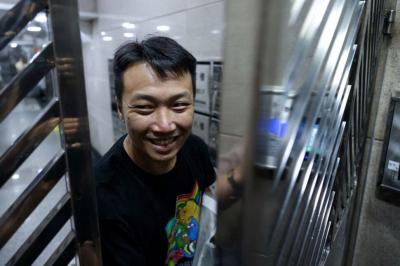
Four people jailed in the landmark Hong Kong national security trial of "47 democrats" accused of conspiracy to commit subversion were freed today after more than four years behind bars, the second group to be released in a month. Among those freed was long-time political and LGBTQ activist Jimmy Sham (岑子杰), who also led one of Hong Kong’s largest pro-democracy groups, the Civil Human Rights Front, which disbanded in 2021. "Let me spend some time with my family," Sham said after arriving at his home in the Kowloon district of Jordan. "I don’t know how to plan ahead because, to me, it feels

‘A THREAT’: Guyanese President Irfan Ali called on Venezuela to follow international court rulings over the region, whose border Guyana says was ratified back in 1899 Misael Zapara said he would vote in Venezuela’s first elections yesterday for the territory of Essequibo, despite living more than 100km away from the oil-rich Guyana-administered region. Both countries lay claim to Essequibo, which makes up two-thirds of Guyana’s territory and is home to 125,000 of its 800,000 citizens. Guyana has administered the region for decades. The centuries-old dispute has intensified since ExxonMobil discovered massive offshore oil deposits a decade ago, giving Guyana the largest crude oil reserves per capita in the world. Venezuela would elect a governor, eight National Assembly deputies and regional councilors in a newly created constituency for the 160,000
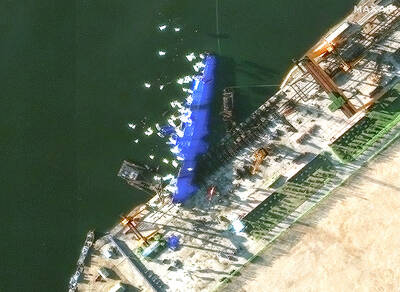
North Korea has detained another official over last week’s failed launch of a warship, which damaged the naval destroyer, state media reported yesterday. Pyongyang announced “a serious accident” at Wednesday last week’s launch ceremony, which crushed sections of the bottom of the new destroyer. North Korean leader Kim Jong-un called the mishap a “criminal act caused by absolute carelessness.” Ri Hyong-son, vice department director of the Munitions Industry Department of the Party Central Committee, was summoned and detained on Sunday, the Korean Central News Agency (KCNA) reported. He was “greatly responsible for the occurrence of the serious accident,” it said. Ri is the fourth person

Poland is set to hold a presidential runoff election today between two candidates offering starkly different visions for the country’s future. The winner would succeed Polish President Andrzej Duda, a conservative who is finishing his second and final term. The outcome would determine whether Poland embraces a nationalist populist trajectory or pivots more fully toward liberal, pro-European policies. An exit poll by Ipsos would be released when polls close today at 9pm local time, with a margin of error of plus or minus 2 percentage points. Final results are expected tomorrow. Whoever wins can be expected to either help or hinder the


 RSS
RSS