

The Nobel Peace laureate and Northern Ireland's Ulster Unionist leader David Trimble called human rights organizations a "great curse" on Wednesday and accused them of complicity in terrorist killings.
"One of the great curses of this world is the human rights industry," he told reporters at an international conference of terrorism victims in Madrid.
"They justify terrorist acts and end up being complicit in the murder of innocent victims," Trimble said.
His words drew an angry reaction from Amnesty International and Human Rights Watch, two of the world's biggest human rights groups, with more than a million members worldwide.
Steve Crawshaw, director of the London office of Human Rights Watch, said:"It is extraordinarily regrettable and disappointing that, above all, a man like that says something like this.
"His own emphasis, together with other politicians in Northern Ireland, on the fact that violence against civilians on all sides of any conflict cannot be justified, has been so important in recent years," Crawshaw said.
Kate Allen, Amnesty International's UK Director, said: "The threat of terrorism must never be used as an excuse for abusing people's human rights.
"David Trimble should remember that human rights organizations have condemned killings and other abuses by terrorist groups all over the world, while at the same time criticizing governments who use the `war on terror' as a pretext to abuse their citizens."
A spokeswoman for the Norwegian Nobel Institute in Oslo, which awarded Trimble his prize in 1988, declined to say whether it considered itself a member of the "human rights industry."
"We don't comment on what former laureates say. We have no reaction to that," she said.
Trimble was joint winner of with the former leader of Northern Ireland's Social Democratic and Labour Party (SDLP), John Hume, for their efforts to find a peaceful solution to the conflict in Northern Ireland.
He made his comment as one of the keynote speakers at the first international congress of terrorism victims.
The conference ended in Madrid on Tuesday night.
He backed another politician at the conference, the Colombian vice-president Francisco Santos, who said that human rights groups were hindering progress towards peace in his country.
"For human rights organizations to call (the Colombian rebel group) FARC `armed opposition groups' undermines the struggle of those who have decided to side with democracy," Santos said. "That is not right. It is unacceptable."
After hearing of Trimble's comments, Robin Kirk, a researcher on Colombia for Human Rights Watch, said: "Human rights defenders are under attack in Colombia, so these are dangerous comments to make."
Human Rights Watch has criticized Colombia's anti-terrorist legislation and calls groups such as FARC either "illegal armed groups" or "leftist guerrillas."
The conference in Madrid ended with a declaration that partly supported Trimble's position.

US President Donald Trump on Wednesday threatened to take action against the EU if it moves forward with European Commission President Ursula von der Leyen’s proposal to make Canada the bloc’s first associate member. “If they do that, if I think it’s at all a hostile act; I will put very serious tariffs or stop trading with Europe on many things,” Trump told reporters en route to an event in North Carolina, calling the proposal “laughable.” “If it’s a good intention, that’s fine. If it’s a bad intention, we’ll put very heavy tariffs on Europe,” he said. Von der Leyen made the proposal
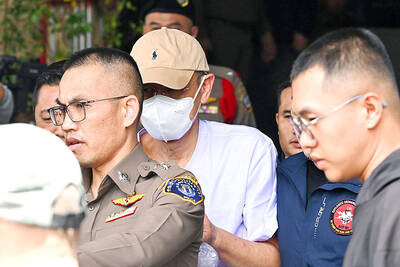
Thai police yesterday said that they arrested a senior Buddhist monk on suspicion of embezzling US$2.8 million intended for his monastery, alongside a suspected female accomplice he was having sex with. The case is the latest scandal to hit the clergy in Buddhist-majority Thailand after a sex and extortion case involving senior monks last year prompted public outrage and calls for greater scrutiny of temple finances. Phra Wachirayan Wi, the 66-year-old abbot of the 14th-century Wat Phutthaisawan in the ancient capital of Ayutthaya, was arrested on Thursday on charges including embezzlement and money laundering, lead police investigator Pattanasak Bupphasuwan said. A 47-year-old woman

SECRET FOOTAGE: A 17-year-old girl told British broadcaster Channel 4 that she had been approached by a man who covertly recorded her and their interaction Calls are growing louder in Europe for action against “pervert” smart glasses after secretly filmed footage of girls and women appeared online — with a petition in Britain demanding a ban on their sale. Anyone wearing smart glasses can take photos, film videos, listen to music, make phone calls, translate text or interact with an artificial intelligence (AI) assistant, with sales now hitting millions. The devices grabbed attention this summer after a marketing tie-up between Kylie Jenner, beauty mogul and member of the Kardashian dynasty, and tech giant Meta. Since smartphones are now embedded in daily life, “big tech” is
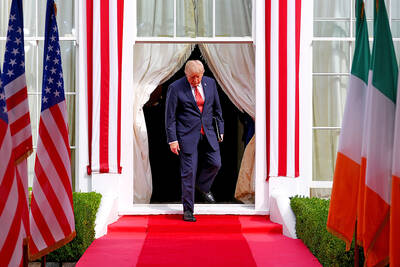
FROSTY RECEPTION: ‘I conveyed the strong view of the Irish people that the normalization of war and genocide can never be accepted,’ the Irish president said US President Donald Trump on Saturday said that he would “love to see” a united Ireland, wading into a politically sensitive subject as he embarked on a two-day Irish visit that blurs the lines between his presidency and personal business interests. After meeting Irish Prime Minister Micheal Martin in Dublin, Trump said reunification of the Republic of Ireland and Northern Ireland — split for more than a century — would be “a fantastic thing.” “It’s going to happen eventually. It may as well happen now,” he told reporters, adding that “the UK will have something to say about it, obviously.”


 RSS
RSS