


Thousands of Shiite Muslims hit the streets of four Iraqi cities on Tuesday, calling on the US to hand over Saddam Hussein to be tried as a war criminal and demanding a bigger say in their political future.
The fresh rallies followed a march through Baghdad on Monday by tens of thousands of people from the majority Shiite community demanding direct elections to decide who controls Iraq when the US hands back power in June.
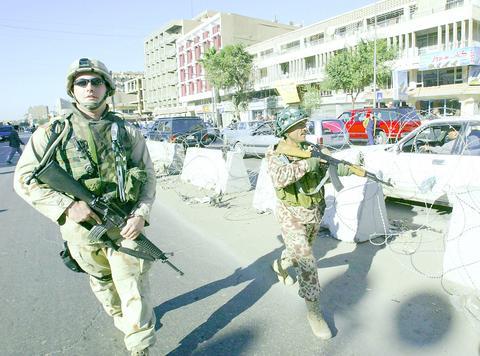
PHOTO: AFP
Many of Tuesday's protesters were supporters of Moqtada al-Sadr, a firebrand religious leader who has expressed support for Iraq's most revered cleric Ayatollah Ali al-Sistani.
Sistani and his followers, long persecuted by Saddam, have proven a thorn for the US by opposing its plans to let regional caucuses appoint a transitional authority to take power at the end of June, instead of letting all Iraqis vote.
"We demand elections or we will bury every American here," said one Shiite cleric, Sattar Jabbar.
In Washington, US President George W. Bush welcomed the current president of the Iraqi Governing Council, Adnan Pachachi, as a guest at his State of the Union address to Congress.
"Sir, America stands with you and the Iraqi people as you build a free and peaceful nation," said Bush, who made no direct reference to the mass demonstrations in Iraq.
Bush did seek to answer US critics of his Iraq policy.
"Some in this chamber, and in our country, did not support the liberation of Iraq," he said. "Objections to war often come from principled motives," he added, while insisting his past claims that Saddam was an imminent threat to the US and the West would be vindicated over time.
"Had we failed to act, the dictator's weapons of mass destruction programs would continue to this day," he said.
In the southern Shiite city of Basra, several thousand protesters demanded Saddam be executed. "We want Saddam dead or alive. We demand Saddam's execution," they chanted.
In Baghdad and the Shiite holy cities of Kerbala and Najaf, similar numbers demanded Saddam be declared a war criminal and handed over for trial soon.
The US declared Saddam a prisoner of war on Jan. 9 following his capture the previous month. Washington has said he will eventually be handed over to Iraqi authorities to be tried under a special tribunal.
But many Iraqis distrust Washington, and are worried they will not get a chance to bring Saddam to justice.
In New York, diplomats said UN Secretary-General Kofi Annan was expected to decide within a week whether to send a political team to Iraq to tackle the Shiite calls for polls.
Washington, which went to war in Iraq without the backing of most of the UN Security Council and for months opposed a wider UN role in Iraq, now wants the world body to help by convincing Iraqis elections cannot be held yet.

‘CROSSING THE LINE’: China’s embassy in Seoul criticized US Forces Korea Commander General Xavier Brunson, asking if his ‘hostile’ remarks were authorized by Washington South Korea and the US are in talks over recent public remarks by the commander of US Forces Korea, Seoul’s presidential office said yesterday, after the comments drew sharp criticism from China. In a recent podcast interview, US Forces Korea Commander General Xavier Brunson described South Korea as “the dagger in the heart of Asia” from China’s east coast, prompting the Chinese embassy in Seoul to say that he had “truly crossed the line.” The interview came amid growing speculation that Washington might seek to expand the role of US Forces Korea in countering the growing regional influence of China, a key

SEEKING ORDER: Rodrigo Paz said that ‘anyone who wants to destroy the nation will have to deal with this president and the full force of the constitution’ Bolivian President Rodrigo Paz on Wednesday said that the nation was at a “breaking point” after nearly a month of protests that have caused shortages of food, fuel and medicine. Paz, who took office six months ago amid the worst economic crisis there in four decades, is battling a groundswell of fury over his policies. The political capital, La Paz, has been besieged by low-income workers and members of the indigenous majority calling for his resignation. “The country needs order and is reaching breaking point,” the 58-year-old said at a public event in La Paz, renewing his appeal for dialogue. On Tuesday, the Bolivian

Through the noise of rushing papers and whirring belts at a print factory in Kyoto, two creators watch their photo essay come to life in broadsheet form — part of an effort to win new audiences in the age of artificial intelligence (AI). Despite the decline of the publishing industry, self-publication and handmade “zine” magazines are growing in popularity in Japan, reflecting the nation’s enduring love of paper in the digital era. While speaking to Agence France-Presse at the plant, his hands black with ink, one of the creators, Kazuma Obara, said: “I think [paper] is a medium that engages all five

Australian researchers have trained lab-grown brain cells on a silicon computer chip to play the 1990s shooter game Doom and said they are just scratching the surface of what the neurons could be capable of doing. It is the science-fiction work of biotech boffins at Cortical Labs, who researched and developed the technology that harnesses the workings of the brain’s networking system. Each so-called “biological computer” contains about 200,000 living human brain cells, grown from stem cells that were harvested from blood donations. Having mastered the simple computer game Pong, where a paddle is moved up and down to send a ball


 RSS
RSS