


The Pentagon repeatedly warned contractor Halliburton-KBR that the food it served to US troops in Iraq was "dirty," as were as the kitchens it was served in, NBC News reported on Friday.
Halliburton-Kellogg Brown and Root's promises to improve "have not been followed through," according to a Pentagon report that warned "serious repercussions may result" if the contractor did not clean up.
The Pentagon reported finding "blood all over the floor," "dirty pans," "dirty grills," "dirty salad bars" and "rotting meats ... and vegetables" in four of the military messes the company operates in Iraq, NBC said, citing Pentagon documents.
The report came as President George W. Bush fended off Pentagon reports that Halliburton-KBR overcharged US$61 million for gasoline it sold the military in Iraq. Dick Cheney ran Halliburton for five years until becoming vice president.
The company feeds 110,000 US and coalition troops daily at a cost of US$28 per troop per day, NBC said.
The Pentagon found unclean conditions at four locations in Iraq, including one in Baghdad and two in Tikrit. Even the mess hall where Bush served troops their Thanksgiving dinner was dirty in August, September and October, according to NBC.
This adds up to "a company that arrogantly is overcharging when they can get away with it and not providing the quality of service that they agreed to do," Representative Henry Waxman, Democrat of California, told NBC.
Halliburton-Kellogg Brown and Root told NBC that "hostile conditions" pose special challenges as they served the 21 million meals so far to the troops at 45 sites in Iraq.
"We have taken quick action to improve," the company said.
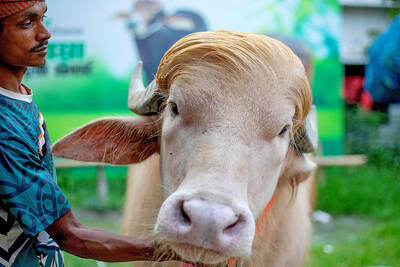
Crowds in Bangladesh are flocking to snap photographs with an unlikely social media star — an albino buffalo with flowing blond hair nicknamed “Donald Trump” that is due to be sacrificed within days. Owner Zia Uddin Mridha, 38, said his brother named the 700kg bull over its flowing helmet of hair resembling the signature look of the US president. “My younger brother picked this name because of the buffalo’s extraordinary hair,” he said at his farm in Narayanganj, just outside the capital, Dhaka. Mridha said that a constant stream of curious visitors — social media fans, onlookers and children — have come throughout

It began as a satirical online project. Now millions of young people in India are flocking to it as an outlet for their frustration. A parody political party called the Cockroach Janta Party, with the insect as its symbol, has exploded across India’s social media by turning absurdist humor into protest. Memes and short videos mocking corruption, joblessness and political dysfunction have flooded social media sites, where millions of users are embracing the cockroach — known for its ability to survive harsh conditions — as a tongue-in-cheek symbol of endurance. The online movement’s rise has been unusually rapid. The Cockroach Janta Party (CJP)
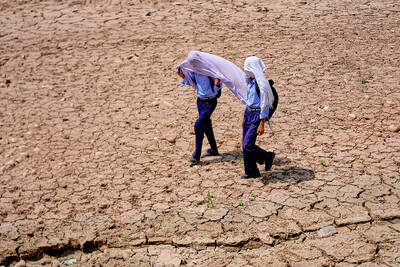
HOTTER: While Indians are accustomed to summer heat, climate change has caused northwestern India to warm faster than other parts of the country, an academic said Roads and markets have emptied during afternoons and some farmers have switched to nighttime work to avoid scorching temperatures as a heat wave grips large parts of India. The India Meteorological Department forecast maximum temperatures for yesterday of about 45°C in the capital, New Delhi, where authorities have opened temporary “cooling zones” to help people cope. The weather department warned that conditions would likely persist across several northern regions in the coming days, with temperatures staying well above seasonal averages. Authorities urged people to stay indoors during the hottest hours and take precautions against heat-related illnesses. India declares a heat wave whenever maximum temperatures

BIGGER ROLE: Beijing has said it maintains an impartial stance on the war in Ukraine, but by training Russian troops, China is far more involved than previously known China’s armed forces secretly trained about 200 Russian military personnel in China late last year, and some have since returned to fight in Ukraine, according to three European intelligence agencies and documents seen by Reuters. While China and Russia have held a number of joint military exercises since Moscow’s full-scale invasion of Ukraine in 2022, Beijing has repeatedly said that it is neutral in the conflict and presents itself as a peace mediator. The covert training sessions, which predominantly focused on the use of drones, were outlined in a dual-language Russian-Chinese agreement signed by senior Russian and Chinese officers in Beijing on


 RSS
RSS