


For the first time since their colleagues were held hostage by rebels here four years ago, UN workers returned on Saturday to this northern frontier town, where Liberia's latest guerrilla war began.
They saw a carcass of a once bustling provincial town. Bedrag-gled boy soldiers dragged along the dirt roads on crutches. A hospital, built by Western aid money, had been emptied. In front of what people here called a clinic sat a row of wounded rebel fighters: a boy whose right eye had been shut by a bullet, another nearly deaf from being around artillery for too long, several with bandaged arms and legs.
Most seemed high as kites, and one did not know the full name of the rebel faction for which he had fought: Liberians United for Reconciliation and Democracy, known here simply as LURD, one of the three factions that make up the new unity government.
"War finished, war finished, white man here," a barefoot beanpole of a soldier yelled gleefully as a UN assessment team stepped off a helicopter, escorted by Seyeh Sheriff, the gaunt red-bereted rebel commander.
For good reason: LURD fighters held UN workers hostage in April 1999 as they stormed into Voinjama with an eye to ousting their nemesis, then-president Charles Taylor.
For the next four years, the rebels punched through the countryside and finally, into the capital, Monrovia. Taylor, weakened by an international arms embargo, stepped down and left the country in August, paving the way for the provisional government and a UN peacekeeping force. Voinjama served as a LURD base for much of the fighting; it is situated near the border with Guinea, the rebels' principal patron and a US ally.
Homecoming
Offering outsiders the first look in years at this rebel outpost, the visit by the UN humanitarian assessment team was a strategic homecoming with much at stake for both sides.
For rebel leaders, a relief convoy stands to strengthen their popularity among civilians. For the UN, it represents a chance to buy peace with medicine and potable water, long before UN troops are ready to do it by force. It will take at least until next March for all 15,000 UN peacekeeping troops to be stationed in Liberia.
Voinjama is a portrait of how much needs to happen before life in this country can return to a measure of normality.
Its red-dirt main street has been so washed away by rains that residents can no longer climb the steps of the gutted storefronts. Nature has reasserted control. Jungles sprout from inside the hollowed houses. Tin roofs are gone.
It is hard to tell from this ruin, but rebel leaders have apparently put in some effort to reconstruct this town. Civilians living in nearby villages and towns, or just hiding in the forests, said they had been driven into Voinjama over the last 18 months to put the place back together again, ordered to start cutting the tall grass and opening up the road.
Vital personnel were recruited: a Pentecostal preacher, a schoolteacher, a midwife.
"They came and captured me, let's put it that way," said Alexander Baysah, 40, an English teacher who now serves as the vice principal of a makeshift school here.
"A civilian man is subject to what an armed man tells you. We were asked to open a school by the authorities in LURD. I did not have an option at the time," he said.
Baysah said he had run away to his village, about two hours from here by foot, when LURD men ordered him to return to town 16 months ago. He pointed out that LURD fighters, in general, had a better record with civilians than their predecessors; Voinjama has been ruled by four successive armed groups over the last 14 years.
No choice
When the latest fighting broke out here, Comfort Zerzay could not run far. She hid in the woods nearby with her elderly parents, while her husband fled with their son. A midwife by training, Zerzay returned when LURD boys showed her the way to the clinic.
"I didn't have a choice," she said. "You have to work to save your life."
On the day of the visit, the fighters were apparently under orders to put away their weapons, but no one had bothered to keep the child soldiers away from view.
One boy, who looked barely 10, wearing a brown T-shirt that hung past his knees, explained in broken English that he was brought here after being injured in the war. On Saturday, he hobbled behind the visitors on his crutches, once gingerly approaching to shake Sheriff's hand.
Neither guests nor hosts mentioned the unsavory history between LURD fighters and UN workers. But in their messages of good will and cooperation lay hints that neither side could afford a replay of the past.
"Those that came to help us, those are dignitaries you are seeing here," Sheriff told his men. "Whether they come by road or they come by air they are welcome."
The first truckloads of medicines could begin to come here within a week, UN officials say.
By the end of the day, LURD officials had offered a battered house for the UN to set up its operations.
The town's commanding officer rode up on a scraggly white horse. "Please tell your people," urged Omar Khatib, the country representative for the WHO, "don't spoil things beyond what's been spoiled."
Then, the UN team climbed aboard the helicopter bound for Monrovia. Voinjama falls under the strictest UN security guidelines. No one is allowed to spend the night here.
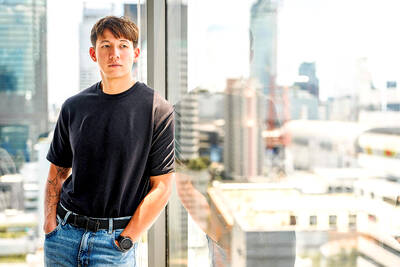
SPEAKING OUT: After Siranudh Scott’s allegations surfaced, celebrities and public figures took to social media to share their own experiences of sexual misconduct and abuse A high-profile alleged sexual abuse case within a wealthy Thai beer brewing family has prompted a wave of painful accounts from survivors of unconnected abuse in the conservative nation. Siranudh Scott, a member of the billionaire Thai family that founded the ubiquitous Singha beer brand, posted an emotional video this month accusing his elder brother Sunit of repeatedly abusing him when he was a teenager. Sunit, who is in his 30s, later denied the allegations in a video posted online, but Singha parent Boonrawd dismissed him from his executive role with the company on Tuesday last week. “I felt I needed to speak

‘CROSSING THE LINE’: China’s embassy in Seoul criticized US Forces Korea Commander General Xavier Brunson, asking if his ‘hostile’ remarks were authorized by Washington South Korea and the US are in talks over recent public remarks by the commander of US Forces Korea, Seoul’s presidential office said yesterday, after the comments drew sharp criticism from China. In a recent podcast interview, US Forces Korea Commander General Xavier Brunson described South Korea as “the dagger in the heart of Asia” from China’s east coast, prompting the Chinese embassy in Seoul to say that he had “truly crossed the line.” The interview came amid growing speculation that Washington might seek to expand the role of US Forces Korea in countering the growing regional influence of China, a key

SEEKING ORDER: Rodrigo Paz said that ‘anyone who wants to destroy the nation will have to deal with this president and the full force of the constitution’ Bolivian President Rodrigo Paz on Wednesday said that the nation was at a “breaking point” after nearly a month of protests that have caused shortages of food, fuel and medicine. Paz, who took office six months ago amid the worst economic crisis there in four decades, is battling a groundswell of fury over his policies. The political capital, La Paz, has been besieged by low-income workers and members of the indigenous majority calling for his resignation. “The country needs order and is reaching breaking point,” the 58-year-old said at a public event in La Paz, renewing his appeal for dialogue. On Tuesday, the Bolivian
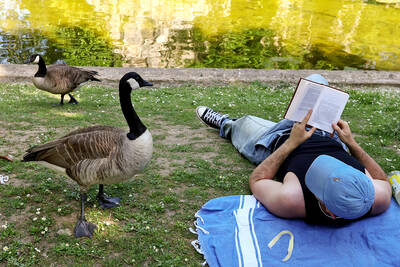
Forecasters in Europe yesterday warned of exceptional heat as record temperatures driven by a “heat dome” push temperatures well above seasonal norms across the continent. The surge follows a record-breaking Monday, with France logging its hottest day in the month of May on record, its weather agency said, and the UK also posting unprecedented highs. A so-called “heat dome” of warm air from northern Africa trapped under a high-pressure system over western Europe is behind the high temperatures not usually seen until high summer. Restrictions on outdoor work were imposed in parts of Italy, beaches in southwest France filled earlier than usual and


 RSS
RSS