


A huge photo of a beaming Venezuelan President Hugo Chavez decorates an army truck as army soldiers unload hundreds of bags of food for the hungry and needy.
For 10,000 bolivars (US$6), citizens walk away with powdered milk, beans, sugar, cornmeal and rice at half the cost they'd find at private markets.
It is enough to convince many that Chavez is the best president they have ever had despite the worst recession in history.
"Chavez isn't going anywhere because he helps the poor," said Jesus del Carmen Vivas, 45, struggling with a bulging food bag. "When have we ever had a president who did anything for us?"
The army food market was part of a large encampment of government social services held recently on a Caracas boulevard where Chavez plans to celebrate the halfway point of his six-year term yesterday.
With all the markings of an inauguration, Chavez's fiesta follows an opposition march this week by hundreds of thousands demanding a recall vote on his presidency. Opposition leaders turned in more than 2 million signatures to request the referendum.
Undaunted, Chavez is plowing ahead with his "Bolivarian Revolution," a mix of socialism and free market policies that seeks to benefit the 80 percent of Venezuelans who live in poverty.
Venezuela has lurched from crisis to crisis under Chavez and could soon see yet more upheaval as the opposition presses for a recall.
Critics label him a power-hungry populist whose social agenda comes second.
Yet Chavez has survived a coup last year and a two-month general strike this year. His standing among voters -- about 30 percent by most polls -- is enhanced by programs directed at the poor.
More than 900,000 illiterate adults are getting free reading and writing classes using methods developed in Cuba. Cuban doctors work for free in Caracas slums.
More than 300,000 people have received government loans to start small businesses. A land reform program has given more than 13,000 people land titles. Indigenous people have gained unprecedented constitutional rights, including the right to own their land.
It was something more personal than a food bag that sold Jesus del Carmen Vivas on Chavez.
At a rally two years ago, the single mother of five grabbed the president's arm and pleaded for justice for her 9-year-old daughter, who had been raped.
Days later, the government sent lawyers to help her pursue the criminal. The man is still at large. But the gesture gave Vivas unshakable faith in the president.
"I just have to talk to Chavez again," she said. "I just haven't had time, being both a mother and a father for my children."
Chavez's personable style have persuaded millions that he is their only hope, even as Venezuela plunges deeper into misery.
"Even though the government hasn't done anything for me, I have faith. I pray for Chavez," said Betty Granas, 47, a coffee vendor.
Granas attends every Chavez rally she can and helps collect signatures for a recall referendum against the anti-Chavez mayor of Caracas.
She's done so despite losing her home in floods, living briefly in cardboard boxes and sending her only son to a shelter. She pleaded for a free bag of food but the soldiers turned her away.
"My moment just hasn't come," she said, her eyes welling with tears.
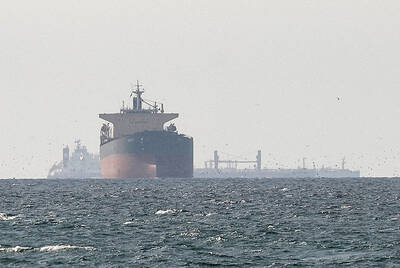
A ship that appears to be taking on the identity of a scrapped gas carrier exited the Strait of Hormuz on Friday, showing how strategies to get through the waterway are evolving as the Middle East war progresses. The vessel identifying as liquefied natural gas (LNG) carrier Jamal left the Strait on Friday morning, ship-tracking data show. However, the same tanker was also recorded as having beached at an Indian demolition yard in October last year, where it is being broken up, according to market participants and port agent’s reports. The ship claiming to be Jamal is likely a zombie vessel that
Japan is to downgrade its description of ties with China from “one of its most important” in an annual diplomatic report, according to a draft reviewed by Reuters, as relations with Beijing worsen. This year’s Diplomatic Bluebook, which Japanese Prime Minister Sanae Takaichi’s government is expected to approve next month, would instead describe China as an important neighbor and the relationship as “strategic” and “mutually beneficial.” The draft cites a series of confrontations with Beijing over the past year, including export controls on rare earths, radar lock-ons targeting Japanese military aircraft and increased pressure around Taiwan. The shift in tone underscores a deterioration
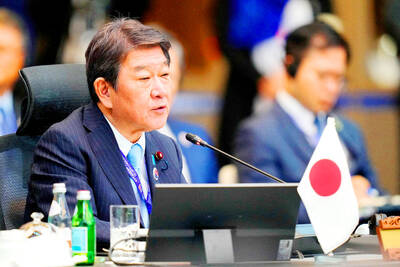
LAW CONSTRAINTS: The US has been pressing allies to send warships to open the Strait, but Tokyo’s military actions are limited under its postwar pacifist constitution Japan could consider deploying its military for minesweeping in the Strait of Hormuz if a ceasefire is reached in the war on Iran, Japanese Minister of Foreign Affairs Toshimitsu Motegi said yesterday. “If there were to be a complete ceasefire, hypothetically speaking, then things like minesweeping could come up,” Motegi said. “This is purely hypothetical, but if a ceasefire were established and naval mines were creating an obstacle, then I think that would be something to consider.” Japan’s military actions are limited under its postwar pacifist constitution, but 2015 security legislation allows Tokyo to use its Self-Defense Forces overseas if an attack,

German Chancellor Friedrich Merz’s conservative Christian Democratic Union (CDU) yesterday faced a regional election battle in Rhineland-Palatinate, now held by the center-left Social Democratic Party (SPD). Merz’s CDU has enjoyed a narrow poll lead over the SPD — their coalition partners at the national level — who have ruled the mid-sized state for 35 years. Polling third is the far-right Alternative for Germany (AfD), which spells a greater threat to the two centrist parties in several state elections in September in the country’s ex-communist east. The picturesque state of Rhineland-Palatinate, bordering France, Belgium and Luxembourg and with a population of about 4 million,


 RSS
RSS