


The US is the fourth most likely of 186 countries to be the target of a terrorist attack within the next 12 months, a research company based in London says in a report to be released on Monday.
The company, World Markets Research Center, ranks Colombia, Israel and Pakistan as the only countries with a greater terror risk than the US in the report, called the World Terrorism Index.
The company provides conservative-leaning research on the risk of terrorism for 500 public and private multinational clients. They include the European Commission, the Organization of the Petroleum Exporting Countries, General Motors, Microsoft, Intel, Pfizer, Procter & Gamble, and Shell Services International.
"Another Sept. 11-style terrorist attack in the United States is highly likely," the report states. "Networks of militant Islamist groups are less extensive in the US than they are in Western Europe, but US-led military action in Afghanistan and Iraq has exacerbated anti-US sentiment."
Guy Dunn, a company director and the author of the report, described the following as criteria used for the rankings: motivation of terrorist groups, the presence of terror cells, the scale and frequency of past attacks, the ability of terror groups to organize and obtain weapons, and the ability of the government to prevent the attacks. Each of the five categories is weighted, he said, with the motivation of terrorist groups receiving the most emphasis.
Colombia, whose government has struggled to control acts of violence by warring leftist guerrillas and rightist paramilitary groups, is at the top of the index. Israel, the report says, was ranked in second place despite a shaky ceasefire and continued international peace efforts.
Pakistan, whose government has struggled to stop the activities "of individuals and cells that espouse and pursue terrorism," is in third place, the report says. Ranked after the US are the Philippines, Afghanistan, Indonesia, Iraq, India and Britain.
Dunn said Iraq had moved up the list from near the bottom. "Iraq was actually in the bottom 10 before the war," he said. "But now with a political vacuum existing, and heavily armed factions, the climate is ripe for terrorism."
Ufi Ibraham, a vice president at the World Travel and Tourism Council, said the index would "have a bearing on the decisions taken by the private sector," in terms of whether they invest in a destination.
Her organization represents the presidents and chief executives of 100 corporations, including some of the world's largest. Terrorism experts said the index could help corporate clients gauge security risks but cautioned that it was nearly impossible to predict terrorist attacks.
"I think there is a great deal of hunger for information about the threat we are facing today," said Magnus Ranstorp, the director for the Study of Terrorism and Political Violence at the University of St. Andrews. He called the index "a useful tool to gauge what has happened in the past."
But he added, "I think it is extremely difficult, with a single index, to predict how terror cells make decisions about what to attack, when and where."
Britain is ranked 10th, the highest of any European country. "Motivation for such an attack among Islamic extremist groups is very high owing to the UK's close alliance with the US," the analysts wrote, "while sophisticated militant networks are known to be present within the country."
At the bottom of the index, in 186th place, is North Korea. "Despite being a member of the so-called Axis of Evil," Dunn said, "North Korea's repressive state has basically made it impossible for terrorists to function."
As part of the research for the index, the firm also sent out surveys to its clients. Of 214 responses, nearly three-quarters said terrorism posed a greater risk to their operations now than it had five years ago, and 72 percent concluded that the risk of terrorism had been a consideration in corporate decision-making.
Despite the heightened awareness, however, 56 percent of those polled said their companies had not conducted safety drills or programs to help prepare for a terrorist attack.
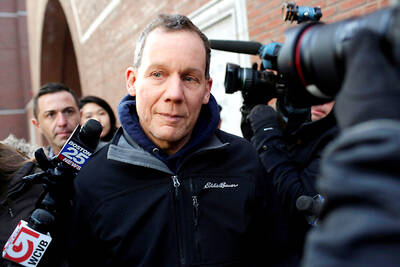
An American scientist convicted of lying to US authorities about payments from China while he was at Harvard University has rebuilt his research lab in Shenzhen, China, to pursue technology the Chinese government has identified as a national priority: embedding electronics into the human brain. Charles Lieber, 67, is among the world’s leading researchers in brain-computer interfaces. The technology has shown promise in treating conditions such as amyotrophic lateral sclerosis and restoring movement in paralyzed people. It also has potential military applications: Scientists at the Chinese People’s Liberation Army have investigated brain interfaces as a way to engineer super soldiers by boosting
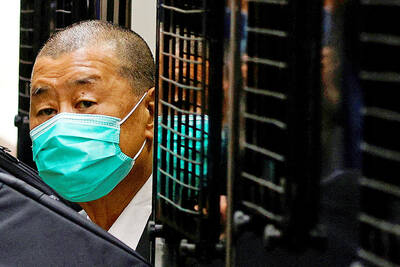
Jailed media entrepreneur Jimmy Lai (黎智英) has been awarded Deutsche Welle’s (DW) freedom of speech award for his contribution to Hong Kong’s pro-democracy movement. The German public broadcaster on Thursday said Lai would be presented in absentia with the 12th iteration of the award on June 23 at the DW Global Media Forum in Bonn. Deutsche Welle director-general Barbara Massing praised the 78-year-old founder of the now-shuttered news outlet Apple Daily for standing “unwaveringly for press freedom in Hong Kong at great personal risk.” “With Apple Daily, he gave journalists a platform for free reporting and a voice to the democracy movement in
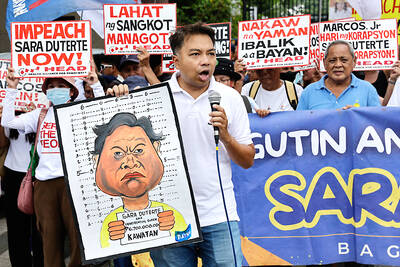
PHILIPPINE COMMITTEE: The head of the committee that made the decision said: ‘If there is nothing to hide, there is no reason to hide, there is no reason to obstruct’ A Philippine congressional committee on Wednesday ruled that there was “probable cause” to impeach Philippine Vice President Sara Duterte after hearing allegations of unexplained wealth, misuse of state funds and threats to have the president assassinated. The unanimous decision of the 53-member committee in the Philippine House of Representatives sends the two impeachment complaints to deliberations and voting by the entire lower chamber, which has more than 300 lawmakers. The complaints centered on Duterte’s alleged illegal use and mishandling of intelligence funds from the vice president’s office, and from her time as education secretary under Philippine President Ferdinand Marcos Jr. Duterte and the
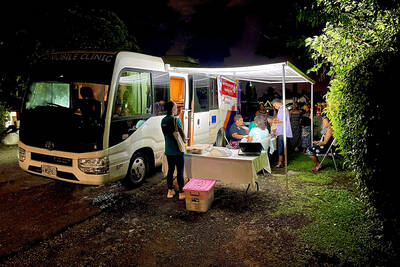
As evening falls in Fiji’s capital, a steady stream of people approaches a makeshift clinic that is a first line of defense against one of the world’s fastest-growing HIV epidemics. In the South Pacific nation — a popular tourist destination of just under a million people — more than 2,000 new HIV cases were recorded last year, a 26 percent increase from 2024. The government has declared an HIV outbreak and described it as a national crisis. “It’s spreading like wildfire,” said Siteri Dinawai, 46, who came to be tested. The Moonlight Clinic, a converted minibus parked in a suburban cul-de-sac in Suva, is


 RSS
RSS