


Alarmed that the last remnants of the Berlin Wall may soon vanish forever, architectural historians in Germany have issued an appeal to save the long-hated symbol of German post-war division and to preserve what is left of it for future generations.
Fourteen years after the Wall fell, tourists to the capital of unified Berlin are baffled by the fact that there are few traces of the Wall to use as backdrops for snapshots.
And tourists who question Berliners about where the Wall was located often elicit only shrugs in response. Older Berliners are eager to forget where the Wall was. Incredibly to outsiders, younger Berliners often do not know where it once stood.
But the architectural historians at Cottbus University say that is precisely why they have written a 750-page application to have the Berlin Wall listed as a cultural heritage monument.
"We are talking about nothing more or less than the history of our nation," Cottbus University professor Leo Schmidt said.
"It may be ugly. It may be contentious. It may be painful for people to look at. But it is our history and our culture," he said.
"If we don't preserve it for future generations, it will one day be lost forever."
A few segments of the Wall were collected and placed together and classified as a national treasure in 2000.
"But that is not nearly enough," Schmidt said. "The Berlin Wall is a hard and very real symbol of the Cold War. We need to act fast to preserve what is left of it in order to keep history alive for future generations, for whom the Cold War will be nothing more than a footnote in history books."
Even Germans old enough to remember when the Wall was built in the summer of 1961 do not know much about the actual structure.
"Everyone has a mental image of the Wall," Schmidt said. "But very few people have ever had a clear overview of the entire fortified barrier which not only cut through the heart of this city but also surrounded West Berlin and which was part of a vast system of moats and fortifications between East and West Germany."
The 750-page document compiled by the architectural historians contains detailed structural information along with first-hand input from East German engineers and a number of East German guards who manned the watch towers and patrolled the length of the Wall.
"These people knew it intimately," he said. "They knew it better than anybody. And it is vitally important to record their impressions while these people are still alive and before their memories fade."
In fact, the Wall consisted of the reinforced concrete wall along the West Berlin side, backed by a no-man's land and a series of barbed-wire and concrete barriers studded with boobytraps and trip-wires culminating in a high fence on the East Berlin side.
At the height of the Cold War, thousands of transit visitors daily went through a gruelling passport checkpoint at Friedrich Strasse.
Those one-day visitors were required to leave East Berlin by midnight, and tearful scenes were common at the Friedrich Strasse checkpoint.
In Berlin slang, the checkpoint entrance there, a glass-and-concrete building just north of Friedrich Strasse train station, became known as the "Traenen Palast" (Palace of Tears).
Now, with the Wall long gone, that structure is a dance club. The words "Traenen Palast" are spelled out in bright neon lights above the entrance.
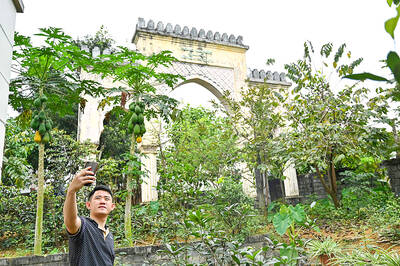
Le Tuan Binh keeps his Moroccan soldier father’s tombstone at his village home north of Hanoi, a treasured reminder of a man whose community in Vietnam has been largely forgotten. Mzid Ben Ali, or “Mohammed” as Binh calls him, was one of tens of thousands of North Africans who served in the French army as it battled to maintain its colonial rule of Indochina. He fought for France against the Viet Minh independence movement in the 1950s, before leaving the military — as either a defector or a captive — and making a life for himself in Vietnam. “It’s very emotional for me,”

The Chinese Communist Party’s (CCP) Central Committee is to gather in July for a key meeting known as a plenum, the third since the body of elite decisionmakers was elected in 2022, focusing on reforms amid “challenges” at home and complexities broad. Plenums are important events on China’s political calendar that require the attendance of all of the Central Committee, comprising 205 members and 171 alternate members with Chinese President Xi Jinping (習近平) at the helm. The Central Committee typically holds seven plenums between party congresses, which are held once every five years. The current central committee members were elected at the
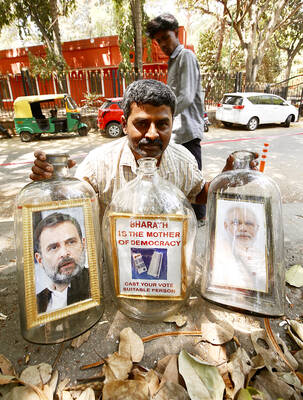
Indian Prime Minister Narendra Modi reaffirmed his pledge to replace India’s religion-based marriage and inheritance laws with a uniform civil code if he returns to office for a third term, a move that some minority groups have opposed. In an interview with the Times of India listing his agenda, Modi said his government would push for making the code a reality. “It is clear that separate laws for communities are detrimental to the health of society,” he said in the interview published yesterday. “We cannot be a nation where one community is progressing with the support of the Constitution while the other

CODIFYING DISCRIMINATION: Transgender people would be sentenced to three years in prison, while same-sex relations could land a person in jail for more than a decade Iraq’s parliament on Saturday passed a bill criminalizing same-sex relations, which would receive a sentence of up to 15 years in prison, in a move rights groups condemned as an “attack on human rights.” Transgender people would be sentenced to three years’ jail under the amendments to a 1988 anti-prostitution law, which were adopted during a session attended by 170 of 329 lawmakers. A previous draft had proposed capital punishment for same-sex relations, in what campaigners had called a “dangerous” escalation. The new amendments enable courts to sentence people engaging in same-sex relations to 10 to 15 years in prison, according to the


 RSS
RSS