


North Korea said yesterday that polls in which voters gave leader Kim Jong-il 100 percent support showed the communist state was "firm as a rock" in the face of economic woes and isolation over its nuclear ambitions.
The 61-year-old Kim was one of 687 deputies elected unopposed on Sunday for seats in North Korea's rubber-stamp legislature, the Supreme People's Assembly.
North Korea's official KCNA news agency quoted the Central Election Committee as saying turnout was 99.9 percent of registered voters and that 100 percent of the votes were cast for the sole candidates.
"This is an expression of all the voters' support and trust in the DPRK government and a manifestation of our army and people's steadfast will to consolidate the people's power as firm as a rock and accomplish the revolutionary cause," KCNA said.
DPRK stands for Democratic People's Republic of Korea, the official title of the country of 22 million Kim has ruled since inheriting power upon the death of his father, state founder Kim Il-sung in 1994.
The election of Kim in a military district was "an expression of the absolute support and trust of all the servicemen and the people in him," KCNA said in a separate report.
North Korean state television showed rare footage of Kim turning out to vote at the Kim Il-sung Military University in Pyongyang. Wearing his customary synthetic leisure suit, Kim shook hands and received flowers from officers before voting.
Kim faces the challenge of reviving an economy, thought by outside experts to be near collapse and plagued by dire food and fuel shortages -- troubles compounded by North Korea's political isolation over its pursuit of nuclear weapons.
North Korea and the US said last week they had agreed to hold six-way talks on the nuclear standoff. China, Japan, Russia and South Korea will also attend talks expected to take place in Beijing this month or next.
The prospect of fresh talks follows months of tension after Washington announced last October that Pyongyang had disclosed it was pursuing a covert nuclear weapons program.
Although North Korea's parliament nominally has the power to write laws, approve the cabinet and vote on the national budget, analysts said any changes in one of the world's most tightly controlled political systems would be implemented top down.
"If anything changes, it will happen at the top executive level and trickle down to the local bodies for support, but not from the legislative or local level," said Kim Hyung-joon, professor of political science at Seoul's Myungji University.
"This election will serve to gather support for the agenda that the North's administration seeks to carry out -- not that there will be any big change in the political climate," he said.
Meanwhile, North Korea said yesterday that talks on the crisis surrounding its nuclear ambitions would take place soon in Beijing, according to South Korea's Yonhap news agency.
"Six-party talks on resolving the nuclear issue between [North Korea] and the United States will be held soon in Beijing," Yonhap quoted a North Korean foreign ministry spokesman as saying through Pyongyang's state media.
Details and timing of the talks are still being discussed, but US and South Korean officials have said they could come as early as this month. Other officials have mentioned September as a target date for talks.
In related news, the US will not begin trading aid for security assurances at crisis talks with North Korea, Secretary of State Colin Powell said in a interview with US media.
Moreover, "there will be no secrets," although the six-party format of the talks may provide opportunities for one-on-one exchanges, Powell told selected US media outlets in a private interview released by the US Department of State on Sunday.
"There will certainly be an opportunity at a six party-meeting for them to say something directly to us if they choose to do so," Powell said of Pyongyang.
"There will be no secrets," Powell told his interviewers on Friday. "Anything the North Koreans say to us will be shared with our friends and partners, because this is going to be an open, transparent process."
He ruled out the non-aggression pact which Kim Jong-Il's government has demanded, while remaining vague on what Washington might offer the North, and when, as an incentive for giving up its nuclear program and addressing other concerns.
"We're not doing non-aggression pacts ... we, as a practice, don't do that. But there are ways to talk about security, and there are ways to talks about intent," he said.
"Our policy, [US President George W. Bush's] policy, is to work diplomatically with our partners and the North Koreans to find a diplomatic political solution to the problem," Powell said.
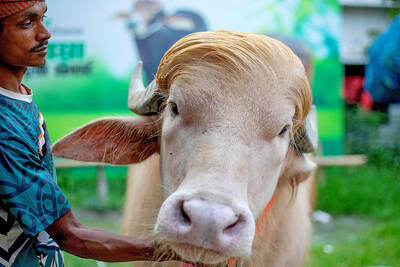
Crowds in Bangladesh are flocking to snap photographs with an unlikely social media star — an albino buffalo with flowing blond hair nicknamed “Donald Trump” that is due to be sacrificed within days. Owner Zia Uddin Mridha, 38, said his brother named the 700kg bull over its flowing helmet of hair resembling the signature look of the US president. “My younger brother picked this name because of the buffalo’s extraordinary hair,” he said at his farm in Narayanganj, just outside the capital, Dhaka. Mridha said that a constant stream of curious visitors — social media fans, onlookers and children — have come throughout

It began as a satirical online project. Now millions of young people in India are flocking to it as an outlet for their frustration. A parody political party called the Cockroach Janta Party, with the insect as its symbol, has exploded across India’s social media by turning absurdist humor into protest. Memes and short videos mocking corruption, joblessness and political dysfunction have flooded social media sites, where millions of users are embracing the cockroach — known for its ability to survive harsh conditions — as a tongue-in-cheek symbol of endurance. The online movement’s rise has been unusually rapid. The Cockroach Janta Party (CJP)
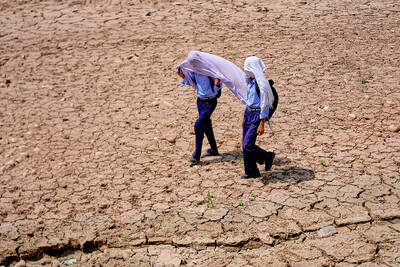
HOTTER: While Indians are accustomed to summer heat, climate change has caused northwestern India to warm faster than other parts of the country, an academic said Roads and markets have emptied during afternoons and some farmers have switched to nighttime work to avoid scorching temperatures as a heat wave grips large parts of India. The India Meteorological Department forecast maximum temperatures for yesterday of about 45°C in the capital, New Delhi, where authorities have opened temporary “cooling zones” to help people cope. The weather department warned that conditions would likely persist across several northern regions in the coming days, with temperatures staying well above seasonal averages. Authorities urged people to stay indoors during the hottest hours and take precautions against heat-related illnesses. India declares a heat wave whenever maximum temperatures

BIGGER ROLE: Beijing has said it maintains an impartial stance on the war in Ukraine, but by training Russian troops, China is far more involved than previously known China’s armed forces secretly trained about 200 Russian military personnel in China late last year, and some have since returned to fight in Ukraine, according to three European intelligence agencies and documents seen by Reuters. While China and Russia have held a number of joint military exercises since Moscow’s full-scale invasion of Ukraine in 2022, Beijing has repeatedly said that it is neutral in the conflict and presents itself as a peace mediator. The covert training sessions, which predominantly focused on the use of drones, were outlined in a dual-language Russian-Chinese agreement signed by senior Russian and Chinese officers in Beijing on


 RSS
RSS