


Thousands of political archives from the Martial Law era and after are to be declassified from today, while the National Archives Administration vowed to expedite the review of potentially sensitive documents.
The legislature last year passed amendments to the Political Archives Act (政治檔案條例), which were promulgated by the president on Dec. 27 and take effect today.
The change requires declassification of files after 30 years unless extended, removing a designation allowing for indefinite classification of documents pertaining to national security or foreign affairs.
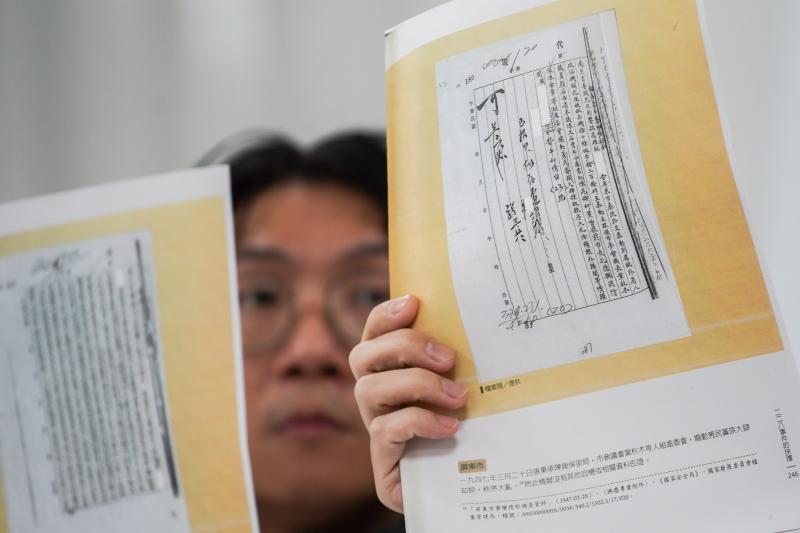
Photo: CNA
In addition to the mandate to declassify documents from Aug. 15, 1945, to Nov. 6, 1992, the archives agency said it is to also reveal related files from after 1992 in the interest of continuity.
Those originally classified due to national security or foreign affairs reasons would be unsealed from today, the agency said in a news release.
An extension may be granted if declassification would seriously jeopardize the safety of intelligence personnel, it said.
Each extension lasts three years, and must be approved by relevant national security agencies, it added.
Extensions must be completed within six months, or they would be considered automatically declassified, it said.
To protect privacy, officials are required to first contact people named in files containing sensitive personal information to notify them of their right to priority access and refusal, it said.
If no objections are raised, such files would be declassified six months after the notice is sent, it said, adding that the first notices would likely go out on July 31.
Political archives constitute about 10 percent of all national documents, the agency said.
Disclosure of historical archives forms the foundation of transitional justice, reflecting the fight for democracy and freedom authored by the lives of those who went before, the agency said, adding that they are key to restoring the truth and achieving reconciliation.

The Ministry of Finance this afternoon announced the winning numbers for the March-April uniform invoice lottery. The winning number for the NT$10 million (US$318,060) special prize is 19531471, and the winning number for the NT$2 million grand prize is 85941329. Three numbers were drawn for the NT$200,000 first prize: 07225810, 20231230 and 83518781. Those with receipts matching the last seven digits of any of the first-prize numbers will win the NT$40,000 second prize, while those matching the last six digits will win the NT$10,000 third prize. Those whose receipts match the last five digits of the first-prize numbers can claim the NT$4,000 fourth prize,

SIX SUBSIDIES: The monthly allowance for older farmers is to increase to NT$10,000, and NT$5,000 is to be given to homemakers under the national pension system, Lai said The government is to implement major welfare policies for disadvantaged groups, including raising the monthly allowance for older farmers to NT$10,000 and providing homemakers with NT$5,000 per month, President William Lai (賴清德) said yesterday. Lai made the remarks during a visit to Wangling Temple in Chiayi County, saying that the planned increases were being introduced amid economic growth and an increase in tax revenue. Touting a policy, in which the government plans to provide a monthly allowance of NT$5,000 for every child under the age of 18 in a bid to address Taiwan’s low birthrate, Lai said that if received for the
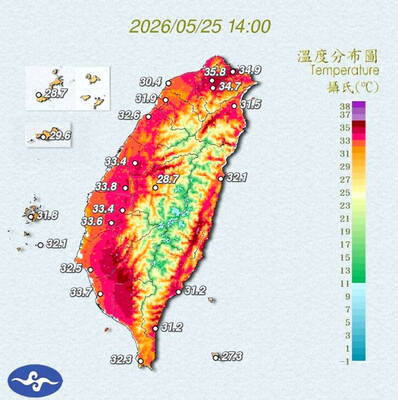
STAY COOL: The HPA recommended that people stay hydrated, use air-conditioning or fans while indoors, wear loose-fitting clothes and walk in the shade while outdoors Employers must implement measures such as installing cooling equipment, and providing drinking water and rest breaks for outdoor workers starting from Monday next week, the Taipei Department of Labor said on Sunday. Employers who fail to comply could face fines of NT$30,000 to NT$300,000 under the Occupational Safety and Health Act (職業安全衛生法), the department said. Businesses in Taipei employing fewer than 100 workers, as well as registered self-employed workers with labor insurance coverage, could receive on-site assessments and guidance from occupational safety consultants to help them apply for central government subsidies to implement or improve heat-protection measures, it said. Under the Ministry of
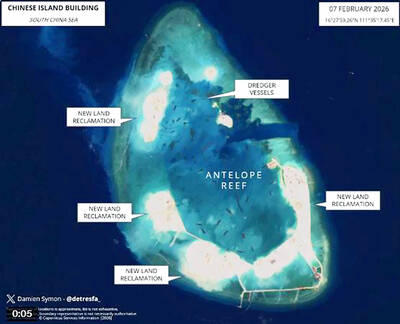
ISOLATION: The outposts would serve as support and backup bases, forcing US forces to either face China head-on or reroute, increasing travel time and operational costs China’s outposts in the South China Sea could be used to delay and constrain foreign forces during a conflict in the Taiwan Strait, giving Beijing a critical window to carry out amphibious landing and blockade operations, a report said. The Chinese Communist Party’s (CCP) forward operating bases on islands and reclaimed features in the South China Sea could delay foreign forces long enough for the Chinese People’s Liberation Army (PLA) to secure a key 48-to-72-hour window in the Taiwan Strait, a report commissioned by the Mainland Affairs Council found. The report, conducted by the Institute for National Defense and Security Research, examined


 RSS
RSS