


The Central Election Commission yesterday said that its decision to bar people with COVID-19 and their close contacts from going to the polls on Nov. 26 if they are in quarantine does not contravene any constitutional principles.
The regulations pertaining to the protection of human health against the spread of transmissible diseases are laid out in Constitutional Interpretation No. 690, which was handed down by the Council of Grand Justices in 2011, the commission said in a statement.
People who test positive for COVID-19 are required to quarantine for seven days, while their close contacts must isolate for three days if they have not received three shots of a COVID-19 vaccine, the Central Epidemic Command Center (CECC) said.
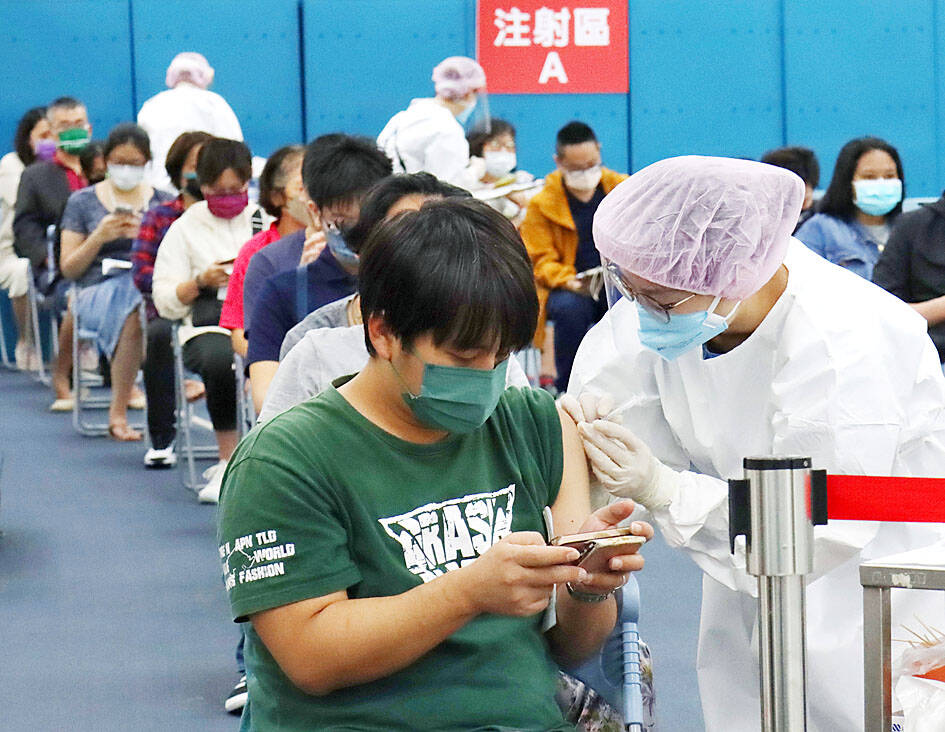
Photo: CNA
The quarantine period for COVID-19 patients can be shortened if they obtain two negative rapid test results five days after infection was confirmed or between the fifth and seventh day of the isolation period, the CECC said.
If the CECC revises its quarantine policy, the decision to disallow people with COVID-19 and their close contacts from voting on Nov. 26 would be adjusted accordingly, the election commission said.
The commission issued the statement after New Power Party and Chinese Nationalist Party (KMT) lawmakers called for the decision to be re-examined, saying it would deprive about 300,000 people of their constitutional right to vote.
Taiwan has recorded an average of 33,813 COVID-19 cases per day over the past seven days, CECC data showed.
Taiwanese are to go to the polls to elect 11,023 public officials at all levels of local government and to vote on a referendum that asks whether the voting age should be lowered to 18 from 20.
In Taiwan, there are no laws that allow early or absentee voting.
Later yesterday, Deputy Minister of Health and Welfare Victor Wang (王必勝), who heads the CECC, said the government was considering relaxing the quarantine rules for people with COVID-19 and their close contacts for the elections.
In other developments, the CECC yesterday reported 37,265 new COVID-19 infections, including 69 imported cases, and 78 deaths.
While yesterday’s domestic infections represented a 23 percent drop from a week earlier, people should continue to observe disease prevention rules, the center said.
The relatively high daily number of fatalities right now reflects the recent surge in the number of COVID-19 cases, and that trend might continue for a while, the CECC added.

Taiwanese can file complaints with the Tourism Administration to report travel agencies if their activities caused termination of a person’s citizenship, Mainland Affairs Council Minister Chiu Chui-cheng (邱垂正) said yesterday, after a podcaster highlighted a case in which a person’s citizenship was canceled for receiving a single-use Chinese passport to enter Russia. The council is aware of incidents in which people who signed up through Chinese travel agencies for tours of Russia were told they could obtain Russian visas and fast-track border clearance, Chiu told reporters on the sidelines of an event in Taipei. However, the travel agencies actually applied

New measures aimed at making Taiwan more attractive to foreign professionals came into effect this month, the National Development Council said yesterday. Among the changes, international students at Taiwanese universities would be able to work in Taiwan without a work permit in the two years after they graduate, explainer materials provided by the council said. In addition, foreign nationals who graduated from one of the world’s top 200 universities within the past five years can also apply for a two-year open work permit. Previously, those graduates would have needed to apply for a work permit using point-based criteria or have a Taiwanese company

The Shilin District Prosecutors’ Office yesterday indicted two Taiwanese and issued a wanted notice for Pete Liu (劉作虎), founder of Shenzhen-based smartphone manufacturer OnePlus Technology Co (萬普拉斯科技), for allegedly contravening the Act Governing Relations Between the People of the Taiwan Area and the Mainland Area (臺灣地區與大陸地區人民關係條例) by poaching 70 engineers in Taiwan. Liu allegedly traveled to Taiwan at the end of 2014 and met with a Taiwanese man surnamed Lin (林) to discuss establishing a mobile software research and development (R&D) team in Taiwan, prosecutors said. Without approval from the government, Lin, following Liu’s instructions, recruited more than 70 software

Chinese spouse and influencer Guan Guan’s (關關) residency permit has been revoked for repeatedly posting pro-China videos that threaten national security, the National Immigration Agency confirmed today. Guan Guan has said many controversial statements in her videos posted to Douyin (抖音), including “the red flag will soon be painted all over Taiwan” and “Taiwan is an inseparable part of China,” and expressing hope for expedited reunification. The agency last year received multiple reports alleging that Guan Guan had advocated for armed reunification. After verifying the reports, the agency last month issued a notice requiring her to appear and explain her actions. Guan


 RSS
RSS