

Premier Su Tseng-chang (蘇貞昌) yesterday ordered the Central Epidemic Command Center (CECC) to establish guidelines for penalizing people who break a quarantine at home or at a center-designated building.
Su made the remarks during a weekly Cabinet meeting.
People subject to quarantine who willfully leave should be subject to a hefty fine and local governments, which are in charge of handing them out, should strictly enforce the rules, the premier said.
A payment deadline and a penalty for when people fail to pay on time needs to be set, Su said.
The authorities should enforce the penalty, meaning that offenders' property would be sequestered, he added.
The center would be instructed to quickly publish guidelines on fining people who contravene the Special Act on COVID-19 Prevention, Relief and Restoration (嚴重特殊傳染性肺炎防治及紓困振興特別條例) so that scenarios are established for when to impose fines, Su said, adding that the directive is designed to safeguard public health.
Su quoted Minister of Health and Welfare Chen Shih-chung (陳時中) as saying that the COVID-19 situation worldwide remains dire, and that the nation must be prepared for the possibility of community spread.
Even though schools have opened, there have not been any cluster infections, which is commendable, Su said, calling on schools at all levels to continue their disease-prevention efforts in collaboration with the Ministry of Education and local governments.
Vice Premier Chen Chi-mai (陳其邁) told local government representatives at the meeting to remind the public to wash their hands thoroughly and frequently, saying that hand washing is one of the most effective ways to avoid becoming infected.
In related news, a man in Hsinchu County was yesterday fined NT$1 million (US$33,378) for breaking a home quarantine.
Lin Tung-ching (林東京), who returned to Taiwan on a Xiamen Air flight on Tuesday last week, should have quarantined himself at home until Tuesday next week, but he changed residence multiple times after the quarantine was ordered, leaving disease-prevention workers unable to locate him.
With the help of Lin’s family members, the Liujia Police Precinct persuaded Lin to turn himself in, and found that he had visited Taipei’s Xinyi (信義) and Wanhua (萬華) districts and New Taipei City’s Baishawan beach during the quarantine period, precinct Chief Yeh Jih-jen (葉日仁) said.
The county government slapped Lin with the highest possible fine under the special act on COVID-19 — over a “malicious” infraction.
The act, passed and ratified on Tuesday last week, contains penalties — which can be retroactively applied to Jan. 15 — for people who breach quarantines, among other infractions.
Minister of the Interior Hsu Kuo-yung (徐國勇) said that the ministry would recommend to the CECC that quarantined people be tracked through video calls.

A Hualien pomelo farmer refused to sell to China after the country announced it would permit more Taiwanese pomelo imports, prompting widespread support from Taiwanese consumers, who rallied to buy his fruit. China’s Taiwan Affairs Office last month said that China’s General Administration of Customs registered an additional 79 Taiwanese pomelo orchards and packing facilities in Hualien County, allowing more Taiwanese producers to export pomelos to China. “I am a Hualien fruit farmer and I refuse to sell to China,” Liu Tzu-hao (劉子豪) from Ruisui Township (瑞穗) said in an online post. Liu is a well-known farmer in the community and has served
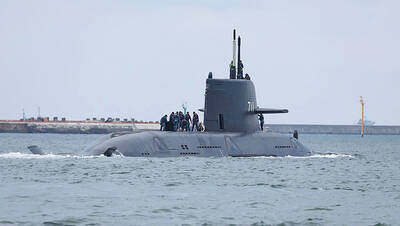
UPDATE: The submarine would need to undergo combined systems testing and crew training for navy personnel before it is ready for mission, an expert said Taiwan’s first domestically built submarine, the Hai Kun (Narwhal, 海鯤), could be delivered to the navy as early as next month, military expert and Taiwan Association for Security and Development chairman Chi Tung-yun (紀東昀) said yesterday. The submarine was yesterday morning observed departing for its 21st sea trial and its 15th submerged test. The vessel missed the initial delivery deadline of November last year due to “testing delays,” its primary contractor, shipbuilder CSBC Corp, Taiwan, said in June. The contractor also cited “political pressure from China” in procuring critical equipment. All testing operations are in the final stages, with the

OCT. 31: The antiviral drugs Tamiflu and Eraflu have been distributed to about 4,000 medical facilities nationwide for people in seven groups who develop flu-like symptoms As the domestic influenza epidemic enters its peak season and continues to escalate, the Centers for Disease Control (CDC) yesterday announced that publicly funded influenza antiviral drugs for seven eligible groups have been extended to Oct. 31, allowing those who develop flu-like symptoms to receive the medication without undergoing a rapid influenza test. The CDC has extended the expanded use of flu antiviral drugs to seven groups: healthcare and influenza-prevention personnel; residents and staff at nursing homes, long-term care facilities and similar institutions; kindergarten and daycare workers and home-based caregivers; students from kindergarten through high school, vocational high school and the
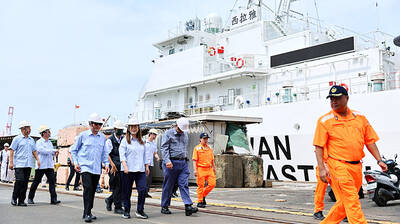
Ocean Affairs Council (OAC) Minister Kuan Bi-ling (管碧玲) on Wednesday said decommissioned coast guard vessels were given to the Philippines to enhance regional rescue capacity and would not affect Taiwanese fishers’ rights and benefits. Kuan made the remarks after confirmation on Tuesday that a 500-tonne Coast Guard Administration (CGA) patrol and rescue vessel would be given to the Philippine Coast Guard. The donation ceremony was reportedly done in Manila, but whether the vessel — previously numbered “CG123” and named Kinmen (金門) — has been handed over has yet to be confirmed. China’s Taiwan Affairs Office (TAO) on Wednesday criticized the donation for “taking


 RSS
RSS