


Authorities have investigated 178 cases of alleged misinformation regarding COVID-19, 45 of which were created by Chinese cyberwarfare units with the aim of disrupting efforts to contain the disease and undermine Taiwan’s national security, the Criminal Investigation Bureau said yesterday.
Of the 178 cases investigated from Jan. 23 to yesterday, 78 cases involving 112 people have been forwarded to prosecutors for indictments, including the proven falsehoods of “President Tsai Ing-wen (蔡英文) was rushed to a hospital for treatment after contracting the Wuhan virus” and “Taoyuan has imposed restrictions and locked down the city,” bureau Deputy Commissioner Chu Tsung-tai (朱宗泰) said.
Investigators found that overseas Internet Protocol (IP) address were used in 45 cases, Chu said, adding that because of their use of simplified Chinese characters and phrases commonly used in China, they were most likely the work of Chinese netizens and cyberwarfare units.
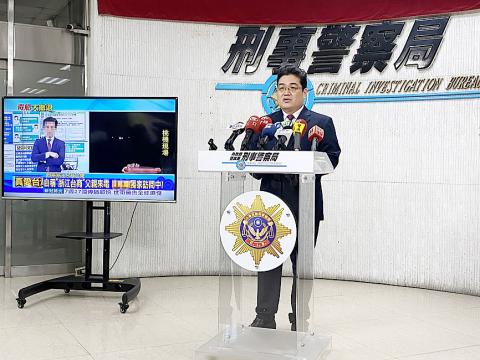
Photo: CNA
Chu cited as an example a person using the name Zhang Xiang (張湘) with an IP address in China’s Hebei Province last week circulating on Facebook a doctored image, which purportedly showed a decree bearing the seal of Taoyuan Mayor Cheng Wen-tsan (鄭文燦) ordering that all traffic and public transportation be locked down and prohibiting residents from leaving the city due to an outbreak of the coronavirus.
Fourth Investigation Corps Captain Lin Chih-cheng (林志誠) said that another IP address in China was last week used to disseminate a message that “there are more than 817 confirmed Wuhan virus cases in Taiwan and more than 500 deaths, with the outbreak especially severe in Pingtung County and Tainan.”
Such messages originating from IP addresses in China are easily identified as part of a deliberate misinformation campaign due to their sensational claims and conspicuous inaccuracies, which can be readily fact-checked through local media reports and government information, as well as their use of simplified Chinese characters and common Chinese phrases, Lin said, adding that sharing the messages on social media could result in criminal prosecution.
Lin cited as an example a 26-year-old Taichung resident surnamed Chang (張), who was on Tuesday questioned by prosecutors and faces charges for spreading rumors related to the virus situation punishable by up to three years in prison and an NT$3 million (US$99,973) fine.
Chang had posted on a popular gaming chat site a message traced to China saying that the “armed forces have placed Taipei under military control as the virus situation escalates,” which was accompanied by a photograph of the 1989 Tiananmen Square Massacre’s “Tank Man,” Lin said.
“When detained by Taichung police on Monday, Chang said that he did not create the message, but failed to verify its content before forwarding it to friends and posting it to the site,” Lin said.
Chinese cyberwarfare units have capitalized on the epidemic and redoubled their misinformation efforts to disrupt Taiwan’s disease-prevention efforts, sow confusion, cause distrust of official communications by health authorities and undermine national security, Lin said.
The bureau said that prosecutors have also questioned a man in Changhua County for allegedly spreading rumors, as he called in to TV talk shows to discuss the epidemic and defend his son, a businessman working in China who returned to Taiwan recently, which was deemed as providing misleading information to the public.
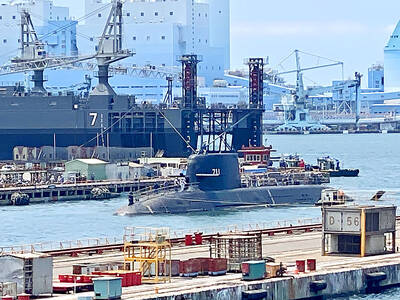
AGING: While Japan has 22 submarines, Taiwan only operates four, two of which were commissioned by the US in 1945 and 1946, and transferred to Taiwan in 1973 Taiwan would need at least 12 submarines to reach modern fleet capabilities, CSBC Corp, Taiwan chairman Chen Cheng-hung (陳政宏) said in an interview broadcast on Friday, citing a US assessment. CSBC is testing the nation’s first indigenous defense submarine, the Hai Kun (海鯤, Narwhal), which is scheduled to be delivered to the navy next month or in July. The Hai Kun has completed torpedo-firing tests and is scheduled to undergo overnight sea trials, Chen said on an SET TV military affairs program. Taiwan would require at least 12 submarines to establish a modern submarine force after assessing the nation’s operational environment and defense

A white king snake that frightened passengers and caused a stir on a Taipei MRT train on Friday evening has been claimed by its owner, who would be fined, Taipei Rapid Transit Corp (TRTC) said yesterday. A person on Threads posted that he thought he was lucky to find an empty row of seats on Friday after boarding a train on the Bannan (Blue) Line, only to spot a white snake with black stripes after sitting down. Startled, he jumped up, he wrote, describing the encounter as “terrifying.” “Taipei’s rat control plan: Release snakes on the metro,” one person wrote in reply, referring
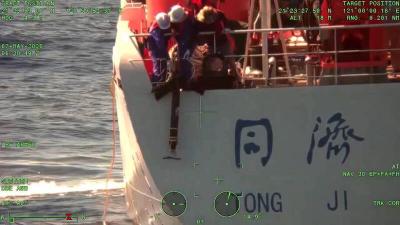
The coast guard today said that it had disrupted "illegal" operations by a Chinese research ship in waters close to the nation and driven it away, part of what Taipei sees a provocative pattern of China's stepped up maritime activities. The coast guard said that it on Thursday last week detected the Chinese ship Tongji (同濟號), which was commissioned only last year, 29 nautical miles (54km) southeast of the southern tip of Taiwan, although just outside restricted waters. The ship was observed lowering ropes into the water, suspected to be the deployment of scientific instruments for "illegal" survey operations, and the coast

Taiwan’s two cases of hantavirus so far this year are on par with previous years’ case numbers, and the government is coordinating rat extermination work, so there should not be any outbreaks, Centers for Disease Control (CDC) Director-General Philip Lo (羅一鈞) said today in an interview with the Liberty Times (the Taipei Times’ sister newspaper). An increase in rat sightings in Taipei and New Taipei City has raised concerns about the spread of hantavirus, as rats can carry the disease. In January, a man in his 70s who lived in Taipei’s Daan District (大安) tested positive posthumously for hantavirus, Taiwan’s


 RSS
RSS